IB DP Biology 2025: Unity and Diversity
A1.1 — Water
Theme A: Form and Function · Standard & Higher Level
A1.1.1
Water as the Medium for Life
Key UnderstandingWater is the medium for life. The first cells originated in water, and water remains the medium in which most processes of life occur.
Life as we know it is entirely dependent on water. It is believed that the very first living cells evolved in the primordial oceans of early Earth. Today, water remains the fundamental medium for all living organisms.
Water provides a stable habitat for early molecules to interact
↓
First single-celled organisms evolve in the ocean
↓
Today: Cytoplasm in all cells is primarily water, acting as the medium for metabolism
- Metabolic Medium: Almost all chemical reactions in biology (metabolism) occur in aqueous solutions (e.g., inside the cytoplasm or nucleoplasm).
- Transport: Water is the main component of blood plasma in animals and phloem/xylem sap in plants, transporting nutrients and oxygen.
- Waste Removal: Toxic metabolic wastes (like urea) are dissolved in water and excreted as urine.
A1.1.2
Hydrogen Bonds and Polarity
Key UnderstandingWater molecules are polar and hydrogen bonds form between them.
Water (H₂O) consists of one oxygen atom covalently bonded to two hydrogen atoms. However, they do not share electrons equally.
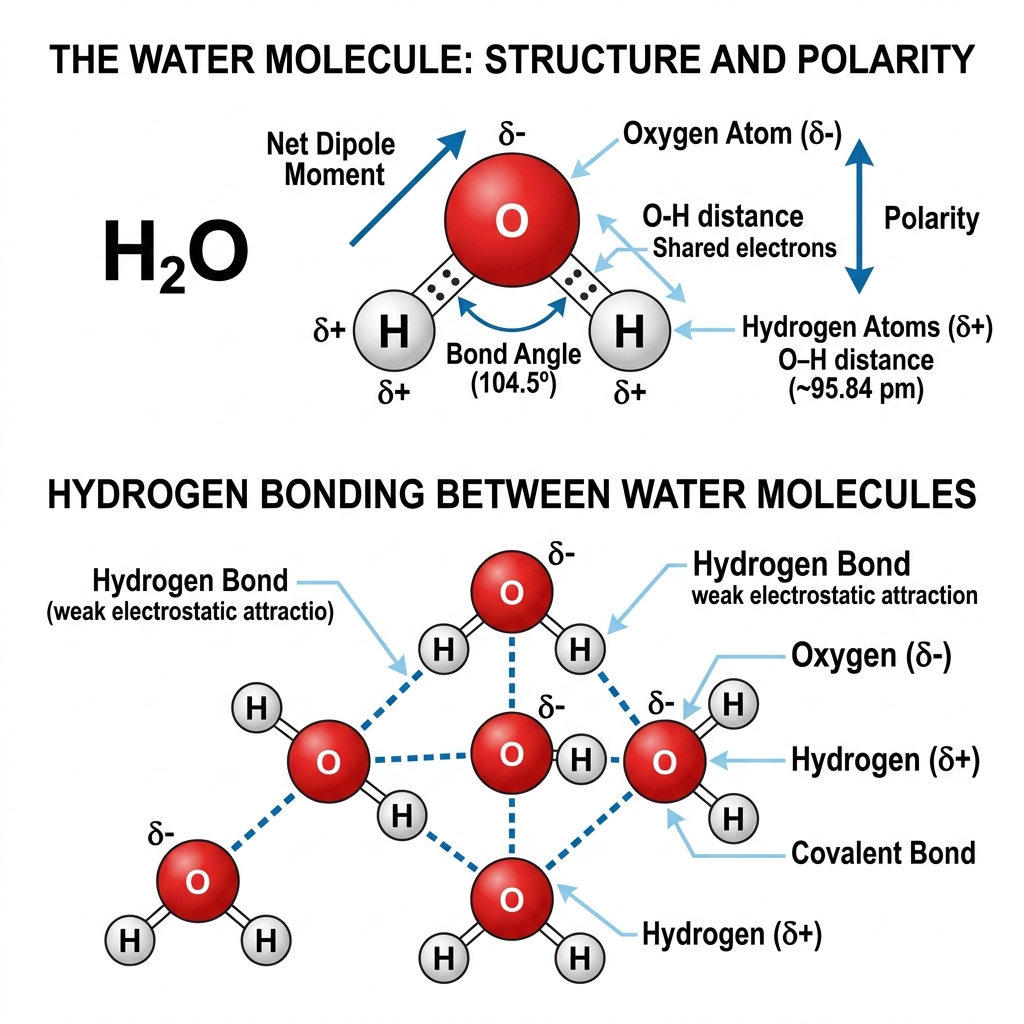
The Mechanism of Polarity:
- Electronegativity: Oxygen is highly electronegative—it pulls the shared electrons closer to its nucleus.
- Partial Charges (Dipole): This unequal sharing gives the oxygen atom a slightly negative charge (δ⁻) and the hydrogen atoms a slightly positive charge (δ⁺). This makes water a polar molecule.
- Hydrogen Bonding: Because opposites attract, the slightly positive hydrogen of one water molecule is attracted to the slightly negative oxygen of a neighboring water molecule. This weak electrostatic attraction is called a Hydrogen Bond.
Exam Tip: One hydrogen bond is very weak and easily broken, but thousands of hydrogen bonds working together are extremely strong! This gives water all of its unique properties.
A1.1.3 / A1.1.4
Cohesion & Adhesion in Action
A1.1.3 (Cohesion) Water molecules stick to each other due to hydrogen bonding.
A1.1.4 (Adhesion) Water molecules stick to other polar or charged surfaces.
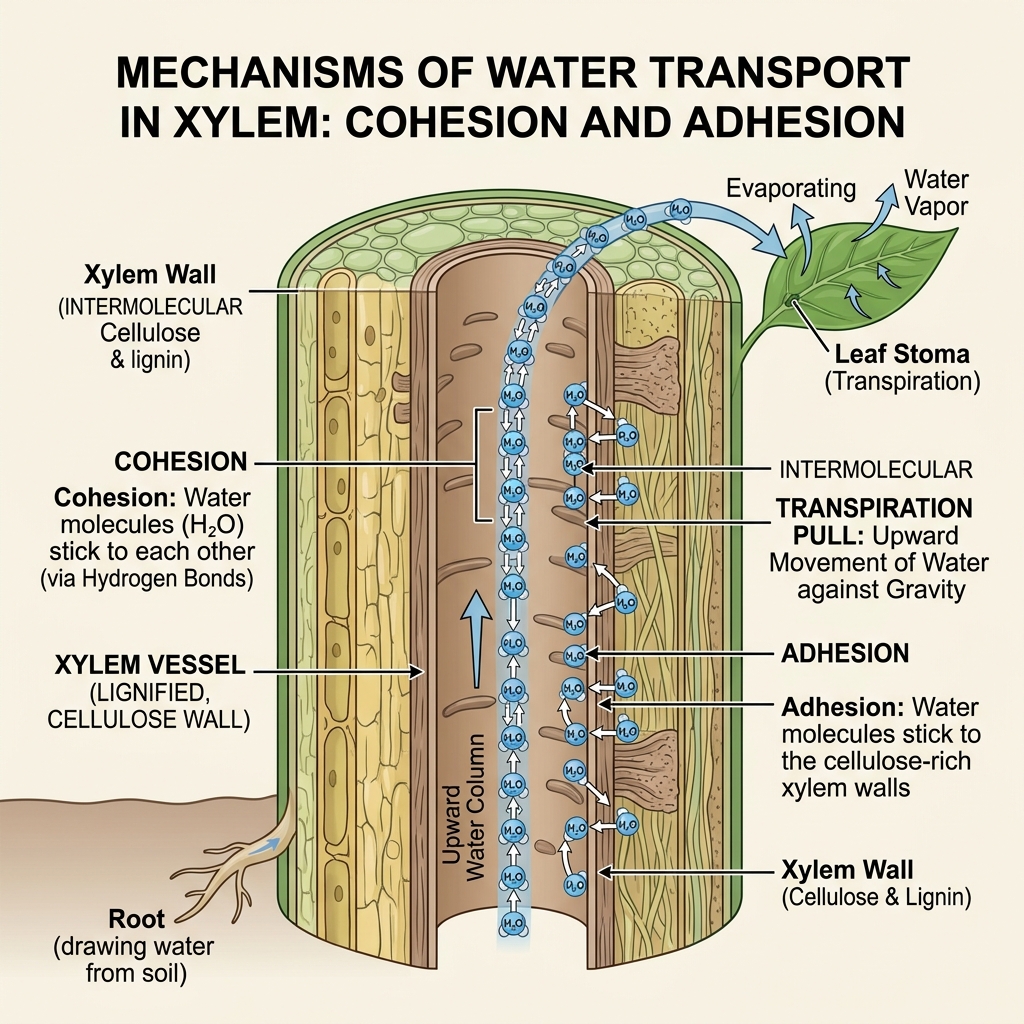
These two properties, working together, are absolutely crucial for plant survival and the movement of water against gravity.
Water evaporates from the stomata in the leaves (Transpiration)
↓
This creates a negative pressure (Tension) pulling water upwards
↓
Cohesion: Water molecules stick to each other, forming an unbroken continuous chain
↓
Adhesion: Water molecules stick to the cellulose cell walls of the xylem, preventing them from falling back down
Other Impacts: Cohesion also creates high surface tension, allowing some insects (like the water strider) to walk on water.
A1.1.5
Solvent Properties
Key UnderstandingWater has excellent solvent properties for other polar molecules and ions, but struggles with non-polar substances.
Because water is polar, it acts as the "universal solvent" for other polar molecules or charged ions (like salt, glucose, and amino acids). The partial charges of water surround and pull apart these substances, dissolving them. This is vital for metabolism and transport.
Hydrophilic ("Water-Loving")
Substances that dissolve easily in water.
- Polar molecules (e.g., Glucose)
- Ions (e.g., Sodium, Chloride)
- Easily transported freely in blood plasma.
Hydrophobic ("Water-Fearing")
Substances that do NOT dissolve in water.
- Non-polar molecules (e.g., Lipids, Fats)
- Must be transported in special structures (like lipoproteins in the blood).
- Crucial Function: The hydrophobic nature of lipids is what allows cell membranes to form stable boundaries in water!
A1.1.6
Physical Properties: Water vs Air
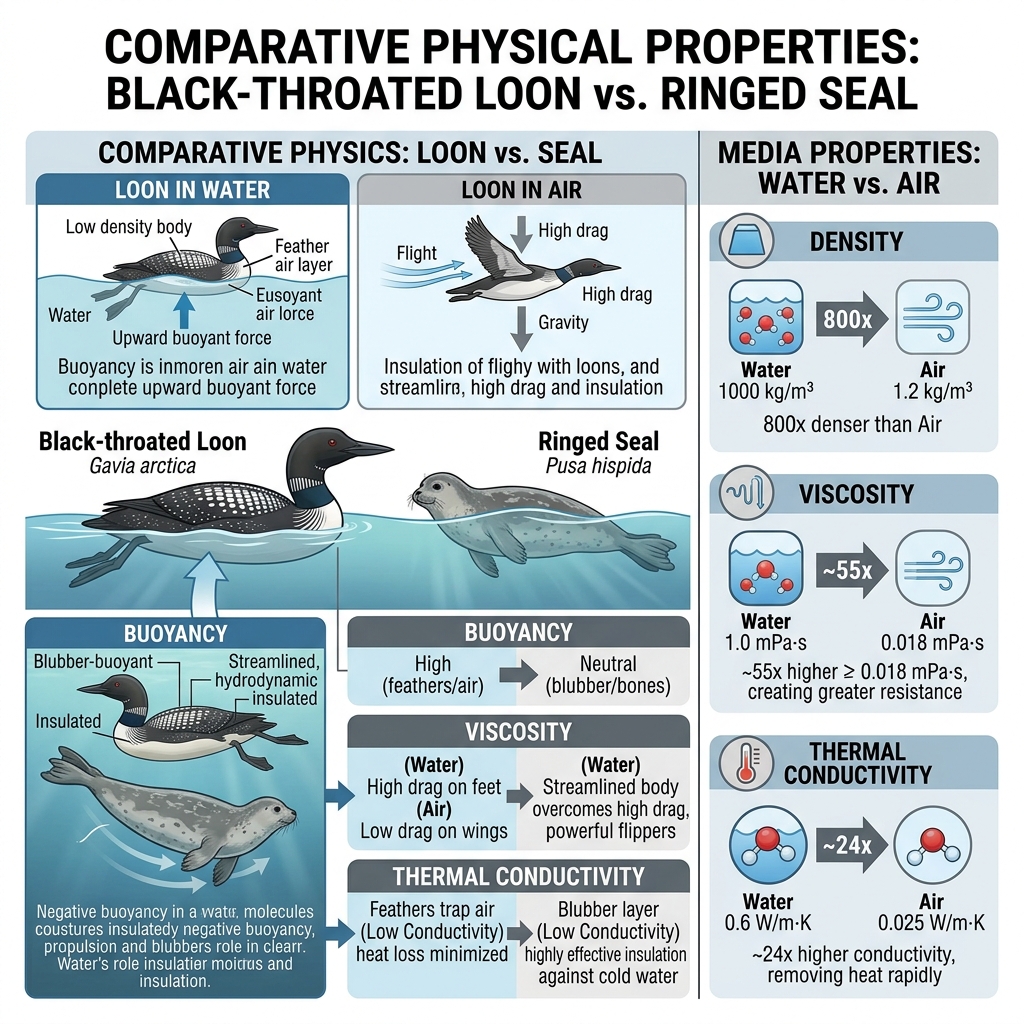
Key UnderstandingThe physical properties of water have profound consequences for the animals that live in it, especially when compared to air.
| Property | Description | Impact on Aquatic Organisms |
|---|
| Buoyancy |
The upward force exerted by a fluid on an object. Water is much denser than air (approx. 800x denser). |
Allows massive animals (like whales or seals) to float easily without needing massive skeletal structures to support their weight. |
| Viscosity |
Resistance to flow (thickness). Water is ~50x more viscous than air. |
Creates significant drag. Aquatic animals like the ringed seal must have highly streamlined, hydrodynamic bodies to move efficiently. |
| Thermal Conductivity |
The rate at which heat passes through a material. Water conducts heat ~24x faster than air. |
Water strips body heat rapidly. The ringed seal requires thick layers of blubber to insulate against fatal heat loss. The loon relies on trapping air in its feathers. |
| Specific Heat Capacity |
The energy required to raise the temperature of 1g of substance by 1°C. Water has a very HIGH heat capacity due to hydrogen bonds. |
Water heats up and cools down very slowly. This provides a highly stable thermal environment for aquatic life. |
A1.1.7 HL Only
The Extraplanetary Origin of Water
Key Understanding (HL) Scientific hypotheses about the origin of water on Earth and reasons for its retention.
Where did Earth's massive oceans come from? Early Earth was a molten mass, too hot for liquid water to exist. The leading scientific consensus is that water was delivered from space.
1. Early Earth forms as a hot, molten planet
↓
2. Heavy Bombardment: Asteroids and comets (rich in ice) continually bombard the planet
↓
3. Retention: Earth's gravity is strong enough to hold onto the vapor, preventing it from escaping into space
↓
4. Cooling: As temperatures drop below 100°C, the vapor condenses into liquid rain, forming the oceans
A1.1.8 HL Only
Extraterrestrial Life and the Goldilocks Zone
Key Understanding (HL) The relationship between the search for extraterrestrial life and the presence of water.
Because water is the fundamental medium for life as we know it, astrobiologists focus their search for alien life entirely on finding liquid water on other exoplanets.
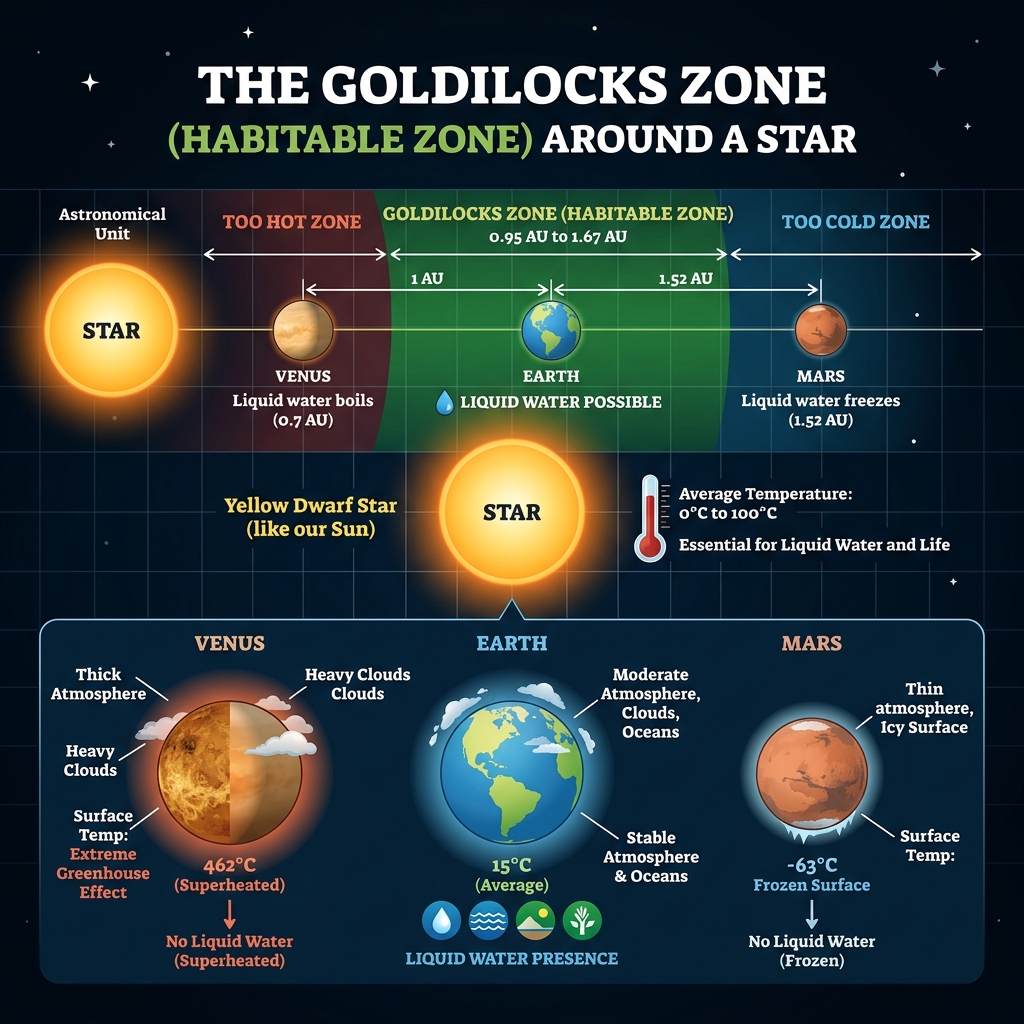
The "Goldilocks" Habitable Zone:
This is the orbital region around a star where the temperature is "just right" (not too hot, not too cold) for liquid water to exist on a planet's surface.
- Too Close (Venus): Intense stellar radiation causes all water to boil away into vapor (Greenhouse effect).
- Too Far (Mars): Lack of heat causes all water to freeze completely solid.
- Just Right (Earth): Liquid water can persist, allowing the complex biochemistry of life to evolve.
✅
A1.1 Water Complete!
You have successfully reviewed all SL and HL understandings for Biology Theme A1.1.