IB DP Biology 2025: Unity and Diversity
A1.2 — Nucleic Acids
Theme A: Form and Function · Standard & Higher Level
A1.2.1
DNA as the Genetic Material
Key Understanding DNA serves as the genetic material of all living organisms.
Deoxyribonucleic acid (DNA) is the molecule of heredity. It stores the instructions necessary for the growth, development, and reproduction of all living organisms.
Information is stored in the DNA sequence
↓
DNA is transcribed into RNA
↓
RNA is translated into Proteins, expressing the traits
- Universal: From bacteria to humans, DNA is the standard storage molecule for genetic information.
- Viruses: Some viruses use RNA as their genetic material, but they are not considered living organisms.
A1.2.2
Nucleotide Structure
Key Understanding Components of a nucleotide: pentose sugar, phosphate group, and nitrogenous base.
Each nucleotide has three components:
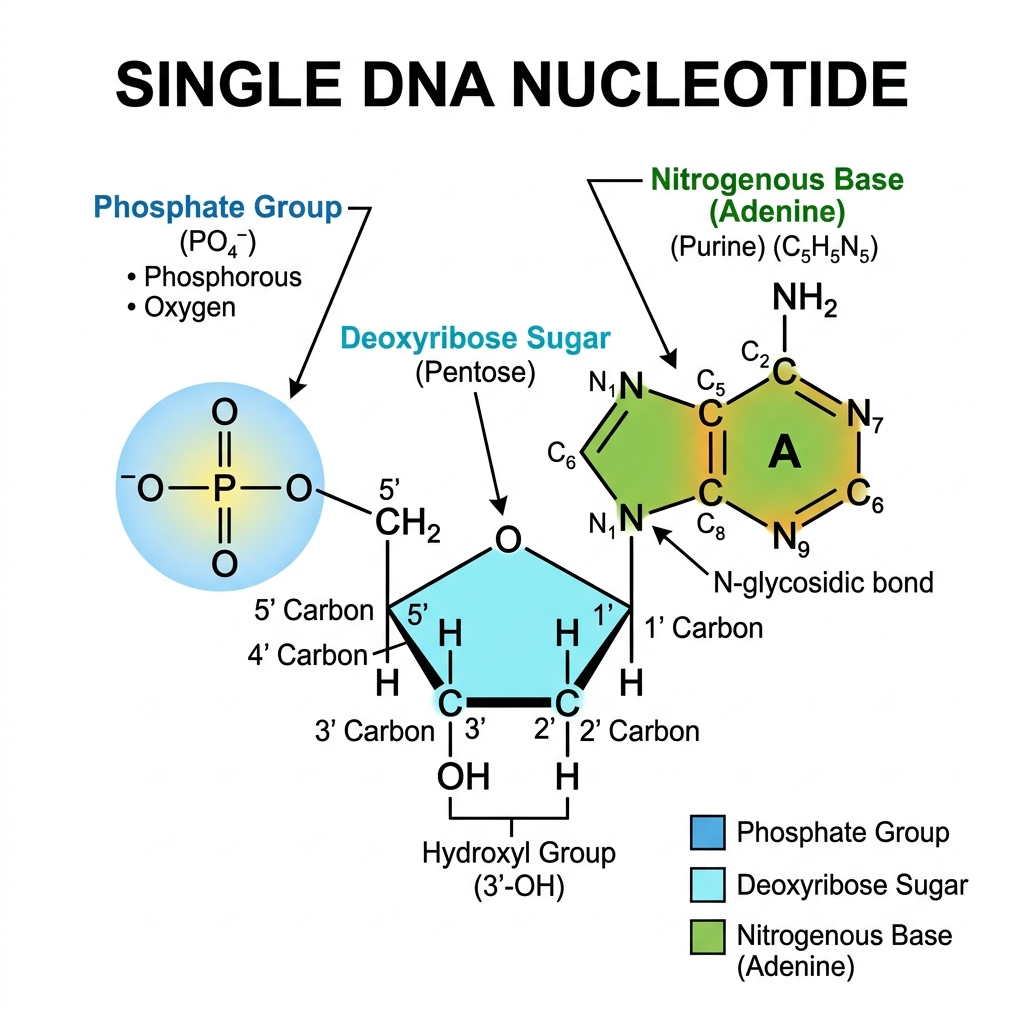
Components of a Nucleotide:
- Pentose Sugar: A 5-carbon sugar (Deoxyribose in DNA, Ribose in RNA).
- Phosphate Group: Highly negatively charged, making DNA an acid.
- Nitrogenous Base: The information-carrying part (A, T, C, G in DNA; A, U, C, G in RNA).
A1.2.3
Polymer Formation & Base Pairing
Key Understanding Sugar–phosphate bonding and the formation of the sugar–phosphate “backbone” of DNA and RNA.
Nucleic acid strands are built through condensation reactions.
Phosphate group of one nucleotide bonds to the 3' carbon of the next pentose sugar
↓
Forms a covalent phosphodiester bond
↓
Creates the strong, continuous Sugar-Phosphate Backbone
A1.2.4 / A1.2.5
Bases and RNA Polymers
Key Understanding Bases in each nucleic acid form the basis of a code, and RNA is a polymer formed by the condensation of nucleotide monomers.
The nitrogenous bases form the alphabet of the genetic code.
- DNA Bases: Adenine, Thymine, Cytosine, Guanine.
- RNA Bases: Adenine, Uracil (replaces Thymine), Cytosine, Guanine.
- RNA Polymer: RNA is typically a single strand formed through condensation reactions between nucleotides.
A1.2.6 / A1.2.7
Differences between DNA and RNA
Key Understanding DNA as a double helix linked by hydrogen bonding, and structural differences between DNA and RNA.
DNA (Deoxyribonucleic Acid)
- Strands: Double-stranded (Double Helix)
- Sugar: Deoxyribose
- Bases: A, T, C, G
- Function: Long-term storage of genetic information
RNA (Ribonucleic Acid)
- Strands: Single-stranded
- Sugar: Ribose
- Bases: A, U (Uracil), C, G
- Function: Transfer information and protein synthesis
A1.2.8 / A1.2.9
Base Pairing & Information Storage
Key Understanding Complementary base pairing enables replication/expression, and base sequence diversity provides limitless information storage.
In double-stranded DNA, the two strands are held together by Hydrogen Bonds between complementary nitrogenous bases:
- Adenine (A) pairs with Thymine (T) with 2 hydrogen bonds.
- Cytosine (C) pairs with Guanine (G) with 3 hydrogen bonds.
The vast diversity of life is possible because the sequence of the four nitrogenous bases can vary infinitely. Variations in these sequences cause the differences between individuals and species.
A1.2.10
Conservation of the Genetic Code
Key Understanding Conservation of the genetic code across all life forms is evidence of universal common ancestry.
- Universal Code: The same codons (3-base sequences) code for the same amino acids in almost all organisms on Earth.
- This consistency provides powerful evolutionary evidence that all life shares a single common ancestor.
A1.2.11 HL Only
Directionality (5' to 3')
Key Understanding (HL) Directionality of RNA and DNA (5' to 3' linkages) is significant for replication, transcription, and translation.
The carbon atoms in the pentose sugar are numbered 1' through 5'. This numbering gives the nucleic acid strand a direction.
One end has a free Phosphate attached to the 5' carbon (5' end)
↓
The other end has a free Hydroxyl (-OH) attached to the 3' carbon (3' end)
↓
DNA replication, transcription, and translation always proceed in the 5' to 3' direction
Because the two strands of the DNA double helix run in opposite directions, they are said to be antiparallel.
A1.2.12 / A1.2.13 HL Only
Helix Stability & Nucleosome Structure
Key Understanding (HL) Purine-to-pyrimidine bonding maintains DNA helix stability, and DNA is organized into nucleosomes in eukaryotes.
Helix Stability:
A bulky purine base (A or G, two rings) always bonds with a smaller pyrimidine base (T or C, one ring). This ensures the DNA helix maintains a constant width and three-dimensional structure.
Nucleosome Structure:
To fit inside the microscopic nucleus, eukaryotic DNA is highly compacted.
- DNA wraps around a core of 8 histone proteins to form a nucleosome.
- This "beads on a string" structure helps in supercoiling the DNA into chromosomes and regulating gene expression.
A1.2.14 HL Only
Hershey–Chase Experiment
Key Understanding (HL) Evidence from the Hershey–Chase experiment for DNA as the genetic material.
Nature of Science (Skills)
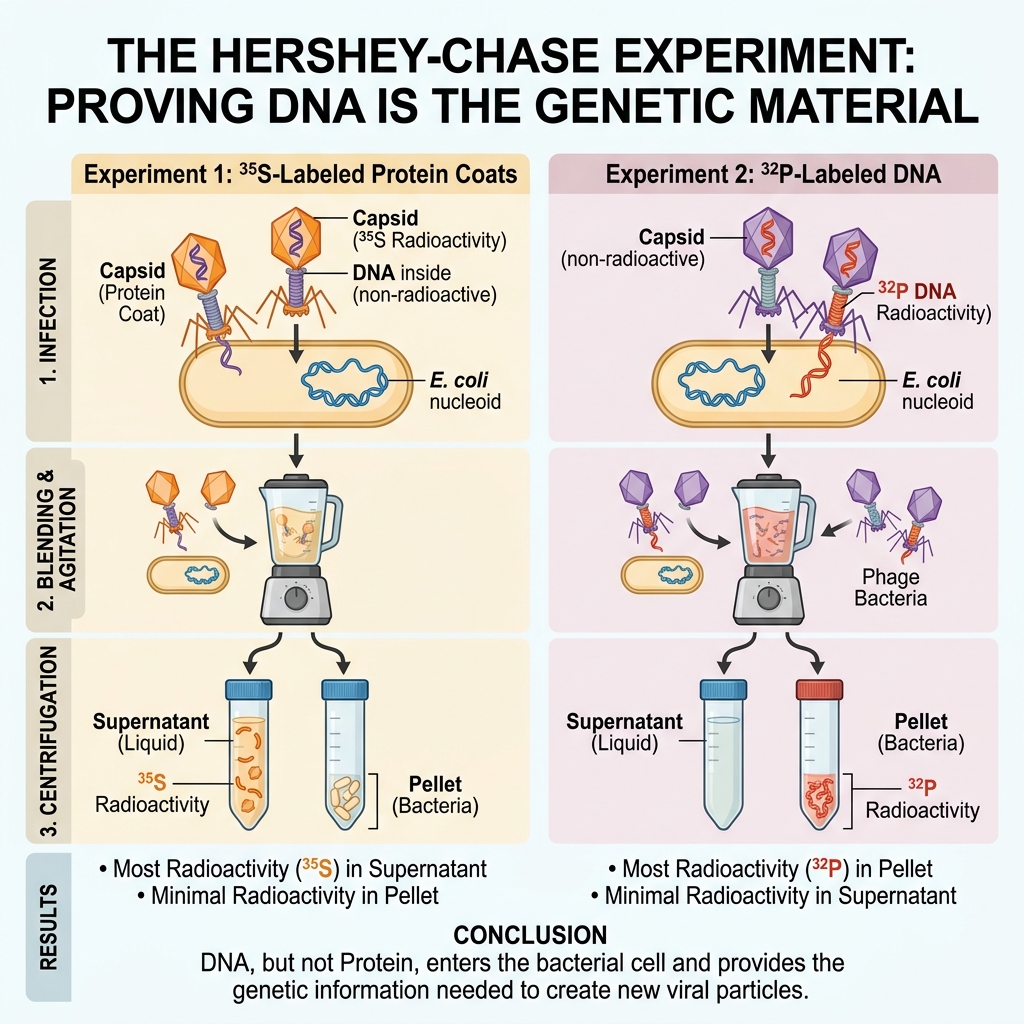
The Hershey-Chase experiment (1952) used radioactive isotopes (S-35 for proteins, P-32 for DNA) to label bacteriophages. After infection and centrifugation, the radioactive phosphorus was found inside the bacterial cells (pellet), while the sulfur remained outside (supernatant). This provided definitive experimental evidence that DNA, not protein, is the genetic material.
A1.2.15 HL Only
Chargaff's Data on Base Ratios
Key Understanding (HL) Chargaff's data on the relative amounts of pyrimidine and purine bases across diverse life forms.
Applications
Erwin Chargaff analyzed the DNA of many species and found that the amount of Adenine always roughly equals Thymine, and Guanine equals Cytosine (A=T and G=C). This also meant that the total amount of purines equals the total amount of pyrimidines. This data was crucial for Watson and Crick in discovering the complementary base pairing of the DNA double helix.
✅
A1.2 Nucleic Acids Complete!
You have successfully reviewed all SL and HL understandings for Biology Theme A1.2.