
IB DP Biology 2025: Unity and Diversity
A2.1 — Origins of Cells
Theme A: Unity and Diversity · Higher Level Only
A2.1.1 HL Only
Conditions on Early Earth
Key Understanding Conditions on early Earth were very different from today, creating a unique environment for the origin of life.
The early Earth's atmosphere was highly reducing, lacked free oxygen, and had a higher proportion of other gases, which facilitated the chemical evolution of life.
High Temperatures and Volcanic Activity
↓
Atmosphere rich in Methane, Ammonia, CO2, and Hydrogen
↓
Lack of Ozone layer allowed intense UV radiation
↓
Provided energy for chemical synthesis
- No Free Oxygen: Unlike today, oxygen was virtually absent, which prevented the breakdown of newly formed organic molecules.
- Energy Sources: Lightning, geothermal heat, and UV radiation provided the activation energy for early chemical reactions.
A2.1.2 HL Only
Cells as the Smallest Units of Life
Key Understanding Cells are the smallest units that display all the characteristics of life.
For life to exist, there must be a basic functional unit that can sustain itself, reproduce, and interact with the environment. The cell is this fundamental unit.
Why Cells?
- They provide compartmentalization, keeping metabolic reactions localized and efficient.
- They have a boundary (the plasma membrane) separating the internal environment from the external chaos.
- They contain genetic material to pass on instructions for life.
A2.1.3 HL Only
The Challenge of Spontaneous Origin
Key Understanding The spontaneous origin of cells is a highly complex process and currently impossible to observe or fully replicate.
Life essentially arose from non-living matter (abiogenesis). The leap from simple organic molecules to complex, self-sustaining, replicating cells is one of the greatest mysteries in biology.
- Complexity: Even the simplest cell requires a vast array of interacting molecules (DNA, RNA, proteins, lipids).
- Probability: The spontaneous assembly of these components in the exact necessary order is statistically extremely improbable, yet it happened.
- Time Scale: This process took hundreds of millions of years in a vast ocean, making it difficult to simulate in a lab.
A2.1.4 HL Only
Evidence for the Origin of Carbon Compounds
Key Understanding The Miller-Urey experiment provided evidence that organic molecules could form under early Earth conditions.
In 1953, Stanley Miller and Harold Urey designed an apparatus to simulate the conditions of early Earth.
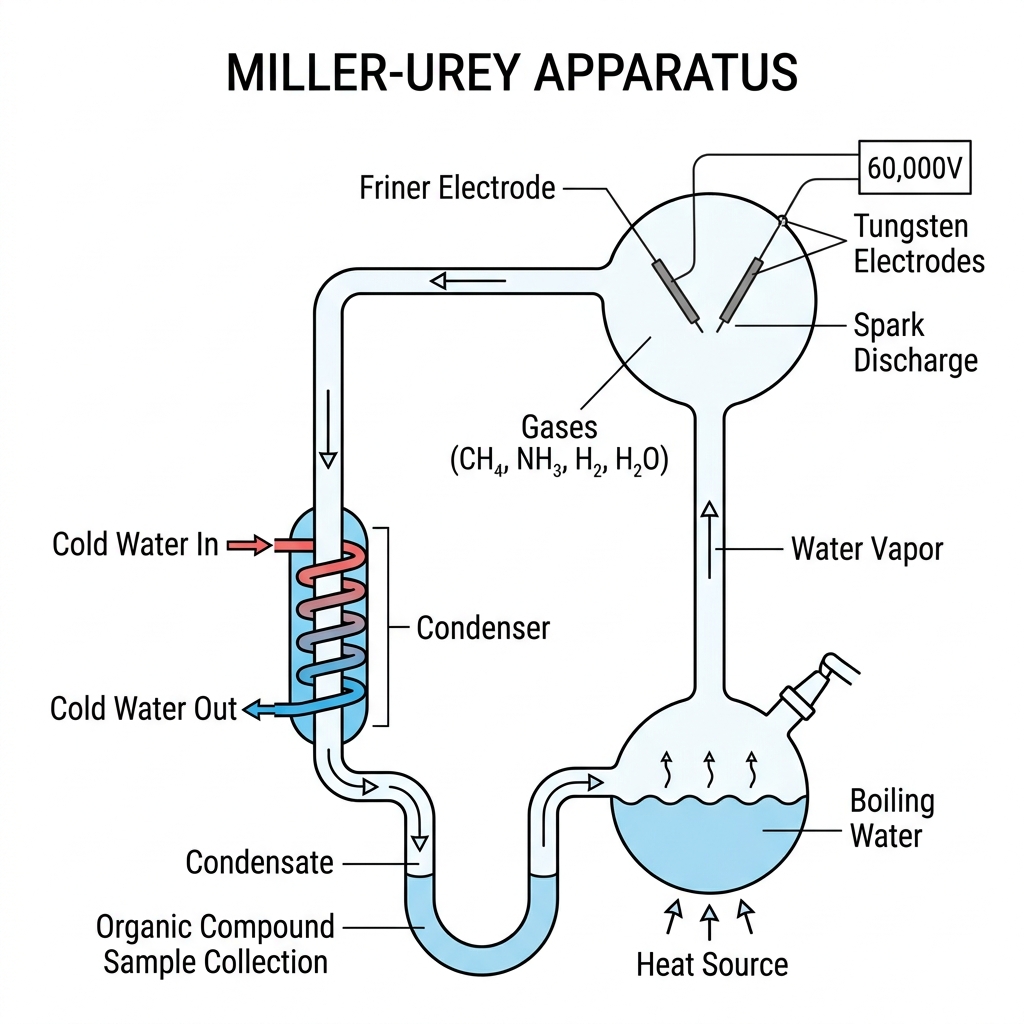
Boiled water created vapor (simulating early oceans)
↓
Mixed with gases (CH4, NH3, H2) simulating early atmosphere
↓
Electrical sparks (simulating lightning) provided energy
↓
Condenser cooled the mixture
↓
Result: Formation of amino acids and other organic compounds
Skills
Analysis of evidence for the origin of carbon compounds from the Miller-Urey experiment. Students should be able to deduce how experimental design replicates hypothetical early Earth conditions.
A2.1.5 HL Only
Vesicle Formation
Key Understanding The spontaneous assembly of amphipathic molecules into vesicles provided early compartmentalization.
Before complex cells existed, simple membranous structures needed to form to protect internal chemistry.
- Amphipathic Molecules: Fatty acids have both hydrophilic (water-loving) and hydrophobic (water-fearing) parts.
- Spontaneous Assembly: In water, these molecules naturally assemble into spherical bilayers called vesicles to hide their hydrophobic tails from water.
- Significance: Vesicles create an isolated internal environment where chemical reactions can occur without interference from the outside world—a crucial step towards true cells.
A2.1.6 HL Only
The RNA World Hypothesis
Key Understanding RNA is thought to be the first genetic material because it can both store information and catalyze reactions.
The "Chicken and Egg" problem of early life: DNA is needed to make proteins, but proteins are needed to replicate DNA. The solution? RNA could do both.
Information Storage
Like DNA, RNA is composed of nucleotide sequences that can store and transmit genetic information.
Catalysis (Ribozymes)
Unlike DNA, some RNA molecules can fold into complex 3D shapes and act as enzymes (ribozymes), catalyzing their own replication and other reactions.
Nature of Science
Testability of the RNA world hypothesis: Scientific hypotheses must be testable. Experimental evidence, such as the synthesis of RNA nucleotides under simulated prebiotic conditions and the discovery of catalytic RNA (ribozymes), provides testable predictions that support the RNA world hypothesis.
A2.1.7 HL Only
Evidence for LUCA
Key Understanding Evidence supports the existence of a Last Universal Common Ancestor (LUCA) from which all life descends.
LUCA was not the very first cell, but rather the most recent population of organisms from which all organisms living on Earth have a common descent.
Key Evidence for LUCA:
- Universal Genetic Code: Almost all organisms use the exact same genetic code to translate DNA into proteins.
- Shared Genes: Studies show hundreds of genes (especially those for metabolism and ribosomes) are shared across all domains of life (Archaea, Bacteria, Eukarya).
- Common Biochemistry: The use of ATP as an energy currency and lipid bilayer membranes are universal.
A2.1.8 / A2.1.9 HL Only
Dating the First Cells & Hydrothermal Vents
A2.1.8 Approaches used to estimate the timing of the first cells and LUCA.
A2.1.9 Hydrothermal vents as a likely site for the origin of life.
- Fossil Evidence: Stromatolites and microfossils suggest life existed at least 3.5 to 3.8 billion years ago.
- Molecular Clocks: Analyzing mutation rates in DNA suggests LUCA existed around 4 billion years ago.
Alkaline Hydrothermal Vents (Deep Ocean)
↓
Provide a continuous source of heat energy
↓
Mineral-rich environment with natural gradients (pH and temperature)
↓
Ideal conditions to fuel early metabolic reactions and form LUCA
A2.1.10 HL Only
The Endosymbiotic Theory
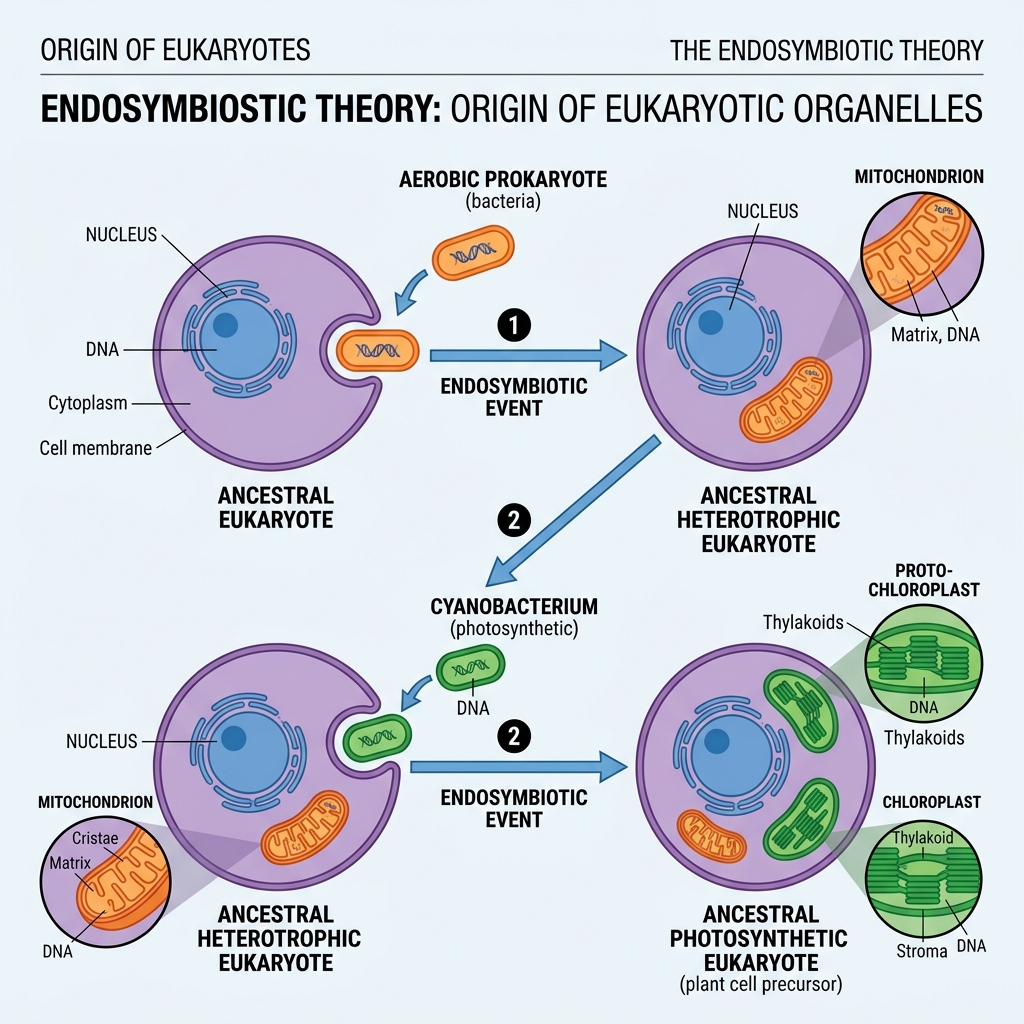
Key Understanding Eukaryotic cells are believed to have evolved from early prokaryotes that were engulfed by phagocytosis.
The origin of eukaryotes (mitochondria and chloroplasts) is explained by the endosymbiotic theory.
Applications
Evaluating evidence for endosymbiosis: Mitochondria and chloroplasts share several characteristics with independent prokaryotes, such as 70S ribosomes, circular naked DNA, double membranes, and autonomous replication by binary fission.
✅
A2.1 Origins of Cells Complete!
You have successfully reviewed all HL understandings for Biology Theme A2.1.