IB DP Biology 2025: Unity and Diversity
A2.3 — Viruses
Theme A: Form and Function · Higher Level Only
A2.3.1 HL Only
Common Structural Features of Viruses
Key UnderstandingViruses share common structural features, reflecting their nature as obligate intracellular parasites.
Viruses are incredibly small, non-cellular infectious agents. Since they lack cytoplasm, ribosomes, and other metabolic machinery, they must infect a host cell to replicate.
- Genetic Material: All viruses contain a genome, which can be either DNA or RNA.
- Capsid: The genetic material is enclosed in a protective protein coat called a capsid.
- Lack of Cytoplasm: Viruses do not have a cytoplasm or their own metabolic enzymes.
- Size: They have a very small, fixed size compared to cells.
Exam Tip: Viruses are considered non-living because they cannot carry out life processes (like metabolism and reproduction) independently outside of a host cell.
A2.3.2 HL Only
Diversity of Viral Structure
Key UnderstandingDespite shared features, viruses exhibit immense diversity in structure.
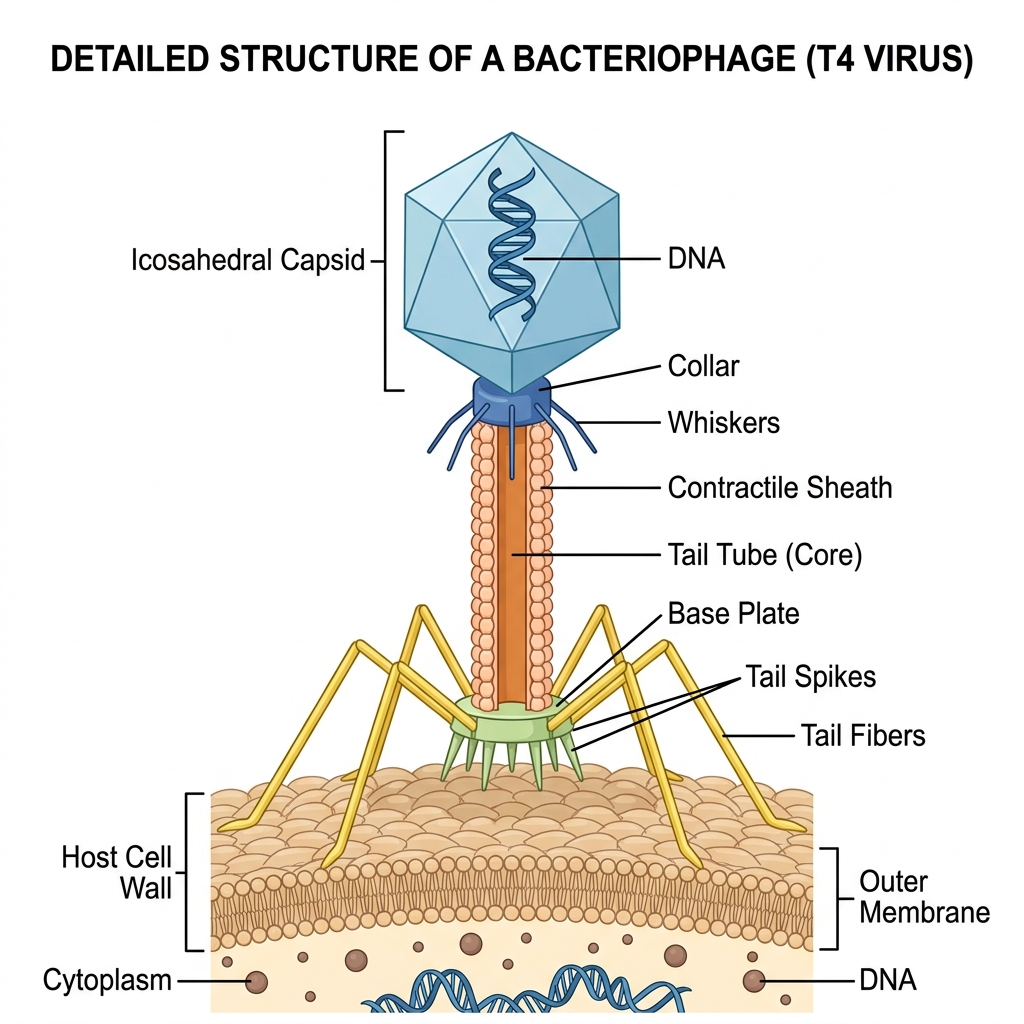
Viruses vary significantly in their structural details:
Genome Diversity
- Can be DNA or RNA.
- Can be single-stranded or double-stranded.
- Can be linear or circular.
Morphological Diversity
- Shapes: Helical (e.g., TMV), Icosahedral (e.g., Adenovirus), or Complex (e.g., Bacteriophage).
- Envelopes: Some viruses have a lipid envelope derived from the host cell membrane; others are "naked" (unenveloped).
A2.3.3 HL Only
The Lytic Cycle
Key UnderstandingThe lytic cycle involves the rapid replication of the virus and the destruction of the host cell.
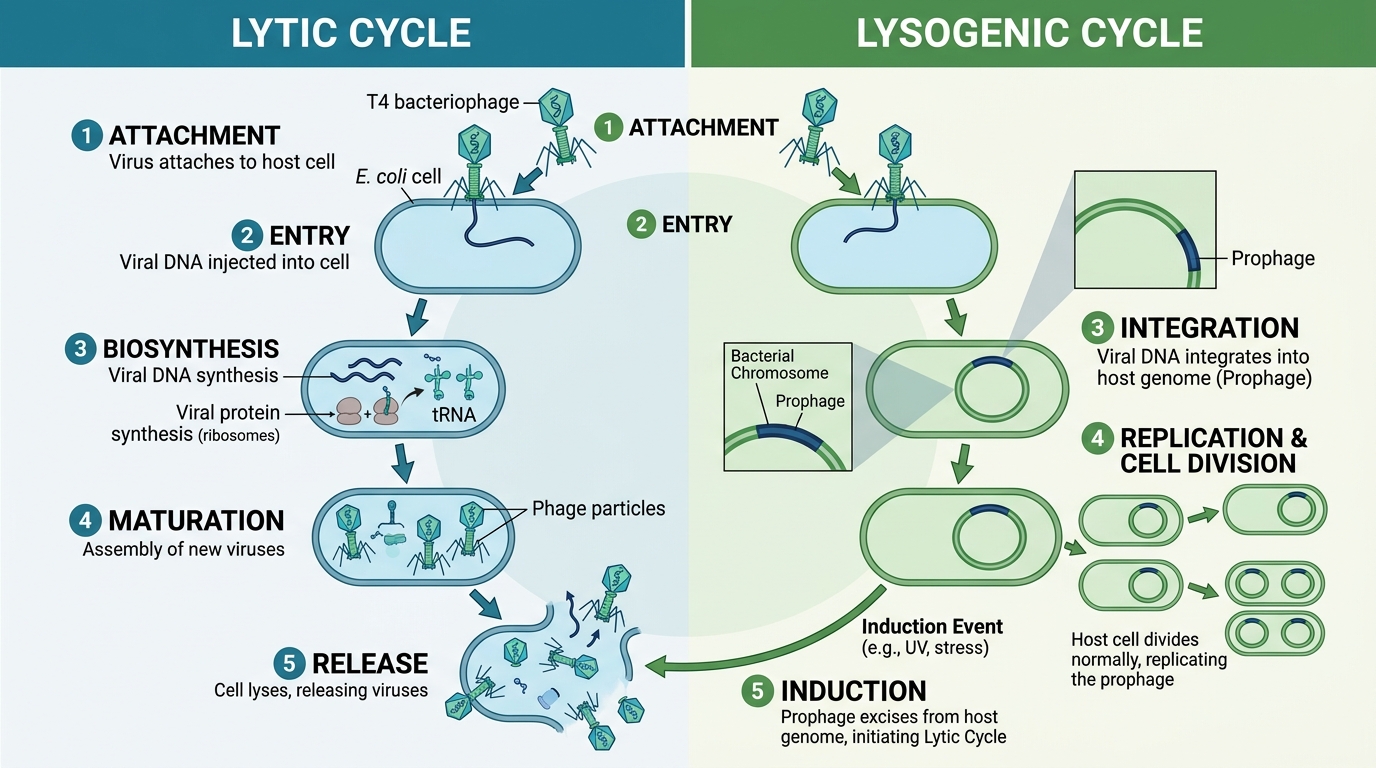
In the lytic cycle, the virus takes over the host's cellular machinery to produce new viral particles, ultimately lysing (bursting) the cell.
1. Attachment: Virus binds to specific receptors on the host cell.
↓
2. Penetration: Viral genetic material enters the host cell.
↓
3. Replication & Synthesis: Host machinery copies viral genome and synthesizes viral proteins.
↓
4. Assembly: New viral particles are assembled.
↓
5. Lysis: The host cell bursts, releasing newly formed virions to infect other cells.
A2.3.4 HL Only
The Lysogenic Cycle & Comparative Analysis
Key UnderstandingThe lysogenic cycle allows viral genomes to integrate and persist within the host cell without immediate destruction.
Some viruses (like temperate phages) can enter a dormant state, where their genetic material integrates into the host cell's genome (forming a provirus or prophage).
1. Integration: Viral DNA integrates into the host chromosome.
↓
2. Replication: As the host cell divides, it replicates the viral DNA along with its own.
↓
3. Latency: The virus remains dormant (latent) for long periods.
↓
4. Induction: An environmental trigger (e.g., UV light, stress) causes the viral DNA to exit the host genome and enter the Lytic Cycle.
Skill: Comparing Lytic and Lysogenic Cycles
You should be able to deduce whether a virus is in the lytic or lysogenic cycle based on a diagram or description. Key differentiator: integration into the host genome and cell survival (lysogenic) versus rapid replication and host cell destruction (lytic).
A2.3.5 HL Only
Evolutionary Origins of Viruses
Key UnderstandingThere is evidence for multiple independent origins of viruses from different cellular organisms.
Viruses are highly diverse and do not share a single common ancestor. Instead, it is hypothesized that they have evolved multiple times through convergent evolution.
- The Escaped Gene Hypothesis: Viruses may have evolved from "escaped" pieces of host genetic material (like plasmids or transposons) that gained the ability to move between cells.
- The Reduction Hypothesis: They may have evolved from small parasitic cells that lost their own cellular components over time.
Application: Horizontal Gene Transfer
The lysogenic cycle has profound evolutionary implications. When a prophage excises from a host genome, it can occasionally take a piece of the host DNA with it. When infecting a new cell, it transfers this DNA in a process called transduction, a form of horizontal gene transfer. This drives rapid evolution, such as the spread of antibiotic resistance genes or virulence factors among bacterial populations.
Convergent Evolution: The fact that viruses infecting bacteria, plants, and animals are so distinct suggests that the parasitic "viral lifestyle" evolved independently several times.
A2.3.6 HL Only
Rapid Evolution in Viruses
Key UnderstandingViruses exhibit extremely rapid rates of evolution and adaptation.
Viruses adapt quickly to host defenses (like immune systems or vaccines) and changing environments due to several key factors:
| Factor | Impact on Evolution |
|---|
| High Mutation Rates |
Especially in RNA viruses (e.g., HIV, Influenza), replication enzymes (like RNA polymerase or reverse transcriptase) lack proofreading ability, leading to frequent mutations. |
| Rapid Replication |
Viruses can produce millions of progeny in a short time. Short generation times mean that mutations accumulate quickly in a population. |
| Recombination |
When two different viral strains infect the same cell, their genomes can mix and re-assort, creating entirely new viral strains rapidly (e.g., antigenic shift in influenza). |
✅
A2.3 Viruses Complete!
You have successfully reviewed all HL understandings for Biology Theme A2.3.