
IB DP Biology 2025: Unity and Diversity
A3.1 — Diversity of Organisms
Theme A: Form and Function · Standard & Higher Level
A3.1.1
Variation as a Defining Feature of Life
Key Understanding Variation is an essential characteristic of life that can be observed at all levels (molecular, cellular, organismal).
Variation refers to the differences between individuals of the same species or between different species. Without variation, evolution and adaptation would be impossible.
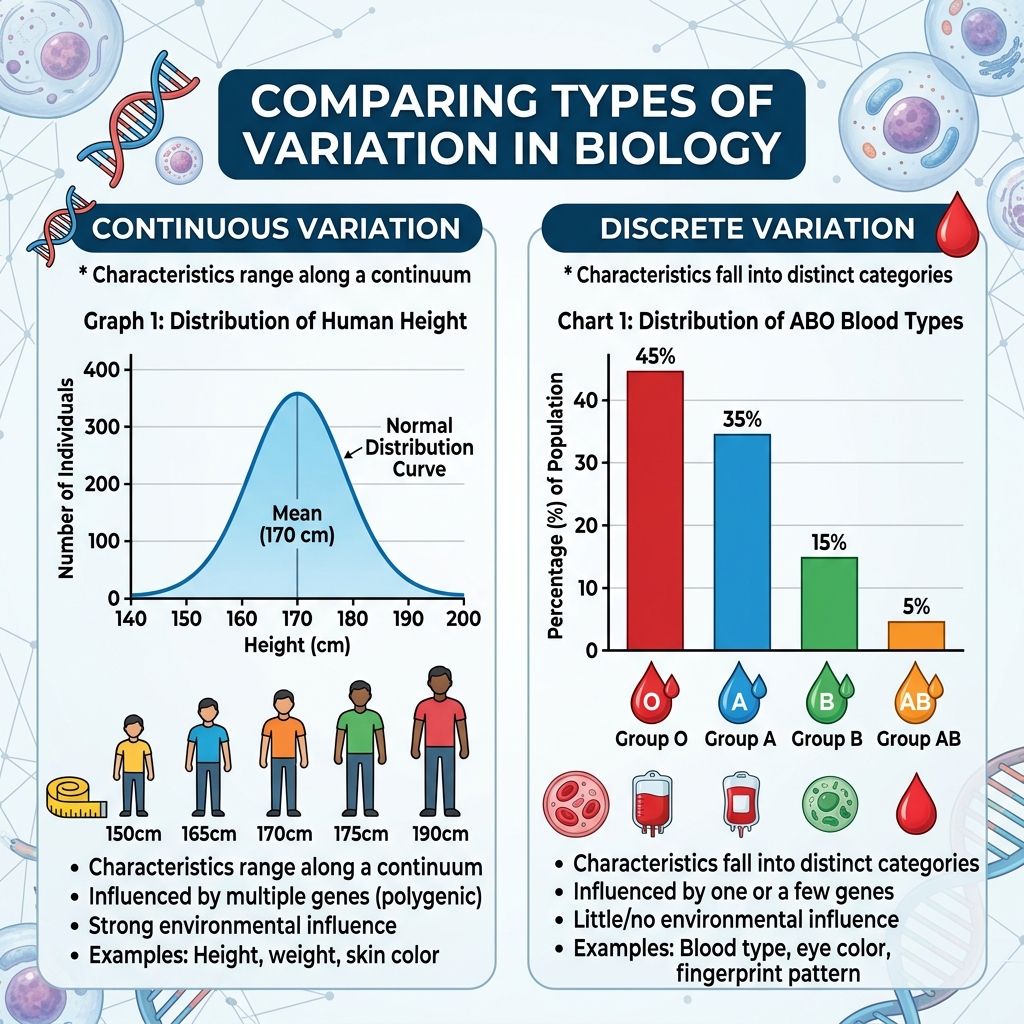
Discrete Variation
Traits fall into distinct categories with no intermediates.
- Controlled by one or a few genes.
- Little to no environmental influence.
- Example: Blood types (A, B, AB, O).
Continuous Variation
Traits range across a continuum (normal distribution).
- Controlled by many genes (polygenic).
- Strongly influenced by the environment.
- Example: Human height, skin color.
A3.1.2 & A3.1.3
Morphological Species Concept & Binomial System
A3.1.2 A species can be defined as a group of organisms with shared traits (morphological concept).
A3.1.3 The binomial system is the universal method for naming species.
For centuries, scientists grouped organisms based entirely on their physical appearance (morphology). While still useful, this method has limitations due to convergent evolution and high intraspecific variation.
The Binomial Naming System:
Developed by Carl Linnaeus, this system provides a unique, universal two-part Latin name for every species.
- Genus: The first part, always capitalized (e.g., Homo).
- Species: The second part, always lowercase (e.g., sapiens).
- Formatting: Must be italicized when typed, or underlined when handwritten.
Application: Classification in 3 Domains
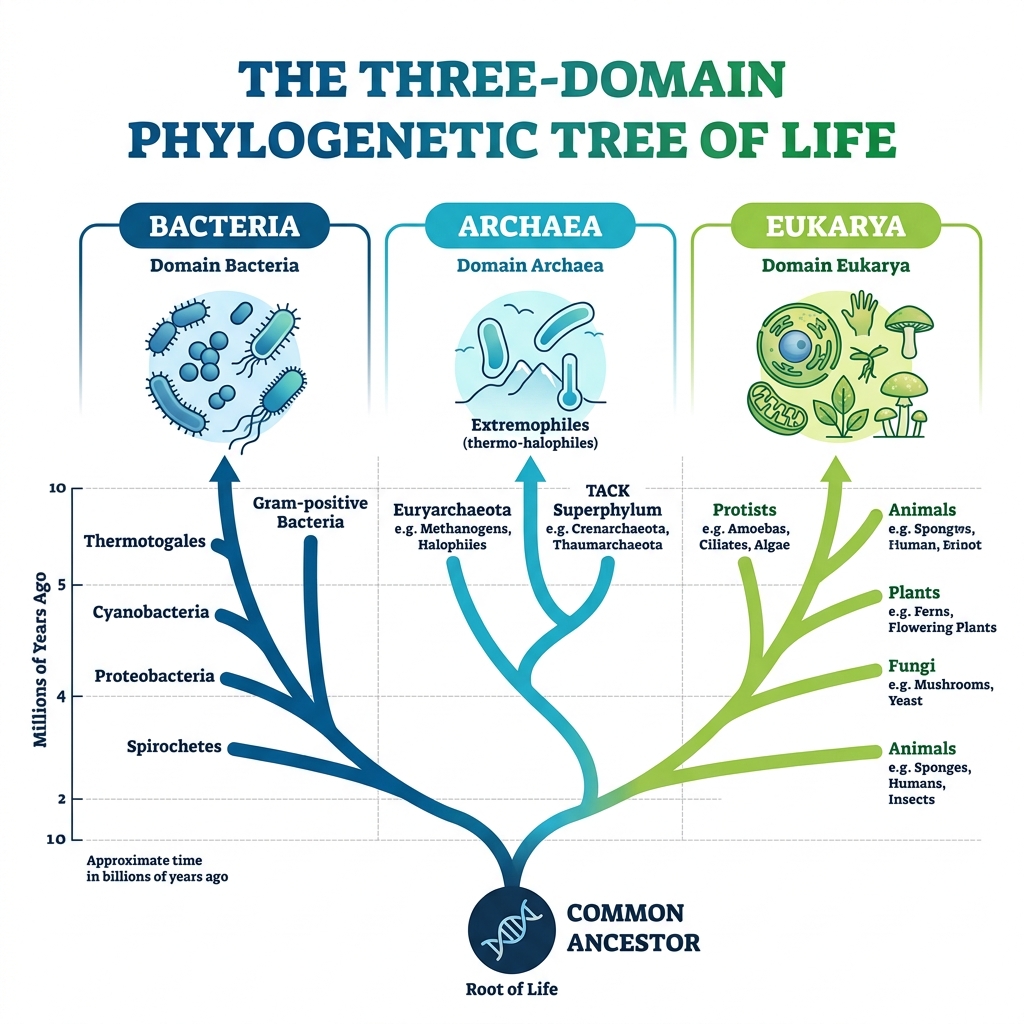
Organisms are classified into three major domains: Bacteria, Archaea, and Eukarya. This system reflects the deepest evolutionary divergences in the history of life.
A3.1.4 & A3.1.5
Biological Species Concept & Speciation
Key Understanding The biological species concept defines a species as a group capable of breeding to produce fertile offspring.
The Biological Species Concept focuses on reproductive isolation. If two organisms can mate and produce healthy, fertile offspring, they belong to the same species.
Exam Tip: A horse and a donkey can mate, producing a mule. However, mules are sterile (infertile). Therefore, horses and donkeys are distinct species!
The Gradual Process of Speciation
It can be very difficult to distinguish between populations and species because speciation (the formation of new species) is a slow, gradual process of divergence.
Single continuous population of a species
↓
Geographic isolation splits the population
↓
Populations experience different selective pressures & accumulate genetic differences
↓
Reproductive isolation is achieved: Two distinct species exist
A3.1.6 & A3.1.7
Chromosomes, Karyograms, and Genomes
Key Understanding There is diversity in chromosome numbers across species, but unity within a species.
Every species has a characteristic number of chromosomes. For example, humans have 46, chimpanzees have 48, and dogs have 78. A difference in chromosome number is a major barrier to reproduction between species.
Karyograms and Karyotyping:
A karyogram is a photograph or diagram of a cell's chromosomes arranged in homologous pairs of decreasing size.
- Used to determine the sex of an individual (XX or XY).
- Used to diagnose chromosomal abnormalities (like Down Syndrome / Trisomy 21).
Application: Human Chromosome 2 Fusion
Evidence from karyotypes and genome sequences shows that human chromosome 2 was formed by the head-to-head fusion of two ancestral ape chromosomes. This perfectly explains why humans have 46 chromosomes while chimpanzees and other great apes have 48, providing powerful evidence for common ancestry.
Unity and Diversity of Genomes:
While every human has a unique genome (due to meiosis and mutation), all humans share the vast majority of their DNA sequence, representing the unity of the species.
A3.1.8
Genome Sizes & Whole-Genome Sequencing
Key Understanding Genomes vary massively in size, and genome sequencing is revolutionizing biology.
| Organism | Approx. Genome Size (Base Pairs) |
|---|
| T2 Phage (Virus) | 170,000 bp |
| E. coli (Bacterium) | 4.6 million bp |
| Drosophila (Fruit Fly) | 130 million bp |
| Homo sapiens (Human) | 3.2 billion bp |
| Paris japonica (Plant) | 150 billion bp |
Note: A larger genome size does NOT necessarily mean the organism is more complex!
Application: Whole-Genome Sequencing
Sequencing technologies have advanced rapidly, leading to widespread applications:
- Current Uses: Tracing evolutionary history and phylogenetics, identifying genetic diseases, and enabling personalized medicine.
- Future Uses: Routine sequencing for all patients, accurately predicting disease susceptibility, and advancing synthetic biology.
A3.1.9 & A3.1.10 HL Only
Challenges in Defining Species
Key Understanding (HL) Applying the biological species concept has significant limitations, especially for asexual organisms and bacteria.
The Biological Species Concept relies on sexual reproduction. How do we classify organisms that do not reproduce sexually?
Asexual Organisms
Organisms like dandelions and some lizards reproduce entirely by cloning themselves (parthenogenesis/asexual reproduction). The biological species concept cannot apply to them.
Bacteria & Horizontal Gene Transfer
Bacteria reproduce asexually, but they can also swap DNA directly with completely different types of bacteria via plasmids. This "horizontal gene transfer" makes drawing species boundaries incredibly difficult.
Chromosome Number as a Shared Trait: Despite these challenges, members of a species almost universally share a characteristic chromosome number, allowing for proper meiosis during reproduction.
A3.1.11 & A3.1.12 HL Only
Dichotomous Keys & eDNA Barcoding
Key Understanding (HL) Tools for identifying species in the environment.
Skill: Using Dichotomous Keys
A tool used to identify species by answering a series of paired, yes/no questions about observable characteristics, narrowing down the possibilities until the species is identified.
1a. Leaves are broad and flat -> Go to step 2
1b. Leaves are needle-like -> Conifer
Skill: Interpreting eDNA Barcoding Data
A cutting-edge technique where water or soil samples are collected, and the trace DNA left behind by organisms is extracted and sequenced. By matching short DNA sequences (barcodes) to a database, scientists can rapidly identify all species present in an ecosystem without ever seeing them.
✅
A3.1 Diversity of Organisms Complete!
You have successfully reviewed all SL and HL understandings for Biology Theme A3.1.