
IB DP Biology 2025: Unity and Diversity
A3.2 — Classification & Cladistics
Theme A: Form and Function · Higher Level Only
A3.2.1 HL Only
Traditional Taxonomy vs. Cladistics
Nature of Science A fixed ranking of taxa (Kingdom, Phylum, Class, etc.) is often arbitrary and may not reflect true evolutionary relationships, leading to a paradigm shift toward cladistics.
For centuries, biologists classified organisms based on morphological (physical) similarities using a hierarchical system. However, appearances can be deceiving due to analogous structures (convergent evolution).
Traditional Taxonomy
- Based primarily on observable physical traits (morphology).
- Uses rigid hierarchical ranks (Domain, Kingdom, Phylum, Class, Order, Family, Genus, Species).
- Can group unrelated species together if they evolved similar traits independently.
Cladistics
- Based entirely on shared evolutionary ancestry.
- Uses molecular evidence (DNA/protein sequences) when possible.
- Groups organisms into clades, regardless of traditional taxonomic ranks.
A3.2.2 HL Only
Defining Clades
Key Understanding A clade is a group of organisms that have evolved from a common ancestor, including all of its descendants.
Species in a clade share homologous structures and molecular sequences derived from their common ancestor. We use cladograms to visualize these relationships.
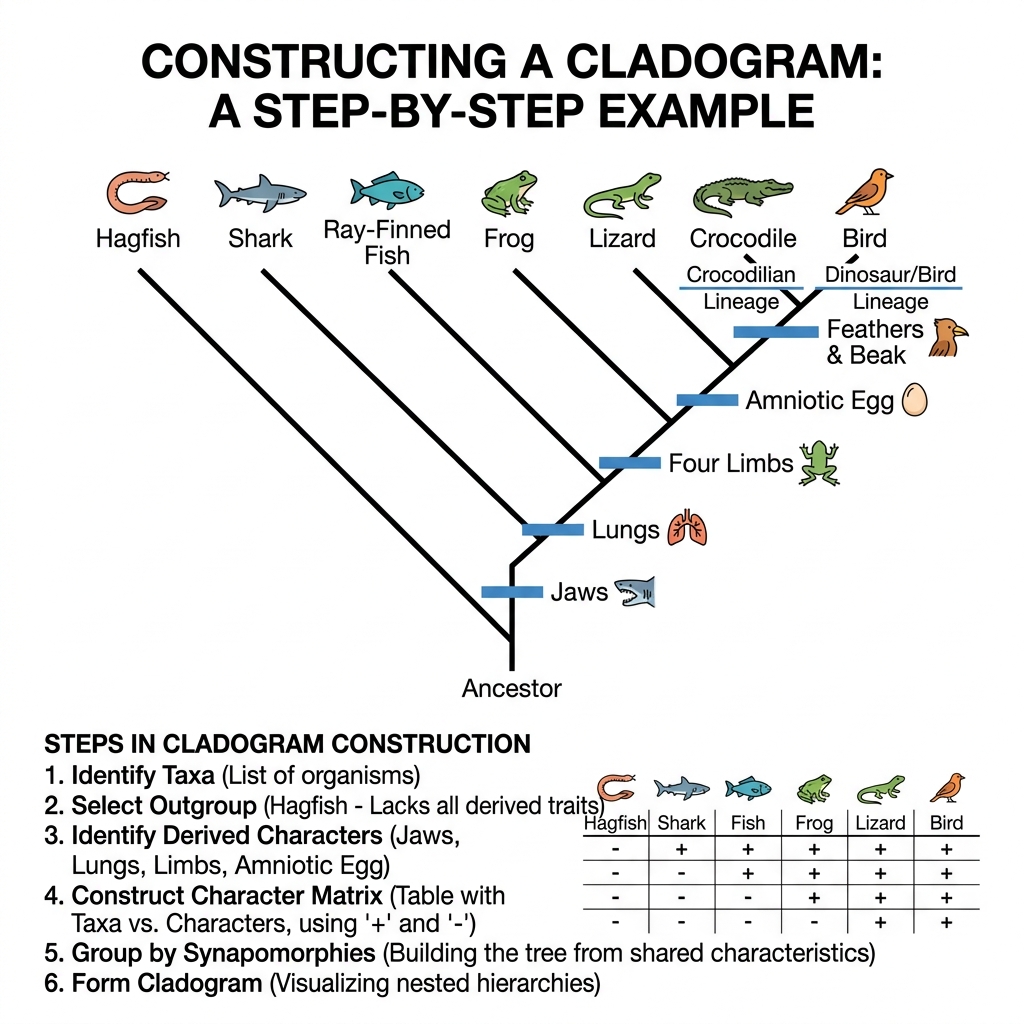
- Node: Represents a speciation event where a common ancestor splits into two or more distinct lineages.
- Root: The initial ancestor common to all organisms within the cladogram.
- Derived Characteristics: Traits that evolved in the lineage leading up to a clade and that set members of that clade apart from other individuals.
Skill: Data Analysis
Constructing cladograms from base sequences or morphological data. You must be able to use a table of shared derived characters to construct a cladogram and identify the branching points (nodes) that represent common ancestors.
A3.2.3 HL Only
Molecular Evidence
Key Understanding Evidence for which species are part of a clade can be obtained from the base sequences of a gene or the corresponding amino acid sequence of a protein.
Since all organisms use DNA and RNA as genetic material, the genetic code is universal. Organisms that share a more recent common ancestor will have more similar DNA and protein sequences.
Extract DNA from two different species
↓
Sequence a highly conserved gene (e.g., Cytochrome c)
↓
Align sequences and count the number of differences (mutations)
↓
Fewer differences = closer relationship (recent common ancestor)
A3.2.4 HL Only
Molecular Clocks
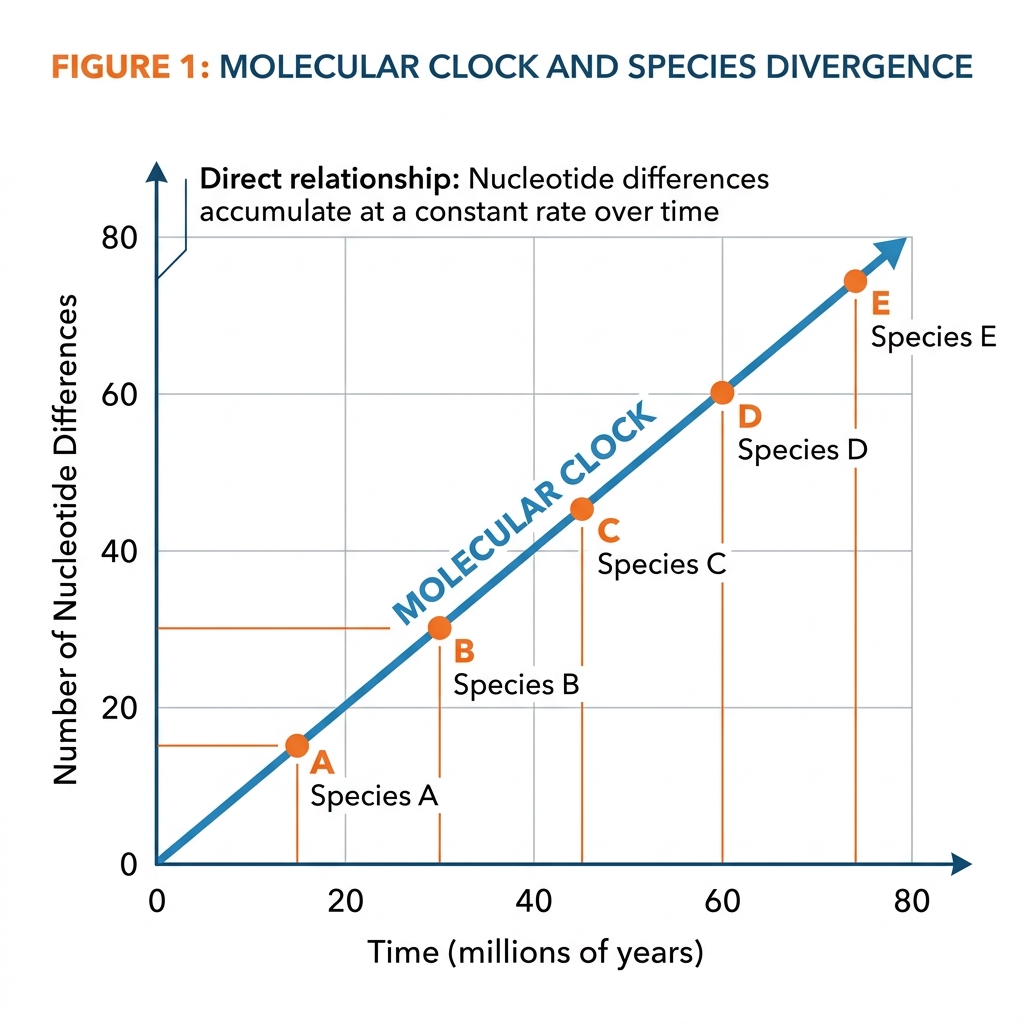
Key Understanding Sequence differences accumulate gradually so there is a positive correlation between the number of differences between two species and the time since they diverged from a common ancestor.
Mutations occur at a relatively constant rate over millions of years. This steady mutation rate acts as a molecular clock.
Application: Using Molecular Clocks
Deducing evolutionary divergence times from molecular clocks. Since mutations occur at a relatively constant rate, the number of differences in DNA or amino acid sequences can be used to estimate how long ago two species shared a common ancestor.
How it works:
If a specific gene mutates at a rate of 1 base pair per million years, and we find 10 differences between Species A and Species B, we can estimate they diverged approximately 10 million years ago.
Caution: Different genes mutate at different rates, and rates can vary between different groups of organisms. Molecular clocks provide estimates, not exact dates, and are often calibrated using fossil records.
A3.2.5 HL Only
Reclassification: The Figwort Family
Key Understanding Evidence from cladistics has shown that classifications of some groups based on structure did not correspond with the evolutionary origins of a group or species.
The Figwort family (Scrophulariaceae) was historically a large taxonomic family of flowering plants. It was classified primarily based on the shared morphological trait of having bilaterally symmetrical flowers.
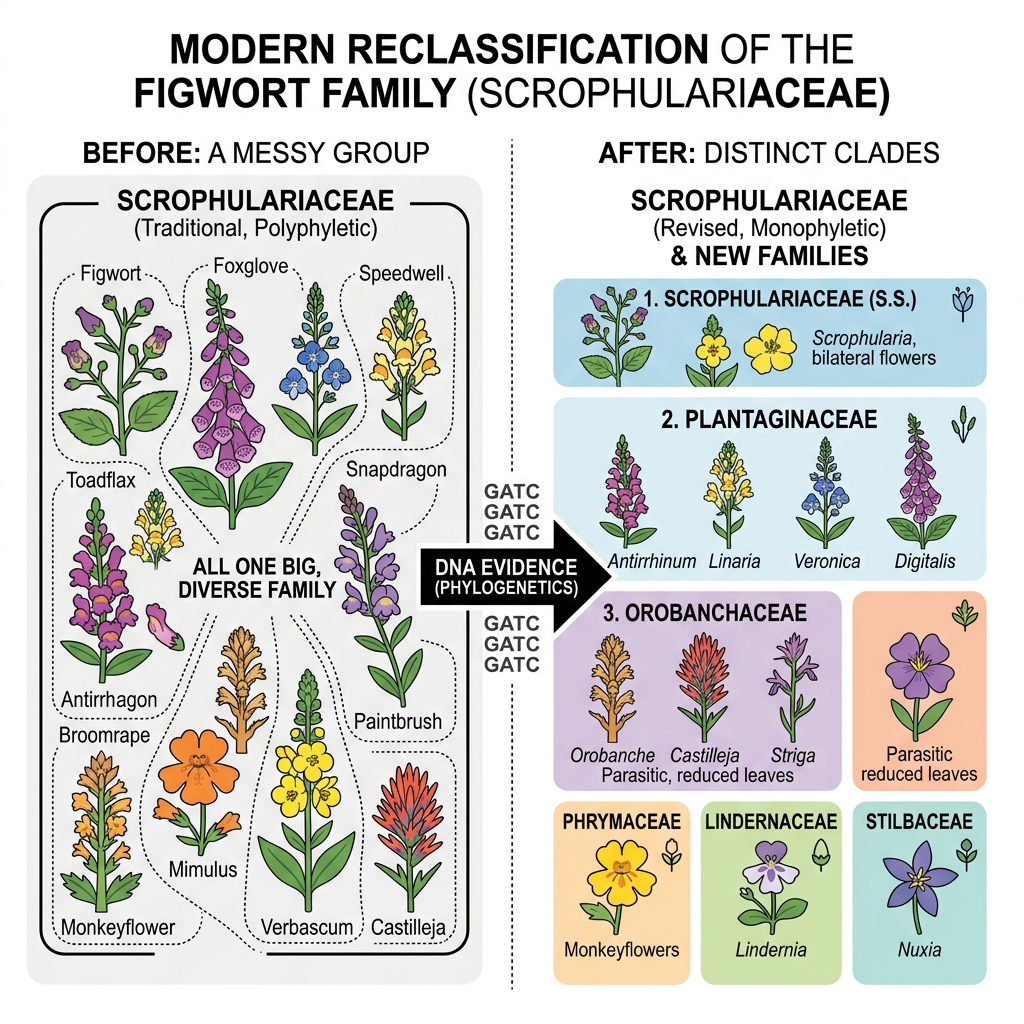
Case Study: DNA Changes Everything
When scientists analyzed the chloroplast DNA of various "figwort" species, they discovered the family was actually polyphyletic (containing species from different ancestral lineages). As a result, the massive traditional family was broken up into several smaller, true evolutionary clades (monophyletic groups), including Plantaginaceae and Orobanchaceae.
A3.2.6 HL Only
The Three-Domain System
Key Understanding All organisms are classified into three domains (Archaea, Bacteria, Eukaryota) based on evidence from rRNA base sequences.
Traditionally, life was divided into two main categories: Prokaryotes and Eukaryotes. However, cladistic analysis of ribosomal RNA (rRNA) genes revealed that prokaryotes are actually composed of two distinct evolutionary branches.
| Domain | Characteristics |
|---|
| Bacteria |
Prokaryotic cells, cell walls contain peptidoglycan. Formed the first major divergence in the tree of life. |
| Archaea |
Prokaryotic cells, unique cell membrane lipids, often extremophiles. More closely related to Eukaryotes than to Bacteria. |
| Eukaryota |
Cells with a membrane-bound nucleus and organelles (includes animals, plants, fungi, and protists). |
✅
A3.2 Classification & Cladistics Complete!
You have successfully reviewed all understandings for this HL Biology topic.