
IB DP Biology 2025: Evolution
A4.1 — Evolution & Speciation
Theme A: Form and Function · Standard & Higher Level
A4.1.1
Evolution as Change in Heritable Characteristics
Key Understanding Evolution occurs when there is a change in the heritable characteristics of a population over successive generations.
Evolution is fundamentally about genetic change. If a characteristic cannot be inherited, any change in it over time is not evolution.
Variation exists within a population (due to mutation, meiosis, sexual reproduction)
↓
Environmental pressures act on the population
↓
Individuals with favorable heritable traits survive and reproduce (Natural Selection)
↓
The frequency of those favorable alleles increases in the next generation
- Acquired characteristics (like a bodybuilder's muscles) are not heritable and thus do not contribute to evolution.
- Populations evolve, not individuals.
Application: Antibiotic Resistance
The rapid evolution of antibiotic resistance in bacteria is a prime example of natural selection in action. When exposed to antibiotics, susceptible bacteria die, while those with advantageous heritable mutations survive and multiply.
A4.1.2 / A4.1.3
Evidence: Molecules & Artificial Selection
A4.1.2 Evidence from base sequences of DNA/RNA and amino acid sequences.
A4.1.3 Evidence from selective breeding (artificial selection).
Molecular Evidence (DNA & Proteins):
All living organisms use the same genetic code (DNA/RNA) and the same 20 amino acids. By comparing the base sequences of DNA or the amino acid sequences of proteins (like cytochrome c) between species, we can determine evolutionary relationships.
- Fewer differences = More recent common ancestor.
- More differences = More distant common ancestor.
Artificial Selection:
Selective breeding of domesticated animals (e.g., dogs, cattle) demonstrates that populations can undergo significant changes in heritable characteristics in a short time frame when specific traits are selected by humans.
- Provides a visible model for natural selection.
- Shows that significant phenotypic variation is possible within a species.
A4.1.4 / A4.1.5
Homologous vs. Analogous Structures
Homologous Structures (A4.1.4)
Structures that share a similar fundamental anatomy, derived from a common ancestor, even if they have evolved different functions.
- Process: Divergent Evolution
- Example: Pentadactyl limb (human arm, whale flipper, bat wing, horse leg).
- Significance: Provides strong structural evidence for a shared evolutionary origin.
Analogous Structures (A4.1.5)
Structures that have similar functions but different underlying anatomies, evolving independently.
- Process: Convergent Evolution
- Example: Wings of birds vs. wings of insects.
- Significance: Shows that different species can independently adapt to similar environmental pressures in similar ways.
A4.1.6
Speciation
Key Understanding Speciation is the splitting of one species into two or more species.
Speciation occurs when populations of the same species become reproductively isolated and diverge over time, eventually becoming unable to interbreed and produce fertile offspring.
Single continuous population
↓
Reproductive isolation occurs (gene flow stops)
↓
Populations experience different selective pressures & genetic drift
↓
Significant genetic divergence
↓
New Species (cannot interbreed to produce fertile offspring)
A4.1.7
Allopatric vs. Sympatric Speciation
Key Understanding Reproductive isolation can be allopatric (geographic barrier) or sympatric (within the same geographic area).
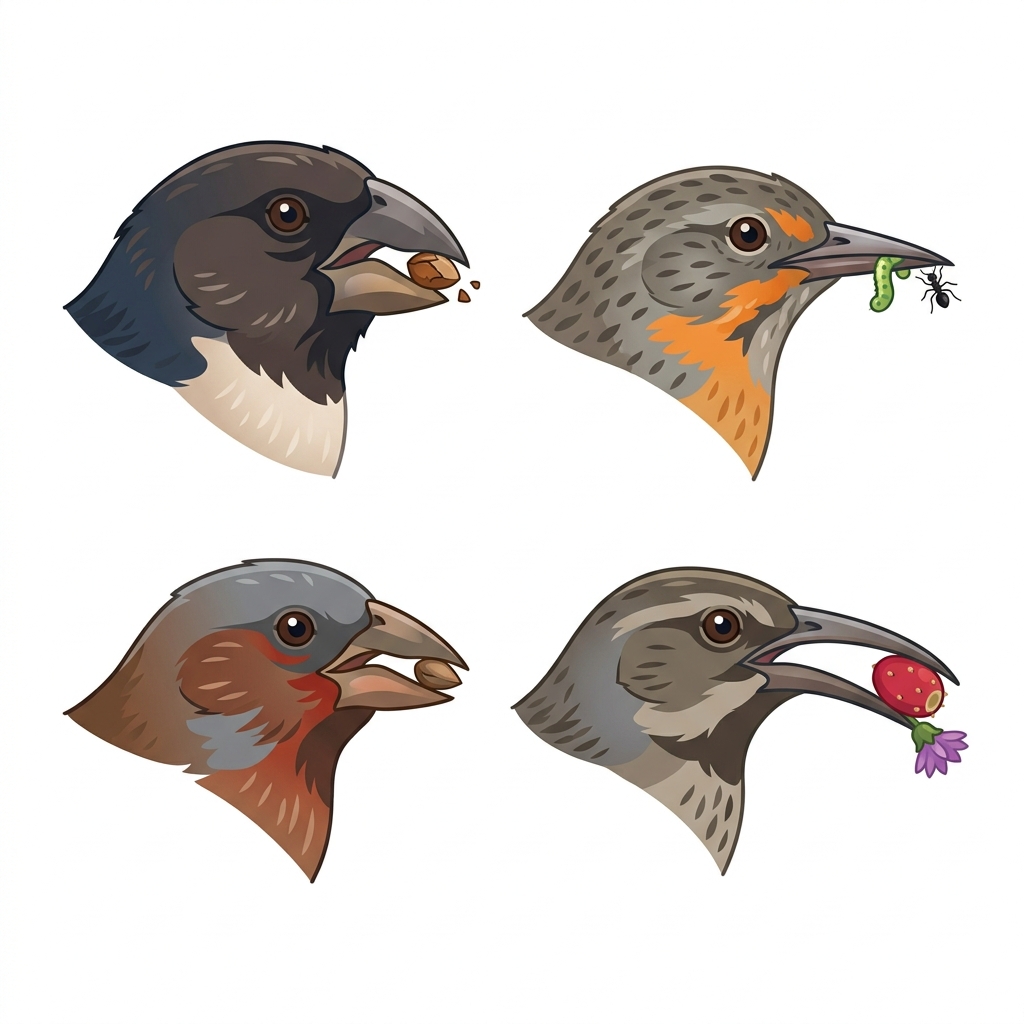
Skills: Galápagos Finches Data Analysis
Analyzing beak size data of Galápagos finches reveals how environmental changes (e.g., droughts affecting seed size) drive rapid evolutionary changes in heritable traits.
| Type | Mechanism | Example |
|---|
| Allopatric |
Populations are separated by a physical/geographic barrier (e.g., mountain, river, sea). |
Darwin's finches on different islands of the Galapagos. |
| Sympatric |
Populations diverge in the same geographic area without a physical barrier (e.g., behavioral, temporal, or genetic isolation). |
Apple maggot flies diverging based on preferred fruit type in the same orchard. |
A4.1.8 HL Only
Patterns of Selection
Key Understanding (HL) Differential selection can be directional, stabilizing, or disruptive.
Natural selection can shape populations in different ways depending on which phenotypes are favored by the environment.
| Type of Selection | Description | Example |
|---|
| Directional |
Favors one extreme phenotype. The population distribution shifts in one direction. |
Peppered moths becoming darker in polluted environments. |
| Stabilizing |
Favors intermediate phenotypes and acts against both extremes. Decreases variation. |
Human birth weights (too small or too large reduces survival). |
| Disruptive |
Favors both extreme phenotypes over the intermediate. Can lead to sympatric speciation. |
Seedcracker finches with either very large or very small beaks, but few intermediate. |
A4.1.9 HL Only
Polyploidy and Sympatric Speciation
Key Understanding (HL) Polyploidy can lead to sudden sympatric speciation, especially in plants.
Polyploidy is the condition of having more than two complete sets of chromosomes (e.g., 3n, 4n, 6n).
How it causes speciation:
- It occurs due to total non-disjunction of chromosomes during meiosis (or mitosis).
- A diploid gamete (2n) fusing with a normal haploid gamete (n) produces a triploid (3n) zygote. Triploids are usually sterile.
- A diploid gamete (2n) fusing with another diploid gamete (2n) produces a tetraploid (4n) plant.
- The tetraploid (4n) plant is reproductively isolated from the original diploid (2n) population because their offspring (3n) would be sterile.
- This creates a new species instantly within the same geographic area (Sympatric Speciation).
Exam Tip: Polyploidy is very common in plants (e.g., Allium genus like onions/garlic, and modern wheat) but rare in animals.
A4.1.10 HL Only
Rates of Speciation
Key Understanding (HL) Speciation can occur gradually (gradualism) or abruptly (punctuated equilibrium).
Gradualism
Evolution occurs through the slow, steady, and continuous accumulation of small changes over long periods of time.
- Supported by intermediate transitional fossils.
- Classic Darwinian view.
Punctuated Equilibrium
Species remain stable for long periods (stasis), punctuated by short, rapid bursts of significant evolutionary change and speciation.
- Often triggered by sudden environmental changes (e.g., meteor impact, volcanic activity).
- Explains gaps in the fossil record.
✅
A4.1 Evolution Complete!
You have successfully reviewed all SL and HL understandings for Biology Theme A4.1.