
IB DP Biology 2025: Unity and Diversity
A4.2 — Conservation of Biodiversity
Theme A: Ecosystems · Standard & Higher Level
A4.2.1
Levels of Biodiversity
Key UnderstandingBiodiversity is the variety of life in all forms, levels, and combinations, including ecosystem, species, and genetic diversity.
Biological diversity (biodiversity) is a multi-dimensional concept that operates at different biological scales.
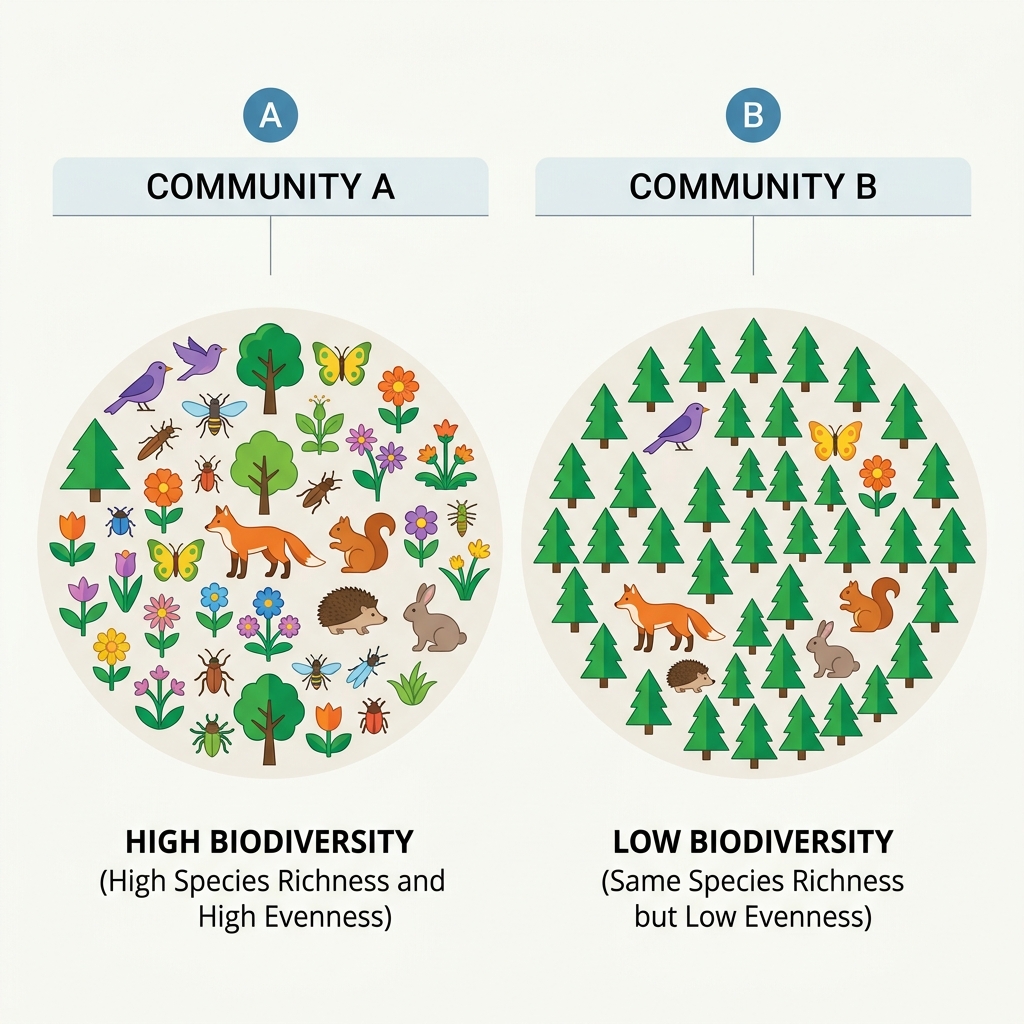
Ecosystem Diversity
The variety of habitats, communities, and ecological processes in the biosphere.
Species Diversity
The number of different species (richness) and their relative abundance (evenness) in a community.
Genetic Diversity
The total number of genetic characteristics in the genetic makeup of a species.
A4.2.2
The Biodiversity Crisis & Extinction
Key UnderstandingCurrent species numbers and extinction rates are much higher than past/background levels, signaling a biodiversity crisis.
Scientists evaluate evidence for a "sixth mass extinction" caused primarily by human activities.
Natural Background Extinction Rate
↓
Anthropogenic pressures (Human Impact)
↓
Accelerated Extinction Rates (100-1000x higher than background)
- Overexploitation: Unsustainable harvesting of species (e.g., overfishing, poaching).
- Invasive Species: Introduction of non-native species that outcompete native flora/fauna.
- Pollution: Contaminants affecting reproductive success or survival.
- Climate Change: Rapidly altering habitats faster than species can adapt.
A4.2.3
Ecosystem Loss & Fragmentation
Key UnderstandingHabitat destruction and fragmentation lead to ecosystem loss and increased edge effects.
When continuous habitats are broken into smaller, isolated patches, it profoundly impacts the species within them.

Edge Effects:
The boundary between a forest and surrounding altered land (e.g., agriculture) has different conditions (more wind, light, lower humidity). Fragmentation increases the ratio of edge to core habitat, reducing the habitable area for core-dependent species.
A4.2.4
Conservation Strategies
Key UnderstandingConservation methods are categorized as in-situ (on-site) and ex-situ (off-site), each with advantages and limitations.

In-situ (On-site)
Protecting species in their natural habitats (e.g., National Parks, Marine Reserves).
- Allows species to interact naturally and evolve.
- Protects the whole ecosystem, not just target species.
- Harder to manage threats like poaching or climate change.
Ex-situ (Off-site)
Conserving species outside their natural habitats (e.g., Zoos, Seed Banks, Botanical Gardens).
- Provides intensive care, captive breeding, and research opportunities.
- Protects from immediate threats in the wild.
- Loss of natural behaviors and expensive to maintain.
A4.2.5
Conservation Prioritization
Key UnderstandingWith limited resources, conservationists must prioritize which species or areas to save.
Not all species can be saved with equal effort. Organizations use frameworks to determine priorities.
EDGE of Existence Programme: Focuses on species that are Evolutionarily Distinct and Globally Endangered. These species have few close relatives on the tree of life (e.g., the Pangolin or the Tuatara). If they go extinct, an entire evolutionary lineage is lost.
- Hotspots: Prioritizing regions with high levels of endemic species that are under severe threat.
- Keystone Species: Protecting species whose removal would cause ecosystem collapse.
A4.2.6 HL Only
Quantifying Biodiversity
Key Understanding (HL) Using biodiversity indices to quantitatively evaluate the health of ecosystems.
Ecologists use mathematical formulas to measure diversity, combining both species richness and species evenness into a single index.
Mathematical Skills: Calculating Diversity Indices
Use Simpson's Reciprocal Diversity Index and Shannon diversity to compare ecosystems.
- Simpson's Reciprocal Index: $D = \frac{N(N-1)}{\sum n(n-1)}$
- Shannon Diversity Index: $H' = -\sum_{i=1}^{S} p_i \ln p_i$ (where $p_i = \frac{n_i}{N}$)
Application:
Comparing these indices helps in monitoring environmental change, assessing the impact of conservation efforts, and determining the stability of an ecosystem.
A4.2.7 HL Only
Indicator and Keystone Species
Key Understanding (HL) Using specific species to evaluate evidence regarding ecosystem health and biodiversity status.
Indicator Species: Highly sensitive to environmental changes (e.g., lichens to air pollution, amphibians to water quality). Their presence or absence provides a rapid assessment of ecosystem health.
↓
Keystone Species: Species that have a disproportionately large effect on their environment relative to their abundance.
Case Study - Sea Otters: Sea otters are a keystone species in kelp forests. They prey on sea urchins. Without otters, urchin populations explode and destroy the kelp, leading to a collapse of the entire ecosystem.
✅
A4.2 Conservation Complete!
You have successfully reviewed all SL and HL understandings for Biology Theme A4.2.