IB DP Environmental Systems & Societies
Perspectives
Subtopic 1.1 — New Syllabus (First Assessment 2026)
Standard Level (SL)
🧠
11 Syllabus Points
1.1.1 – 1.1.10
📊
Core Content Focus
Environmental Value Systems (EVS)
1.1.1
What Is a Perspective?
Key UnderstandingA perspective is how a particular situation is viewed and understood by an individual. It is based on a mix of personal and collective assumptions, values, and beliefs.
What Shapes a Perspective?
- Personal experience: direct encounters with environmental issues
- Cultural background: traditions, norms, and values of the community
- Education: formal and informal learning about the environment
- Social context: family, peers, media influence
- Geographic location: urban vs rural, developed vs developing
Key point: No two individuals have exactly the same perspective, even when raised in the same environment. Perspectives are shaped by the unique intersection of all the factors above.
1.1.2
Factors Informing Perspectives
Key UnderstandingPerspectives are informed and justified by sociocultural norms, scientific understandings, laws, religion, economic conditions, local and global events, and lived experience, among other factors.
| Factor | How It Shapes Perspectives | Example |
|---|---|---|
| Sociocultural norms | Cultural values dictate what is "normal" or "acceptable" | Attitudes to wildlife differ between indigenous and urban societies |
| Scientific understanding | Evidence changes what people believe is happening | Climate data shifts perspectives on fossil fuel use |
| Laws and policies | Legal frameworks shape what is permitted | Plastic bans change attitudes to single-use plastics |
| Religion | Beliefs about humanity's role in nature | Stewardship ethic vs dominion over nature |
| Economic conditions | Poverty vs wealth changes environmental priorities | Developing nations may prioritize growth over conservation |
| Events | Major disasters shift public opinion | Oil spills → increased environmental awareness |
| Lived experience | Direct exposure to environmental change | Farmers in drought-affected areas view water differently |
Exam questions may ask you to explain why two different groups hold different perspectives on the same environmental issue. Use this table to identify relevant factors.
1.1.3
Values
Key UnderstandingValues are qualities or principles that people feel have worth and importance in life.
What Are Values?
- Core beliefs about what matters most
- Guide behaviour and decision-making
- Developed through socialization and experience
- Can be individual or shared by groups
- Are relatively stable but can change over time
Examples of Environmental Values
- Conservation: protecting nature for its own sake
- Preservation: keeping wilderness untouched
- Utilitarian: nature has value because it provides resources
- Aesthetic: nature is beautiful and worth protecting
- Economic: environment = financial asset
Values underpin perspectives — understanding someone's values helps you understand why they hold a particular perspective on environmental issues.
1.1.4
Values in Action
Key UnderstandingThe values that underpin our perspectives can be seen in our communication and actions with the wider community. The values held by organizations can be seen through advertisements, media, policies and actions.
Individual Values → Actions
- Recycling behaviour reflects environmental values
- Consumer choices (organic, fair trade) signal priorities
- Protest and activism express deeply held values
- Voting patterns reflect environmental priorities
Organizational Values → Communication
- Advertisements: what a company promotes reveals its priorities
- Media: how issues are framed reflects underlying values
- Policies: environmental regulations reveal societal values
- Corporate actions: CSR reports, sustainability goals
1.1.5
Investigating Perspectives with Values Surveys
Key UnderstandingValues surveys can be used to investigate the perspectives shown by a particular social group towards environmental issues.
How Values Surveys Work
- Questionnaires or interviews designed to reveal underlying values
- Can compare perspectives between different social groups
- May use Likert scales, ranking exercises, or open-ended questions
- Results help identify patterns in environmental attitudes
Example: Comparing Two Groups
A survey might ask: "How important is economic growth compared to protecting the environment?" Results could reveal that urban professionals value conservation more than rural farmers who depend on resource extraction.
In the exam, you may be asked to design or evaluate a values survey. Consider: sample size, representativeness, question design, and potential biases.
1.1.6
Environmental Worldviews
Key UnderstandingWorldviews are the lenses shared by groups of people through which they perceive, make sense of, and act within their environment. They shape people's values and perspectives through culture, philosophy, ideology, religion and politics.
What Is an Environmental Worldview?
An environmental worldview is a set of assumptions and beliefs about how the world works and humanity's relationship with nature. It acts as a lens through which all environmental information is interpreted.
Key distinction: A perspective is an individual's view; a worldview is a shared lens held by a group. Worldviews shape the values that underpin individual perspectives.
1.1.7
The Environmental Value System
Key UnderstandingAn environmental value system (EVS) is a model that shows the inputs affecting our perspectives and the outputs resulting from our perspectives.
EVS Model
Inputs (culture, education, experience, media) → Perspective → Actions & Communication
Inputs → Perspective → Outputs
Inputs (shaping perspective):
- Cultural traditions
- Education system
- Media coverage
- Personal experiences
- Religious beliefs
- Scientific knowledge
Outputs (from perspective):
- Behaviour and lifestyle choices
- Consumer decisions
- Voting patterns
- Communication with others
- Advocacy and activism
- Career choices
1.1.8
Three Environmental Perspectives
Key UnderstandingEnvironmental perspectives (worldviews) can be classified into the broad categories of technocentric, anthropocentric, and ecocentric.
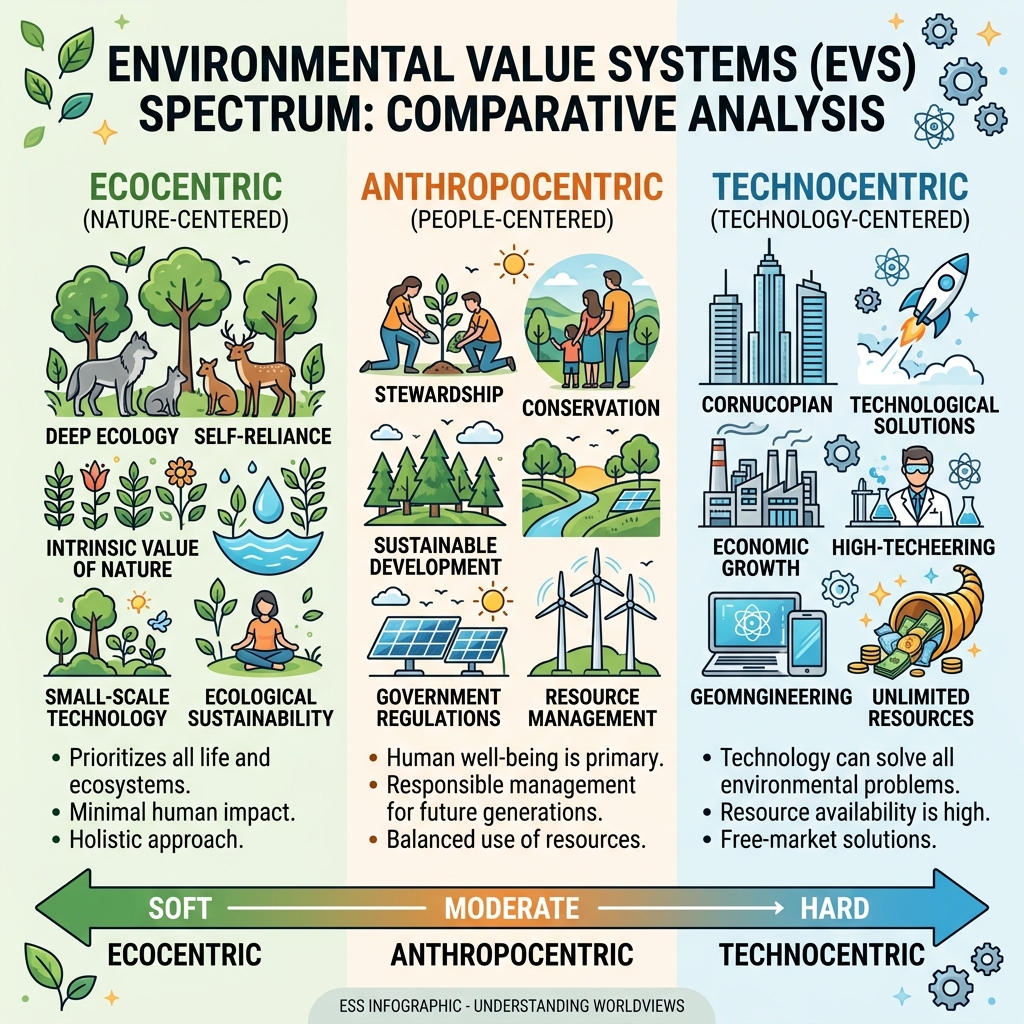
| Perspective | Core Belief | Attitude to Nature | Solution Approach |
|---|---|---|---|
| Technocentric | Technology can solve environmental problems | Nature is a resource to be managed | Innovation, engineering, market solutions |
| Anthropocentric | Human needs come first | Nature has instrumental value (useful to humans) | Balancing human needs with environmental protection |
| Ecocentric | All living things have intrinsic value | Nature has value independent of human use | Conservation, preservation, reduced consumption |
⚙️
Technocentric
"Humanity will innovate its way out of problems"
🧑
Anthropocentric
"Nature matters because humans depend on it"
🌍
Ecocentric
"All life has value, regardless of human utility"
Exam questions often ask you to classify a given statement or policy as technocentric, anthropocentric, or ecocentric. Look at WHO benefits and what is being valued.
1.1.9
How Perspectives Change
Key UnderstandingPerspectives and the beliefs that underpin them change over time in all societies. They can be influenced by government or NGO campaigns or through social and demographic change.
What Drives Change in Perspectives?
- Government campaigns: policy shifts, public awareness programs
- NGO campaigns: Greenpeace, WWF raising awareness
- Social change: generational shifts (younger generations often more environmental)
- Demographic change: urbanization, migration, education levels
- Technology: access to information changes understanding
- Media: documentaries (e.g., Blue Planet II → plastic awareness)
1.1.10
The Environmental Movement
Key UnderstandingThe development of the environmental movement has been influenced by individuals, literature, the media, major environmental disasters, international agreements, new technologies and scientific discoveries.
Key Influences on the Environmental Movement
| Influence | Example | Impact |
|---|---|---|
| Individuals | Rachel Carson, David Attenborough, Greta Thunberg | Public figures who changed attitudes |
| Literature | Silent Spring (Carson, 1962) | Exposed DDT dangers → pesticide regulation |
| Media | Blue Planet II (2017) | Global plastic awareness movement |
| Disasters | Chernobyl (1986), Deepwater Horizon (2010) | Increased scrutiny of energy industries |
| Agreements | Paris Agreement (2015), Montreal Protocol (1987) | International coordinated action |
| Technology | Satellite monitoring, social media | Made environmental data accessible |
| Science | Climate change research, ozone layer discovery | Provided evidence for policy change |
For exams, be ready to name at least 2–3 specific influences and explain how they shifted environmental perspectives.
Glossary
Key Terms
| Term | Definition |
|---|---|
| Perspective | How a situation is viewed, based on assumptions, values and beliefs |
| Value | A quality or principle felt to have worth and importance |
| Worldview | A shared lens through which a group perceives and acts in the environment |
| EVS | Environmental Value System — a model of inputs → perspective → outputs |
| Technocentric | Belief that technology can solve environmental problems |
| Anthropocentric | Human-centred perspective; nature valued for human benefit |
| Ecocentric | Nature-centred perspective; all life has intrinsic value |
| Environmental movement | Social movement focused on protecting the natural environment |
You've covered all 11 syllabus points ✅
1.1.1 – 1.1.10