Systems Thinking
Subtopic 1.2 — New Syllabus (First Assessment 2026)
Standard Level + Higher Level
How do systems function and how can systems thinking help us understand environmental issues?
A. Systems (Syllabus points 1.2.1–1.2.9)
Foundations — what systems are, how they are structured, modelled, and described.
B. Feedback Loops (Syllabus points 1.2.10–1.2.13)
Mechanisms — how systems self-regulate or amplify change.
C. System Resilience (Syllabus points 1.2.14–1.2.18)
Adaptation — how systems absorb disturbance, shift states, and integrate human dimensions.
Systems thinking is a conceptual framework that examines how components within a system interact to produce behaviour that cannot be understood by looking at individual parts in isolation. In Environmental Systems and Societies (ESS), systems thinking is the foundational approach for understanding all environmental interactions — from nutrient cycles in ecosystems to global climate dynamics.
What is an Environmental System?
An environmental system is a collection of components that interact with each other and their physical environment to form a functional whole.
1. Interactions — components influence each other
2. Interdependence — components rely on one another for function
3. Complexity — the number and nature of interactions create non-linear behaviour
Examples of Environmental Systems
| System | Components | Interactions |
|---|---|---|
| Forest ecosystem | Trees, soil, fungi, insects, water cycle, sunlight | Nutrient cycling, competition, predation, photosynthesis |
| Urban drainage system | Impervious surfaces, drains, rivers, groundwater | Runoff, infiltration, flooding, sediment transport |
| Global carbon system | Atmosphere, oceans, biosphere, lithosphere | Photosynthesis, respiration, combustion, dissolution |
Structure, Function, and Emergent Properties
Systems have three fundamental characteristics: structure (what it is), function (what it does), and emergent properties (what arises from interactions).
| Characteristic | Definition | Example (Lake Ecosystem) |
|---|---|---|
| Structure | The components and their relationships | Fish, algae, zooplankton, dissolved oxygen, nutrients, sediment |
| Function | Energy flows and matter cycling through the system | Sunlight → algae photosynthesis → zooplankton grazing → fish predation → decomposition → nutrient recycling |
| Emergent Properties | Properties arising from interactions that do not exist in individual components | Water clarity, species diversity, trophic stability, primary productivity |
Another Example: Wetland Water Purification
A wetland's ability to filter pollutants is an emergent property. No single plant, microbe, or sediment grain can filter water alone — it is the combination of microbial decomposition in anaerobic sediments, nutrient uptake by plants, and physical filtration by root networks that produces this function.
Open, Closed, and Isolated Systems
Systems are classified by how they exchange energy and matter with their surroundings.
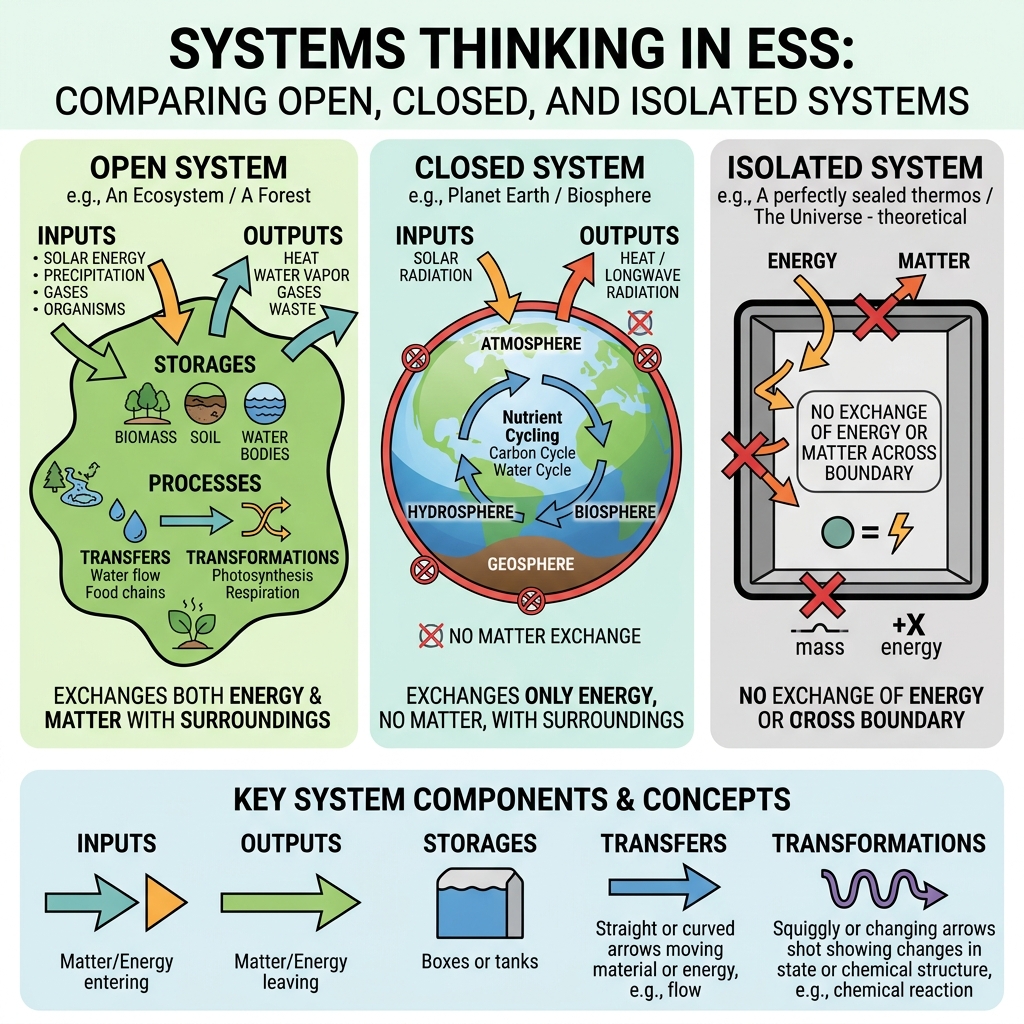
| System Type | Energy Exchange | Matter Exchange | Real-World Example |
|---|---|---|---|
| Open system | Yes | Yes | Most natural systems — e.g., forest (receives sunlight, exchanges water vapour, nutrients) |
| Closed system | Yes | No | Earth as a whole (energy in/out via radiation; matter largely conserved except for meteorites) |
| Isolated system | No | No | Theoretical only — no real system is truly isolated. Sometimes used as a simplification. |
Modelling Systems
Systems can be modelled using diagrams, mathematical equations, and computer simulations. Models simplify reality to help us understand complex interactions.
| Model Type | Description | Strengths | Limitations |
|---|---|---|---|
| Physical model | Tangible, scaled representation (e.g., a diorama, a wind tunnel model) | Intuitive; allows direct observation | Cannot capture all interactions; expensive to build |
| Conceptual model | Diagrammatic representation (e.g., systems diagram, food web) | Visualises relationships; identifies feedback loops | Qualitative; may oversimplify |
| Mathematical model | Equations describing relationships (e.g., population growth models) | Precise; testable; predictive | Requires data; sensitive to assumptions |
| Computer simulation | Programmed model that can run scenarios (e.g., climate models) | Can handle large complexity; scenario testing | "Black box" problem; requires technical expertise |
Systems Thinking
Systems thinking involves understanding how parts of a system interact to produce emergent properties. It requires looking at the whole system, not just individual components.
Key Principles of Systems Thinking
- Holism — the whole is greater than the sum of its parts
- Interconnectedness — changing one component affects others
- Non-linearity — cause and effect are not always proportional or immediate
- Feedback — outputs become inputs, creating circular causation
- Mental models — our understanding of systems shapes how we act within them
Example: Deforestation Through a Systems Lens
A reductionist approach might focus on the number of trees cut. A systems thinking approach would consider:
- Links between logging companies, local communities, and global timber markets
- Soil erosion affecting downstream agriculture
- Reduced transpiration affecting regional rainfall
- Loss of biodiversity reducing ecosystem services (pollination, water purification)
- Carbon release contributing to climate change, which feeds back to affect forests
Inputs, Processes, Outputs, and Feedback
Any system can be described in terms of inputs, processes (throughputs), outputs, and feedback.
Energy, matter, information
Transformations within the system
Products, waste, heat
Output influences future inputs
| Element | Definition | Example: Forest Ecosystem |
|---|---|---|
| Input | What enters the system from outside | Solar radiation, rainfall, atmospheric CO₂ |
| Process | What happens inside the system | Photosynthesis, decomposition, nutrient cycling, growth, predation |
| Output | What leaves the system | Evapotranspiration, leaf litter, oxygen, heat |
| Feedback | How outputs influence future system behaviour | Increased CO₂ → increased growth → more shade → reduced understorey growth |
Hierarchical Systems
Systems are hierarchical — they are composed of smaller subsystems, and they are nested within larger supersystems.
(Supersystem)
(System)
(Subsystem)
(Sub-subsystem)
Hierarchy in Practice
| Level | Example | Emergent Properties at This Level |
|---|---|---|
| Individual | A single oak tree | Growth rate, photosynthetic efficiency |
| Population | All oak trees in a forest | Population density, age structure, carrying capacity |
| Community | All species in a forest | Species diversity, trophic structure, competitive exclusion |
| Ecosystem | Forest + soil + climate + hydrology | Nutrient cycling, primary productivity, energy flow |
| Biosphere | All ecosystems on Earth | Global biogeochemical cycles, climate regulation |
System Boundaries
Boundaries define what is inside and outside a system. They can be real (physical — e.g., a shoreline) or conceptual (imposed by the observer — e.g., defining "a wetland").
Factors Influencing Boundary Selection
- Purpose of study — what question are we asking?
- Feasibility — can data realistically be collected within the boundary?
- Relevance — does the boundary capture the key interactions?
- Scale — local, regional, or global?
Example: Water Quality Study
| Boundary Choice | Advantage | Limitation |
|---|---|---|
| Single farm paddock | Detailed data; direct land management link | Misses upstream/downstream effects |
| Entire river catchment | Captures all inputs and outputs | Data-intensive; harder to isolate causes |
| Political boundary (e.g., county) | Aligns with governance and policy | May not reflect natural system dynamics |
Stocks and Flows
A system's state can be described by its stocks (accumulations of matter, energy, or information) and flows (rates at which stocks change).
| System | Stock | Inflow(s) | Outflow(s) |
|---|---|---|---|
| Population | Number of individuals | Births, immigration | Deaths, emigration |
| Lake | Volume of water | Rainfall, river inflow, groundwater | Evaporation, outflow, seepage |
| Atmospheric CO₂ | Concentration (ppm) | Respiration, combustion, deforestation | Photosynthesis, ocean absorption |
| Soil nutrients | Nutrient concentration | Decomposition, fertiliser application | Plant uptake, leaching, erosion |
Feedback — An Overview
Feedback occurs when the output of a system feeds back as an input, modifying the system's subsequent behaviour. Feedback is what makes systems dynamic rather than linear.
| Type | Effect | Result | Analogy |
|---|---|---|---|
| Negative feedback | Opposes change | Stabilisation; equilibrium | Thermostat — when temperature rises, heating turns off |
| Positive feedback | Amplifies change | Destabilisation; runaway change; potential tipping points | Microphone feedback — small signal → louder → louder → screech |
Negative Feedback
Negative feedback opposes change and tends to stabilise systems by returning them to their original state after a disturbance. It maintains equilibrium.
Case Study: Predator–Prey Dynamics (Canadian Lynx and Snowshoe Hare)
This creates a cyclical, self-regulating oscillation that has been documented in Hudson Bay Company fur records spanning over 200 years.
Other Examples of Negative Feedback
| System | Negative Feedback Mechanism |
|---|---|
| Human body | Body temperature rises → sweat glands activated → evaporative cooling → temperature returns to normal |
| Ocean pH | Increased CO₂ → ocean absorbs more → CO₂ dissolves → atmospheric CO₂ decreases |
| Grassland | Overgrazing → grass biomass declines → livestock food availability drops → grazing pressure reduces → grass recovers |
| Atmosphere | Higher temperature → increased evaporation → more clouds → more solar reflection → temperature decreases |
Positive Feedback
Positive feedback amplifies change and tends to destabilise systems, potentially pushing them past tipping points to new, often irreversible states.
Case Study: Ice-Albedo Feedback (Arctic)
This loop accelerates warming in the Arctic far faster than the global average — a phenomenon known as Arctic amplification.
Other Examples of Positive Feedback
| System | Positive Feedback Mechanism | Potential Tipping Point |
|---|---|---|
| Permafrost | Warming → permafrost thaws → releases CH₄ and CO₂ → more warming | Large-scale permafrost collapse; irreversible carbon release |
| Deforestation | Forest cleared → less transpiration → less rainfall → drier conditions → more forest stress and fire | Savannification of tropical forest (e.g., Amazon) |
| Ocean circulation | Ice sheet melt → freshwater inflow → reduced thermohaline circulation → altered climate patterns | Collapse of Atlantic Meridional Overturning Circulation (AMOC) |
Multiple Feedback Loops
Most real systems have both positive and negative feedback operating simultaneously. The balance between them determines overall system behaviour.
Case Study: Coral Reef System
| Feedback Type | Mechanism | Effect |
|---|---|---|
| Negative | Herbivorous fish graze algae → prevents algal overgrowth → coral recruits successfully | Stabilises reef; maintains coral dominance |
| Negative | Coral growth provides structural habitat → supports fish populations → more herbivory | Self-reinforcing stability |
| Positive | Coral bleaching → less live coral → fewer fish → less herbivory → more algae → less coral recovery | Accelerates degradation; potential phase shift |
| Positive | Warming → bleaching → reduced photosynthesis → less energy for reproduction → fewer coral larvae | Reduces recovery capacity |
System Resilience
System resilience is the ability of a system to recover from disturbance and return to its original state. A resilient system absorbs change without fundamentally altering its structure and function.
Resilience vs. Resistance
| Property | Definition | Example |
|---|---|---|
| Resistance | Ability to withstand disturbance without change | A hardwood forest resisting a small fire |
| Resilience | Ability to recover after disturbance | A grassland regrowing after fire |
A system can be highly resilient (recovers quickly) but not very resistant (changes easily), or vice versa. These are different properties.
Factors Affecting Resilience
Three key properties determine a system's resilience:
| Factor | Definition | How It Builds Resilience | Example |
|---|---|---|---|
| Biodiversity | Number and variety of species | More species = more functional alternatives; if one species declines, others can fill its role | Tropical rainforest — thousands of species mean high functional redundancy in pollination |
| Connectivity | How components are linked | High connectivity allows rapid transfer of energy/matter/information; can also spread disturbance | Coral reef channels connecting lagoon and open ocean maintain larval supply |
| Redundancy | Duplication of functional roles | Multiple species performing the same function means loss of one is not catastrophic |
Connectivity: A Double-Edged Sword
While high connectivity generally supports resilience, it can also allow disturbances to spread more rapidly. For example, highly connected food webs can transmit disease faster, and interconnected financial markets can propagate economic crises.
Tipping Points
A tipping point is a threshold beyond which a system shifts to a new state, often irreversibly. Once crossed, the system reorganises around new feedback loops that maintain the new state.
Case Studies of Tipping Points
| System | Tipping Point Trigger | New State | Reversibility |
|---|---|---|---|
| Coral reef | Chronic thermal stress (repeated bleaching) | Algal-dominated reef | Very difficult — recovery takes decades if possible |
| Lake eutrophication | Nutrient loading exceeds absorption capacity | Hypoxic, algae-dominated lake | Difficult — requires sustained nutrient reduction over years |
| Savannification of Amazon | Deforestation + drought reduces rainfall below threshold | Savanna / grassland | Largely irreversible at human timescales |
| Arctic sea ice | Ice-albedo feedback amplifies warming | Ice-free Arctic summers | Possible if emissions reduced, but uncertain timescale |
| Groundwater depletion | Extraction exceeds recharge rate for extended period | Compaction, land subsidence | Permanent — aquifer structure is physically destroyed |
Social-Ecological Systems
A social-ecological system (SES) is a system that integrates human (social) and natural (ecological) components. Most environmental issues occur within social-ecological systems.
Example: Coastal Fisheries
(Ecological component)
(Social component)
(Institutional component)
| Component Type | Elements | Interactions |
|---|---|---|
| Ecological | Fish populations, marine habitats, ocean currents, food webs | Spawning cycles, trophic cascades, habitat degradation |
| Social | Fishing communities, cultural traditions, livelihoods, food security | Economic dependence, traditional knowledge, overfishing pressure |
| Institutional | Fishing quotas, marine protected areas, trade agreements, subsidies | Regulation effectiveness, enforcement, political will |
Overfishing is not just a biological problem — it emerges from the interaction of economic incentives, cultural practices, governance structures, and ecological dynamics. Solutions must address all these dimensions.
Applying Systems Thinking to Real-World Issues
Systems thinking can be applied to real-world environmental issues using systems diagrams that identify components, flows, and feedback loops.
Case Study: Climate Change
Key Feedback Loops in Climate Change
| Feedback | Type | Mechanism |
|---|---|---|
| Ice-albedo | Positive | Warming → ice loss → darker surface → more absorption → more warming |
| Water vapour | Positive | Warming → more evaporation → more water vapour (greenhouse gas) → more warming |
| Cloud formation | Negative (uncertain) | Warming → more clouds → more reflection → cooling |
| Plant growth | Negative | Higher CO₂ → increased photosynthesis → more CO₂ absorbed |
Case Study: Deforestation in the Amazon
| Component | Role in System |
|---|---|
| Forest | Carbon sink, water recycler, biodiversity reservoir |
| Agriculture (cattle/soy) | Economic driver of deforestation |
| Rainfall | Dependent on forest transpiration (50% of Amazon rainfall is recycled by the forest) |
| Fire | Both consequence and cause of deforestation (positive feedback) |
| Local communities | Dependent on forest for livelihoods; affected by land-use change |
| Global market | Drives demand for beef and soy; creates economic incentive for deforestation |
Case Study: Integrated Water Resource Management
| System Component | Interactions |
|---|---|
| Groundwater | Stock depleted by extraction; recharged by rainfall infiltration |
| Agriculture | Major consumer; returns nutrients and pesticides to water |
| Urban areas | Impervious surfaces increase runoff; wastewater treatment plants |
| Ecosystems | Depend on environmental flows; provide water purification services |
| Policy | Water allocation, quality standards, pricing mechanisms |
Key Terms & Definitions
| Term | Definition |
|---|---|
| System | A collection of components that interact with each other and their environment to form a functional whole. |
| Environmental system | A system in which natural components (biotic and abiotic) interact with each other and with human activities. |
| Emergent property | A property that arises from the interactions of components within a system but does not exist in any individual component. |
| Open system | A system that exchanges both energy and matter with its surroundings. Most natural systems are open. |
| Closed system | A system that exchanges energy but not matter with its surroundings. Earth is approximately a closed system with respect to matter. |
| Isolated system | A system that exchanges neither energy nor matter with its surroundings. Theoretical only — no true isolated systems exist. |
| Model | A representation of a system used to understand, predict, or manage its behaviour. Can be physical, conceptual, mathematical, or computer-based. |
| Systems thinking | An approach to understanding phenomena by examining how components interact within a system to produce emergent properties. |
| Input | Energy, matter, or information that enters a system from outside its boundary. |
| Output | Energy, matter, or information that leaves a system through its boundary. |
| Feedback | A process in which the output of a system feeds back as an input, modifying the system's subsequent behaviour. |
| Negative feedback | Feedback that opposes a change, tending to stabilise a system and maintain it near equilibrium. |
| Positive feedback | Feedback that amplifies a change, tending to destabilise a system and potentially push it past a tipping point. |
| Stock | An accumulation of matter, energy, or information within a system at a given point in time. |
| Flow | The rate of change of a stock — the movement of matter, energy, or information into or out of a stock. |
| Resilience | The ability of a system to absorb disturbance and recover to its original state. |
| Tipping point | A threshold beyond which a system undergoes a significant, often irreversible shift to a new state. |
| Social-ecological system | A system that integrates human (social) and natural (ecological) components, recognising their interdependence. |
| Boundary | The conceptual or physical limit that defines what is inside and outside a system. |
| Hierarchical | Organised in levels, with smaller subsystems nested within larger systems. Each level has its own emergent properties. |
| Dynamic equilibrium | A state in which the stocks of a system remain constant because inflows equal outflows, despite ongoing processes. |
| Hysteresis | The phenomenon where the effort required to reverse a system shift is greater than the effort that caused it. |
| Reductionism | An approach that studies a system by breaking it into its individual components (contrast: systems thinking). |
Command Terms & Common Patterns
Command Terms in 1.2
| Command Term | What to Do | Example |
|---|---|---|
| Define | Give the meaning of a term precisely | "Define the term emergent property." |
| Describe | Give an account of features | "Describe a negative feedback loop in an ecosystem." |
| Explain | Give reasons or account for how/why something occurs | "Explain how positive feedback can lead to a tipping point." |
| Outline | Briefly describe or give main features | "Outline the factors that affect system resilience." |
| Distinguish | Identify differences between two or more items | "Distinguish between open and closed systems." |
| Compare | Identify similarities AND differences | "Compare positive and negative feedback." |
| Evaluate | Make judgements using evidence and criteria | "Evaluate the effectiveness of systems models in predicting environmental change." |
| Apply | Use knowledge in a new context | "Apply systems thinking to analyse a case study of your choice." |
Common Question Patterns
| Question Type | Strategy |
|---|---|
| Draw/label a systems diagram | Include: components (boxes), flows (arrows), feedback loops (circular arrows), boundary. Label clearly. Use a case study you know well. |
| Identify feedback types | Read the scenario carefully. If the process opposes change → negative. If it amplifies change → positive. Always explain WHY it is positive/negative. |
| Explain resilience | Define resilience. Identify at least TWO factors (biodiversity, connectivity, redundancy). Apply to the specific case study. Mention tipping points if relevant. |
| Apply systems thinking | Identify components. Map interactions. Identify feedback loops. Discuss emergent properties. Mention boundaries and scale. Consider social-ecological dimensions. |
| Evaluate a model | Identify what the model shows (strength). Identify what it simplifies or misses (limitation). Discuss whether it is appropriate for the question being asked. |
| Stocks and flows analysis | Identify the stock. List all inflows and outflows. Determine if inflows = outflows (equilibrium) or not (change). Discuss what would happen if a flow is altered. |
Sample 9-Mark Essay Structure
- Introduction — Define key terms. State the systems thinking approach you will use.
- Body Paragraph 1 — Identify system components and their interactions. Draw reference to a systems diagram.
- Body Paragraph 2 — Identify feedback loops (positive and negative). Explain how they shape system behaviour.
- Body Paragraph 3 — Discuss resilience, tipping points, and emergent properties in the context of your case study.
- Body Paragraph 4 (HL) — Apply systems thinking to analyse a management strategy or policy intervention.
- Conclusion — Summarise key insights. Evaluate the effectiveness of the systems thinking approach for understanding the issue.
- Always use specific examples — abstract answers score poorly.
- Practise drawing systems diagrams by hand — this is a frequently assessed skill.
- For negative/positive feedback, always explain the direction of the loop and the outcome.
- The phrase "emergent property" must appear in almost every systems-related response.
- In HL, explicitly reference the concept of social-ecological systems when relevant.