Biogeochemical
Cycles
Subtopic 2.3 — New Syllabus (First Assessment 2026)
Standard Level + Higher Level
What This Subtopic Covers
Biogeochemical cycles describe how chemical elements (carbon, nitrogen, phosphorus, water) move through biotic and abiotic components of ecosystems. Understanding these cycles is essential for analyzing human impacts on the environment.
Stores, flows, fossil fuels, ocean acidification, sequestration
Bacteria, fixation, nitrification, denitrification, human impacts
Guiding Questions
- How do chemical elements cycle through ecosystems?
- How do human activities alter these natural cycles?
- What are the consequences of disrupting biogeochemical cycles?
What Are Biogeochemical Cycles?
Why Do Elements Need to Cycle?
- The Earth is a closed system for matter — very little new matter enters or leaves
- Life requires a finite supply of elements (C, N, P, S, H₂O, etc.)
- Without cycling, these elements would become locked up and unavailable
- Cycles ensure elements move between living (biotic) and non-living (abiotic) components
Stores, Sinks, and Sources
Storage
A place where an element is held for a period of time
e.g., Carbon in atmosphere, ocean, fossil fuels, biomass
Sink
A store that is absorbing more than it releases (net uptake)
e.g., Oceans absorb more CO₂ than they release
Source
A store that is releasing more than it absorbs (net output)
e.g., Burning fossil fuels releases more CO₂ than is stored
Carbon Stores
Organic Carbon Stores
- Biosphere: living organisms (biomass)
- Fossil fuels: crude oil, natural gas, coal
- Dead organic matter: leaf litter, detritus
- Carbon is bonded to hydrogen in complex molecules
Inorganic Carbon Stores
- Atmosphere: CO₂ (~420 ppm and rising)
- Oceans: dissolved CO₂, bicarbonates, carbonates
- Soils: carbonate minerals, limestone
- Rocks: calcium carbonate (CaCO₃)
Carbon Flows in Ecosystems
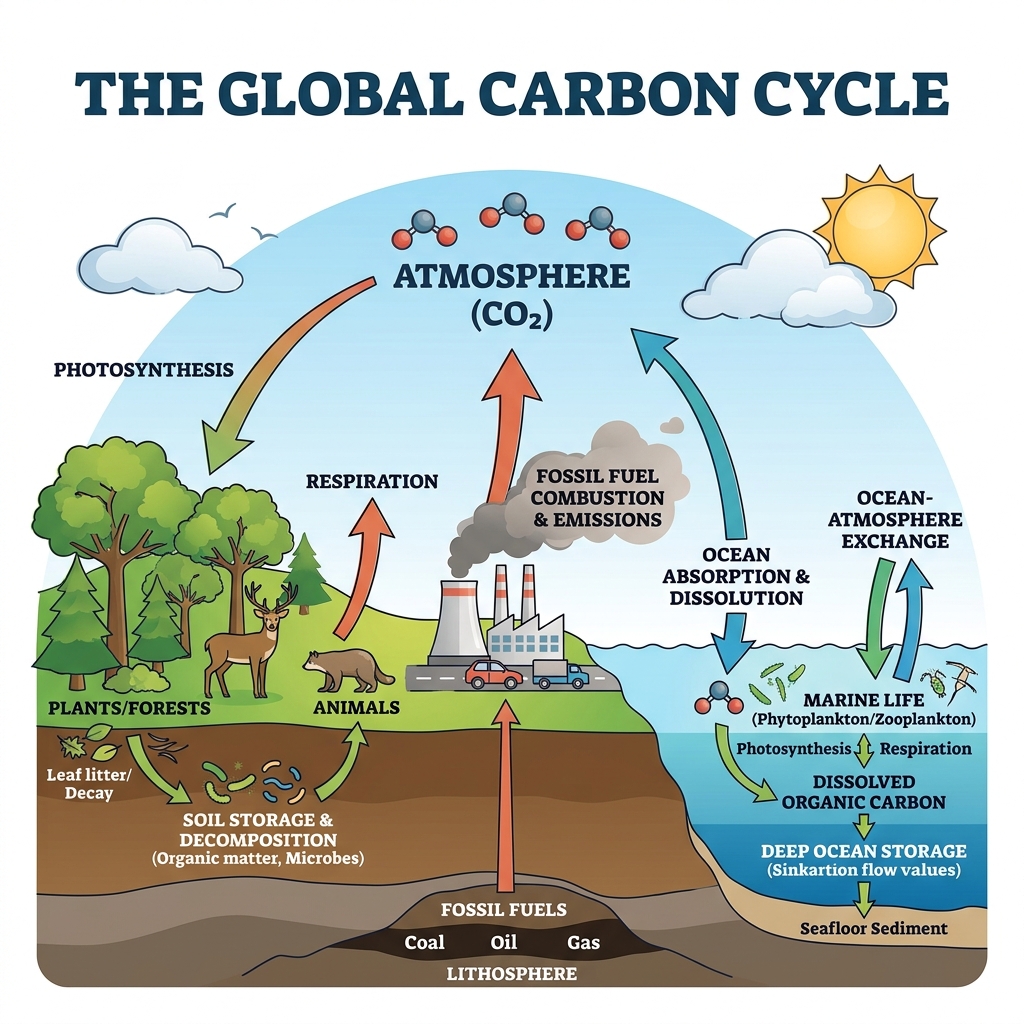
CO₂
Photosynthesis
Feeding
Death + Decay
Key Flows
| Process | Carbon Movement |
|---|---|
| Photosynthesis | Atmosphere CO₂ → plant biomass (organic C) |
| Feeding | Producer C → consumer C (organic C transferred) |
| Defecation | Undigested C → soil (organic matter) |
| Cellular respiration | Organic C → atmosphere CO₂ |
| Death & decomposition | Dead organic C → soil → atmosphere (via decomposers) |
Carbon Sequestration
Natural Sequestration
- Photosynthesis: plants capture CO₂ → biomass
- Ocean absorption: CO₂ dissolves into seawater
- Soil organic matter: decomposition stores C in soil
- Rock weathering: CO₂ reacts with minerals
Artificial Sequestration
- CCS: Carbon capture and storage from industrial sources
- Direct air capture: Machines that pull CO₂ from air
- BECCS: Bioenergy with carbon capture and storage
- Afforestation: Planting trees on non-forest land
Ecosystems as Carbon Stores, Sinks, or Sources
| Ecosystem | Carbon Role | Why? |
|---|---|---|
| Healthy forest | Sink | Growth absorbs more CO₂ than respiration releases |
| Burning forest | Source | Fire releases stored carbon rapidly |
| Open ocean | Sink | Phytoplankton + dissolution absorb CO₂ |
| Wetland | Store | Waterlogged conditions slow decomposition → peat |
| Agricultural land | Source (often) | Tilling releases soil carbon; monocultures reduce storage |
Fossil Fuels: Ancient Carbon Stores
Formation and Timescales
- Coal: formed from partially decomposed terrestrial plants (millions of years)
- Oil: formed from marine organisms (plankton, algae) in ocean sediments
- Natural gas: formed alongside oil from organic matter under heat and pressure
- Residence time: effectively infinite until extracted and burned
Agriculture and the Carbon Cycle
Carbon Sinks (Good Practices)
- Agroforestry: trees + crops → more biomass storage
- No-till farming: soil carbon preserved
- Cover crops: continuous photosynthesis
- Composting: organic matter added to soil
Carbon Sources (Bad Practices)
- Tilling: exposes soil carbon to oxidation → CO₂ release
- Deforestation for farmland: releases tree biomass carbon
- Rice paddies: anaerobic conditions → methane emissions
- Livestock: enteric fermentation → methane
Oceans and Carbon
Ocean Carbon Exchange
How Oceans Absorb CO₂
- CO₂ dissolves at the ocean surface
- Cold water absorbs more than warm water
- Phytoplankton take up dissolved CO₂ via photosynthesis
- ~30% of human CO₂ emissions absorbed by oceans
Temperature Effect
As ocean temperatures rise, water holds less dissolved CO₂ → reduced absorption capacity → more CO₂ remains in atmosphere → warming accelerates (positive feedback).
Ocean Acidification
The Chemistry
More H⁺ ions = lower pH = more acidic. Ocean pH has dropped from ~8.2 to ~8.1 since pre-industrial times (a 26% increase in acidity).
Who Is Affected?
- Corals: can't build calcium carbonate skeletons → bleaching + death
- Molluscs: shells dissolve or become thinner
- Plankton: shell-forming species decline → food web collapse
- Fish: sensory disruption, behavioural changes
Why It Matters
- Marine food webs depend on shell-forming organisms
- Coral reefs support 25% of marine biodiversity
- Fisheries and coastal protection at risk
- Extremely difficult to reverse
Alleviating Human Impacts on the Carbon Cycle
| Strategy | How It Helps | Example |
|---|---|---|
| Reduce emissions | Less CO₂ entering atmosphere | Renewable energy, electric vehicles |
| Carbon sequestration | Remove CO₂ from atmosphere | Afforestation, CCS technology |
| Protect carbon sinks | Preserve existing storage | Stop deforestation, protect peatlands |
| Restore degraded land | Re-establish carbon uptake | Reforestation, wetland restoration |
| Change agriculture | Reduce emissions + increase soil carbon | No-till, cover crops, agroforestry |
Carbon in the LithosphereHL
Fossil Fuel Stores
- Coal: terrestrial plant matter compressed over millions of years
- Oil: marine organisms buried in sedimentary rock
- Natural gas: formed with oil from organic matter under pressure
- Residence time: millions of years (until extracted)
Rock Stores
- Limestone (CaCO₃): largest inorganic carbon store
- Formed from accumulated shells and coral skeletons
- Weathering slowly releases CO₂ back to atmosphere
- Residence time: hundreds of millions of years
Reef-Building Organisms & LimestoneHL
How Limestone Forms
builds CaCO₃ shell
Sinks
accumulates
over millions of years
CaCO₃ rock
Fossil Fuel FormationHL
Coal Formation
- Terrestrial plants in swamp forests die
- Waterlogged conditions prevent full decomposition
- Layers accumulate → peat → lignite → coal
- Process: millions of years under heat and pressure
Oil & Gas Formation
- Marine organisms (plankton, algae) die and sink
- Buried in ocean sediment → compressed
- Heat transforms organic matter → oil and gas
- Migrate through porous rock → trapped in reservoirs
Methane ProductionHL
Where Is Methane Produced?
| Source | Conditions | Scale |
|---|---|---|
| Wetlands | Waterlogged, anaerobic soil | Largest natural source |
| Rice paddies | Flooded fields, anaerobic | Major agricultural source |
| Ruminant digestion | Anaerobic gut fermentation | Cattle, sheep, goats |
| Landfills | Decomposition without oxygen | Growing source |
| Permafrost thaw | Frozen organic matter decomposes | Concerning feedback loop |
Methane's Atmospheric LifetimeHL
Methane in the Atmosphere
Unlike CO₂ (which persists for centuries), methane is relatively short-lived. However, while it is in the atmosphere, it is an extremely powerful greenhouse gas.
Implications
- Reducing methane emissions gives fast climate benefits
- Methane reduction is one of the most cost-effective climate strategies
- But methane sources are diverse and widespread
The Paradox
Methane is short-lived but potent. CO₂ is long-lived but less potent per molecule. Both matter — methane for near-term warming, CO₂ for long-term climate trajectory.
The Nitrogen Cycle: Overview
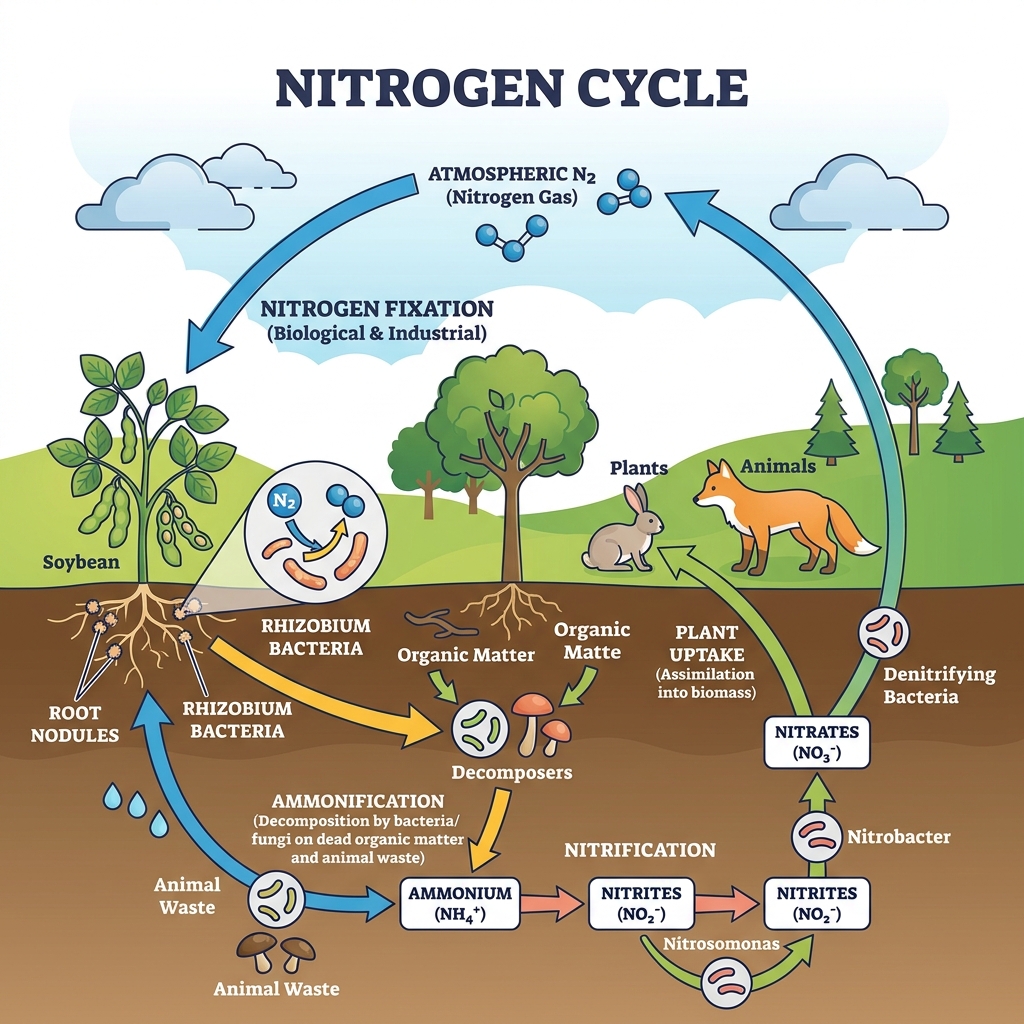
Inorganic Nitrogen Stores
- Atmosphere: N₂ gas (78% of atmosphere)
- Soil: ammonium (NH₄⁺), nitrate (NO₃⁻)
- Water: dissolved nitrates and ammonia
Organic Nitrogen Stores
- Living organisms: proteins, DNA, chlorophyll
- Dead organic matter: leaf litter, detritus
- Waste products: animal excretion (urea, ammonia)
Bacteria in the Nitrogen Cycle
| Process | Bacteria Type | What Happens |
|---|---|---|
| Nitrogen fixation | Nitrogen-fixing bacteria (e.g., Rhizobium) | N₂ → NH₃ (ammonia) |
| Nitrification | Nitrifying bacteria | NH₃ → NO₂⁻ → NO₃⁻ (nitrate) |
| Ammonification | Decomposer bacteria | Organic N → NH₃ (ammonia) |
| Denitrification | Denitrifying bacteria | NO₃⁻ → N₂ (back to atmosphere) |
Denitrification Conditions
Why Anaerobic?
- Denitrifying bacteria use NO₃⁻ instead of O₂ for respiration
- Only possible when oxygen is absent
- Waterlogged soils, wetlands, flooded rice paddies
Impact
- Removes usable nitrogen from soil → reduced fertility
- Returns N₂ to atmosphere → closes the cycle
- Over-irrigation can increase denitrification → crop yield loss
Plants and Nitrogen Fixation
The Legume–Rhizobium Mutualism
(plant)
(bacteria in root nodules)
Nitrogen Cycle Flows
Atmosphere
Soil
Uptake
Feeding
Ammonification
| Flow | Process |
|---|---|
| Mineral uptake | Producers absorb NO₃⁻ / NH₄⁺ from soil |
| Consumption | N moves up food chain when organisms eat each other |
| Excretion | Animals excrete nitrogenous waste (urea, ammonia) |
| Death | Dead organisms contain organic nitrogen |
| Decomposition | Decomposers break down organic N |
| Ammonification | Organic N → NH₃ (ammonia) in soil |
Human Impacts on the Nitrogen Cycle
| Activity | Impact on Nitrogen Cycle |
|---|---|
| Agriculture (fertilizers) | Massive increase in reactive N (NO₃⁻) in soils and waterways |
| Deforestation | Removes vegetation that would take up nitrogen → N accumulates in soil |
| Aquaculture | Fish waste and uneaten feed release ammonia into water |
| Urbanization | Sewage, vehicle emissions (NOₓ), industry release reactive N |
| Burning fossil fuels | Produces nitrogen oxides (NOₓ) → acid rain + smog |
The Haber Process
Why It Matters
- Made synthetic nitrogen fertilizer possible
- Enabled the Green Revolution → food for billions
- Without it, Earth could only support ~4 billion people
- ~50% of nitrogen in human bodies came via Haber process
The Environmental Cost
- Massive increase in reactive nitrogen in environment
- Runoff → eutrophication of waterways
- N₂O emissions → potent greenhouse gas
- Soil acidification
The Nitrogen Planetary Boundary: CROSSED
What Happens When the Boundary Is Crossed?
- Eutrophication: excess nitrogen → algal blooms → oxygen depletion → dead zones
- Biodiversity loss: nitrogen-loving species outcompete others → species decline
- Groundwater contamination: nitrates in drinking water → health risks
- Acid rain: NOₓ emissions → soil and water acidification
- Climate change: N₂O is 298× more potent than CO₂ as a greenhouse gas
Global Collaboration on Nitrogen
What Needs to Happen
- Precision agriculture: apply fertilizer only where and when needed
- Organic farming: reduce synthetic fertilizer dependence
- Wastewater treatment: remove nitrogen before discharge
- Dietary shifts: less meat = less nitrogen-intensive agriculture
- International agreements: coordinated targets for nitrogen reduction
- Cover crops and crop rotation: reduce nitrogen fertilizer needs
Essential Vocabulary
| Term | Definition |
|---|---|
| Biogeochemical cycle | Cycling of chemical elements through biotic and abiotic components |
| Store | Place where an element is held in a cycle |
| Sink | Store absorbing more than it releases (net uptake) |
| Source | Store releasing more than it absorbs (net output) |
| Carbon sequestration | Capturing atmospheric CO₂ and storing it in solid/liquid form |
| Ocean acidification | Decrease in ocean pH from dissolved CO₂ |
| Methane (CH₄) | Greenhouse gas produced by methanogenic bacteria in anaerobic conditions |
| Nitrogen fixation | Conversion of N₂ gas to NH₃ by bacteria |
| Nitrification | Conversion of NH₃ to NO₃⁻ by bacteria |
| Denitrification | Conversion of NO₃⁻ back to N₂ in anaerobic conditions |
| Ammonification | Decomposition of organic N → NH₃ |
| Haber process | Industrial production of NH₃ from N₂ and H₂ |
| Eutrophication | Nutrient enrichment of water → algal blooms → oxygen depletion |
| Residence time | Average time an element spends in a particular store |
Key Takeaways & Exam Tips
Must-Know Processes
Carbon Cycle
Photosynthesis ↔ Respiration ↔ Decomposition ↔ Fossil fuel burning
Nitrogen Cycle
Fixation → Nitrification → Uptake → Ammonification → Denitrification
Common Exam Patterns
- Trace a cycle: follow an element through all stores and flows
- Explain human disruption: which store/flow is affected and how
- Ocean acidification: know the chemistry and biological consequences
- Nitrogen bacteria: match each type to its process (fixation, nitrification, denitrification, ammonification)
- Haber process: benefits vs environmental costs
- Compare carbon and nitrogen cycles: both involve bacteria, but carbon also involves photosynthesis/respiration
- Planetary boundaries: know which cycles have been crossed and consequences
You've covered all 25 syllabus points ✅
2.3.1 – 2.3.21 (SL) + 2.3.12 – 2.3.16 (HL)