IB DP Environmental Systems & Societies — Topic 3: Biodiversity & Conservation
Human Impact
on Biodiversity
Subtopic 3.2 — New Syllabus (First Assessment 2026)
Standard Level + Higher Level
7 SL Points
3.2.1 – 3.2.7
6 HL Extensions
3.2.8 – 3.2.13
Overview
What You Need to Know
This subtopic identifies the direct and indirect human threats to biodiversity, examines how multiple impacts interact, introduces the IUCN Red List, explores invasive species, the tragedy of the commons, and — at HL — biodiversity hotspots, Key Biodiversity Areas, indigenous land management, environmental justice, and planetary boundaries.
A. Threats to Biodiversity
Direct & indirect influences, multiple impacts, invasive alien species
B. Assessment & Status
IUCN Red List, conservation status, named species case studies
C. Resource Management
Tragedy of the commons, overexploitation
D. Priority Areas & Justice (HL)
Hotspots, KBAs, indigenous management, environmental justice, planetary boundaries
Guiding Question
- What causes biodiversity loss, and how are ecological and societal systems impacted?
Time allocation: minimum 4 hours SL + 4–5 hours HL.
3.2.1
Direct & Indirect Threats to Biodiversity
Key UnderstandingBiological diversity is being adversely affected by both direct and indirect influences.
🔴 Direct Threats
- Overharvesting: Overfishing, logging, hunting beyond sustainable levels (Atlantic cod collapse)
- Poaching: Illegal hunting for commercial value (African elephant ivory)
- Deforestation: Large-scale clearing for agriculture/development (Amazon for cattle)
- Illegal pet trade: Wild capture of exotic species (parrots, reptiles)
🔵 Indirect Threats
- Habitat loss / degradation / fragmentation: Breaking continuous habitat into isolated patches
- Pollution: Air, water, soil, light, noise, thermal
- Climate change: Shifts ranges, alters timing, reduces resilience
- Invasive alien species: Outcompete native species, introduce disease
Natural Hazards
Naturally occurring events (wildfires, volcanic eruptions, tsunamis) can also damage biodiversity — but are distinct from human-caused threats. The 2019–20 Australian bushfires killed an estimated 3 billion animals, devastating koala habitat.
Key distinction: Direct threats = immediate, observable harm (poaching, deforestation). Indirect threats = underlying drivers that increase vulnerability (climate change, pollution, habitat fragmentation).
3.2.2
Multiple Human Impacts
Key UnderstandingMost ecosystems are subject to multiple human impacts.
Human impacts rarely act alone — they interact to produce compounded effects more severe than any single threat.
| Interaction | Mechanism | Example |
|---|
| Climate change + habitat loss | Warming shifts ranges; fragmented habitats block migration | Mountain species trapped — can't move higher, habitat shrinking |
| Pollution + invasive species | Pollution weakens natives; invasives exploit weakened competitors | Nutrient runoff → algal blooms → native fish die → invasives fill niche |
| Habitat fragmentation + overexploitation | Small isolated populations are easier targets | Small forest patches → remaining wildlife concentrated → easier to poach |
| Climate change + invasive species | Warming benefits some invasives; stressed natives less competitive | Kudzu grows faster in warmer conditions, outcompeting stressed natives |
🌡️ Climate change
+
🪓 Habitat loss
+
🧪 Pollution
=
⚠️ Cascading loss
Exam tip: When asked about impacts on an ecosystem, always consider how threats interact — don't just list them in isolation.
3.2.3
Invasive Alien Species
Key UnderstandingInvasive alien species can reduce local biodiversity by competing for limited resources, predation and introduction of diseases or parasites.
| Mechanism | How It Works | Example |
|---|
| Competition | Outcompete natives for food, water, space — especially without natural predators | Grey squirrel (UK) vs native red squirrel |
| Predation | Prey on natives that lack evolved defenses | Brown tree snake (Guam) → extinction of 10+ bird species |
| Disease | Introduce pathogens natives have no immunity to | American crayfish → fungal disease devastating European crayfish |
| Habitat alteration | Physically change the environment | Kudzu vine (SE US) smothers native trees and plants |
| Hybridization | Interbreed with natives → genetic dilution | Mallard ducks hybridizing with native duck species |
Pathways of Introduction
| Pathway | Example |
|---|
| Shipping / trade | Zebra mussel in ballast water → Great Lakes |
| Agriculture / horticulture | Cane toad (Australia) introduced for pest control → became pest |
| Pet trade | Burmese python released in Florida → Everglades population |
| Tourism | Seeds/spores on boots and gear → spread in national parks |
3.2.4
The IUCN Red List
Key UnderstandingThe global conservation status of species is assessed by the International Union for Conservation of Nature (IUCN) and is published as the IUCN Red List. Status is based on number of individuals, rate of increase or decrease of the population, breeding potential, geographic range and known threats.
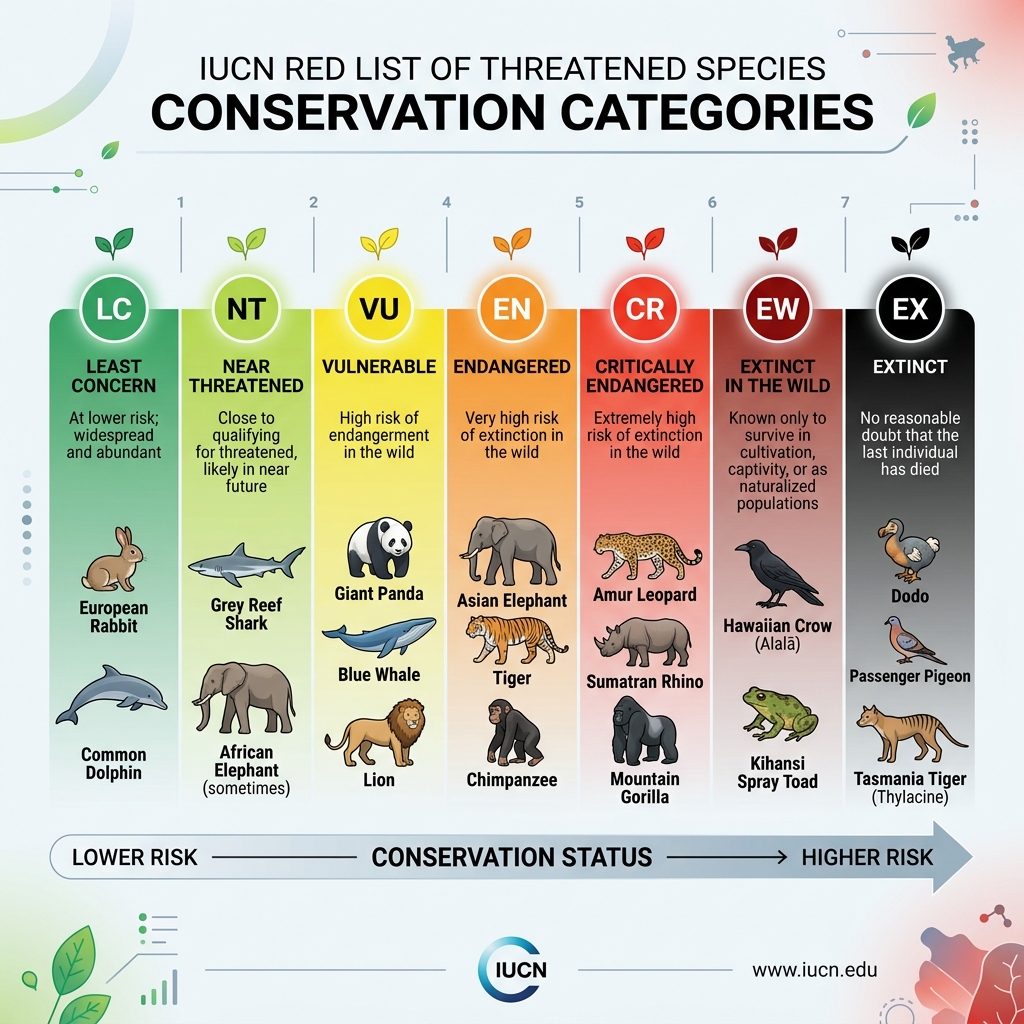
Assessment Criteria
| Criterion | What It Measures | Example |
|---|
| Population size | Small populations are inherently more vulnerable | Amur leopard: <100 individuals → CR |
| Rate of decline | Speed of population decrease | Javan rhino: rapid decline from poaching → CR |
| Geographic range | Restricted range → higher vulnerability | Golden poison frog: small Colombian range → EN |
| Habitat fragmentation | Isolated populations → less genetic exchange | Bornean orangutan: fragmented forest → CR |
| Known threats | Poaching, pollution, climate change, invasive species | Hawaiian monk seal: habitat degradation + entanglement → CR |
Key stat: ~8.7 million species estimated on Earth; ~80% still undiscovered. Species are going extinct before they are even described.
3.2.5
Conservation Status & Prioritization
Key UnderstandingAssigning a global conservation status publicizes the vulnerability of species and allows governments, non-governmental agencies and individual citizens to select appropriate conservation priorities and management strategies.
| Stakeholder | Priority | Example |
|---|
| Governments | National interests, economic value, legal frameworks | US Endangered Species Act; Kenya elephant protection for tourism |
| NGOs | Flagship species, biodiversity hotspots, community engagement | WWF: polar bears, pandas; protecting the Amazon |
| Individuals | Advocacy, donations, sustainable consumer choices, citizen science | Anti-whaling campaigns → humpback whale recovery |
How Conservation Status Drives Action
- Awareness: CR status draws global attention → funding, policy change
- Resource allocation: Limited funds directed to most urgent cases
- Policy: Informs international agreements (CBD, CITES)
- Tracking: Status changes over time measure conservation progress
Flagship species: Charismatic species (tigers, pandas, elephants) chosen to attract public support — protecting them protects the broader ecosystem they inhabit.
3.2.6
Named Species Case Studies
Key UnderstandingInvestigate three different named species: a species that has become extinct due to human activity; a species that is critically endangered; and a species whose conservation status has been improved by intervention.
| Status | Species | Ecological Role | Threats / Intervention | Outcome |
|---|
| Extinct |
Dodo (Raphus cucullatus) |
Seed disperser on Mauritius |
Hunted by sailors; habitat cleared; invasive rats ate eggs |
Extinct ~1681 — loss of unique island ecosystem function |
| Critically Endangered |
Kakapo (Strigops habroptilus) |
Nocturnal herbivore; seed disperser (NZ) |
Habitat loss; introduced cats, rats, stoats; low reproductive rate |
~250 individuals; intensive management (captive breeding, predator-free islands) |
| Improved |
California Condor (Gymnogyps californianus) |
Scavenger — cleans carcasses, prevents disease spread |
Lead poisoning (ammunition), DDT, habitat loss → 22 birds in 1982 |
Captive breeding + release → ~500 today; lead ammunition bans in range |
Exam requirement: You must know the ecological role, pressures, and evaluation of methods for all three case studies. The kakapo and condor are the most commonly cited examples.
3.2.7
Tragedy of the Commons
Key UnderstandingThe tragedy of the commons describes possible outcomes of the shared unrestricted use of a resource, with implications for sustainability and the impacts on biodiversity.
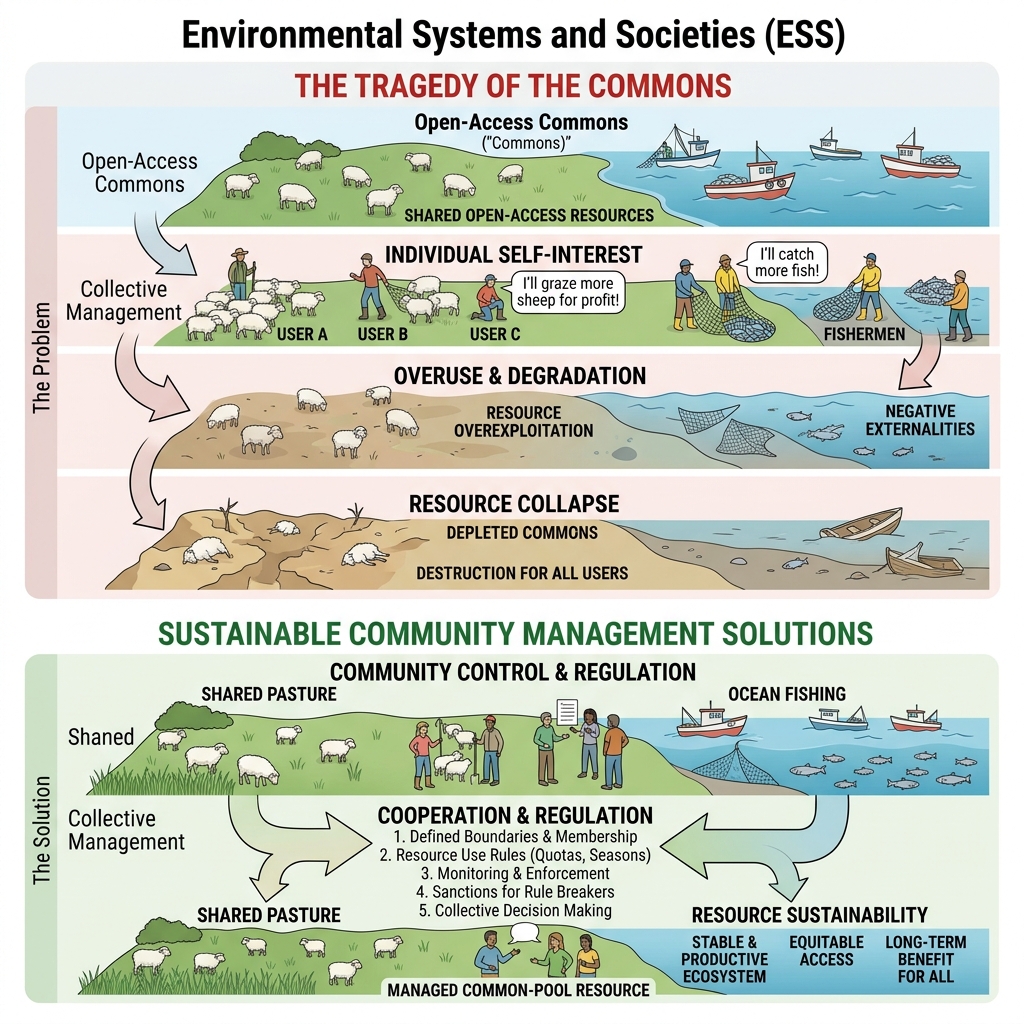
| Example | Resource | What Happened |
|---|
| Grand Banks cod fishery | Atlantic cod (international waters) | Unrestricted trawling by multiple nations → cod population collapsed in 1992; moratorium still largely in effect |
| Great Pacific Garbage Patch | Ocean as waste sink | Unrestricted plastic disposal → 80,000 tonnes floating in Pacific; harms marine life |
| Atmospheric CO₂ | Atmosphere (carbon sink) | Unrestricted emissions by all nations → climate change → global biodiversity loss |
Solutions
- Regulation: Fishing quotas, marine protected areas, emissions caps
- Privatization: Assign ownership → incentive to manage sustainably
- Community management: Elinor Ostrom's work — local communities can manage commons effectively with clear rules, monitoring, and sanctions
Ostrom's insight: The tragedy of the commons is not inevitable — communities with strong governance and clear rules can sustain shared resources. (Ostrom won the Nobel Prize in Economics for this work.)
HL — 3.2.8
Biodiversity HotspotsHL
Key UnderstandingBiodiversity hotspots are under threat from habitat destruction, which could lead to a significant loss of biological diversity, especially in tropical biomes.
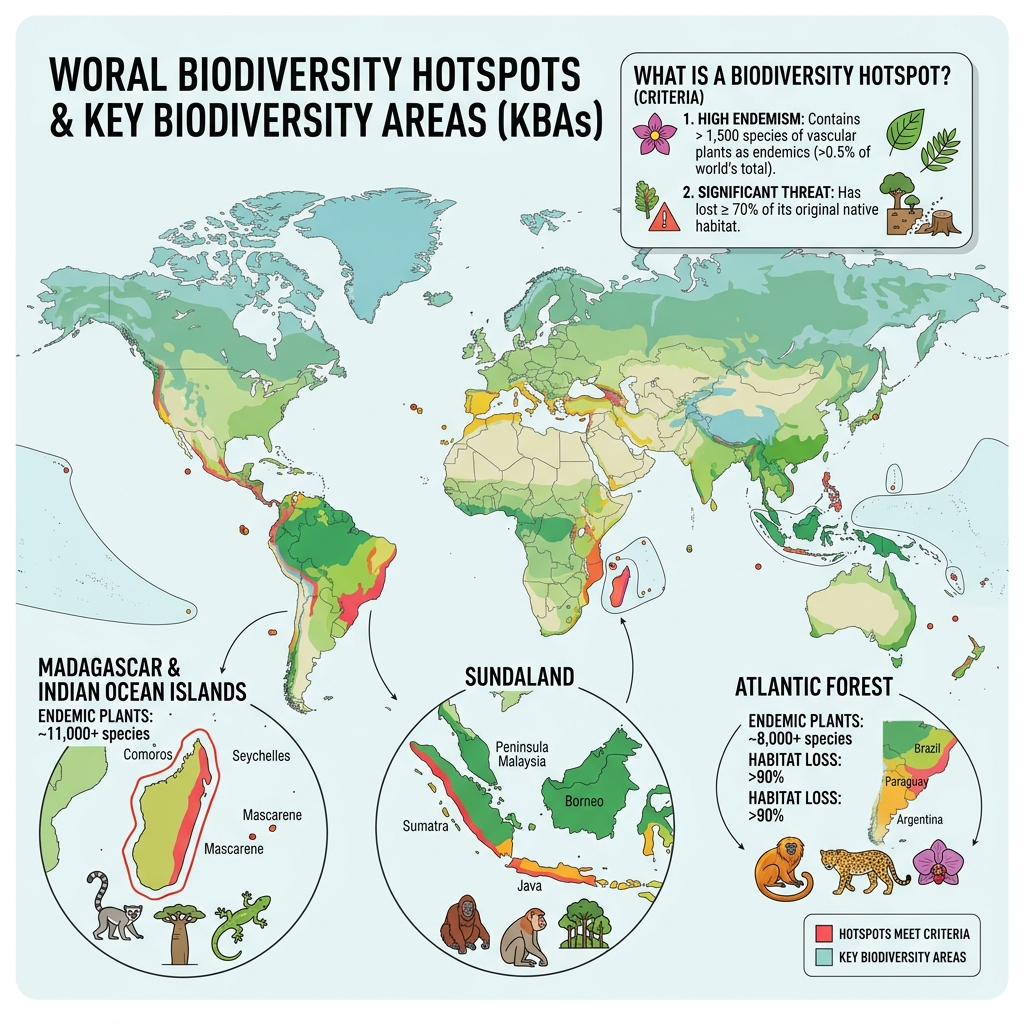
Criteria for a Biodiversity Hotspot
- ≥1,500 endemic vascular plant species (found nowhere else)
- ≥70% habitat loss from original extent
36 recognized hotspots globally — covering ~2.3% of Earth's land surface but containing >50% of endemic plant species and ≥42% of terrestrial vertebrates.
| Hotspot | Location | Key Endemics | Main Threats |
|---|
| Madagascar | Indian Ocean island | ~100 lemur species (90% endemic) | Deforestation for agriculture, illegal logging, bushmeat hunting |
| Sundaland | SE Asia (Indonesia, Malaysia) | Orangutans, Sumatran tiger, rhino | Palm oil plantations, logging |
| Atlantic Forest | Brazil | Golden lion tamarin | Fragmentation from urbanization, agriculture |
| Coral Triangle | Western Pacific | 76% of coral species globally | Ocean warming, acidification, overfishing |
Why hotspots matter: Losing a hotspot = losing species that exist nowhere else. Protecting hotspots is the most cost-effective strategy for conserving global biodiversity.
HL — 3.2.9
Key Biodiversity AreasHL
Key UnderstandingKey areas that should be prioritized for biodiversity conservation have been identified on the basis of the international importance of their species and habitats.
Key Biodiversity Areas (KBAs) are sites of global significance for biodiversity — identified using standardized, science-based criteria.
| KBA Criterion | Description |
|---|
| Globally threatened species | Presence of CR, EN, or VU species with restricted ranges |
| Range-restricted species | Species with very small geographic ranges |
| Endemic species | Species found only at that site |
| Global congregations | Sites where a large proportion of a species' population gathers (breeding colonies, migration stopovers) |
Why KBAs Matter
- Home to species listed as VU, EN, or CR on the IUCN Red List
- Harbor globally unique or irreplaceable ecosystems
- Provide essential ecosystem services (carbon sequestration, water purification)
- International collaboration via the KBA Partnership (BirdLife International, CI, IUCN)
KBAs vs hotspots: Hotspots are large regions defined by endemic plants + habitat loss. KBAs are specific sites defined by threatened species presence. A hotspot may contain many KBAs.
HL — 3.2.10
Conflict in Key Biodiversity AreasHL
Key UnderstandingIn KBAs, there is conflict between exploitation, sustainable development and conservation.
| Interest | Priority | Stakeholders |
|---|
| Economic exploitation | Income, jobs, resource extraction (logging, mining, agriculture) | Governments, corporations, local workers |
| Sustainable development | Balance economic needs with long-term ecological health | Development agencies, some governments |
| Conservation | Protect species, ecosystems, and biodiversity | NGOs, scientists, indigenous communities |
Case Study: Congolese Rainforest (Congo Basin)
- Second-largest tropical rainforest — critical for gorillas, forest elephants, biodiversity
- Conflict: Logging concessions + mineral mining (coltan for electronics) vs conservation of endemic species
- Stakeholders: Government (revenue), logging companies (profit), local communities (livelihoods), WWF/IUCN (conservation)
- Resolution attempts: Community-based forest management, sustainable logging certifications, protected area expansion
Exam skill: Identify all stakeholders, their interests, and potential compromises. There is rarely a "right" answer — the IB rewards balanced analysis of trade-offs.
HL — 3.2.11
Indigenous Land ManagementHL
Key UnderstandingTraditional indigenous approaches to land management can be seen as more sustainable but are facing challenges of population growth, economic development, climate change and a lack of governmental support and protection.
| Approach | How It Works | Example |
|---|
| Controlled burning | Low-intensity fire to reduce fuel loads, promote new growth, maintain biodiversity | Australian Aboriginal fire management; millennia-old practice now recognized by modern ecology |
| Rotational harvesting | Cyclic use of different areas → allows recovery | Amazonian shifting cultivation (small-scale, short cycles) |
| Sacred groves | Religiously protected forest patches → de facto conservation | India's sacred groves; West African forest reserves |
| Traditional fishing | Seasonal bans, size limits, taboo species | Pacific Islander reef management systems |
Challenges Facing Indigenous Management
- Population growth: Larger communities require more resources → pressure on traditional practices
- Economic development: Governments may prioritize mining/logging over indigenous land rights
- Climate change: Shifting conditions may render traditional ecological knowledge less applicable
- Governmental support: Many indigenous groups lack legal recognition of land tenure → vulnerable to displacement
Key stat: Indigenous peoples manage or hold tenure over ~25% of the world's land surface, which contains ~80% of remaining biodiversity. Supporting indigenous land rights is one of the most cost-effective conservation strategies.
HL — 3.2.12
Environmental JusticeHL
Key UnderstandingEnvironmental justice must be considered when undertaking conservation efforts to address biodiversity loss.
Environmental justice = the fair treatment and meaningful involvement of all people, regardless of background, in environmental decisions. Conservation must not disproportionately burden disadvantaged communities.
| Issue | Justice Dimension | Example |
|---|
| "Fortress conservation" | Protected areas created by displacing indigenous/local communities | Maasai evicted from Serengeti/Ngorongoro for game reserves |
| Unequal burden of loss | Poorest communities lose resources first; wealthier nations benefit from conservation | Fishing communities restricted by marine protected areas while industrial trawlers operate offshore |
| Benefit sharing | Who profits from ecotourism or genetic resources? | Pharmaceutical biopiracy — using indigenous plant knowledge without compensation |
| Participation | Local communities excluded from conservation decision-making | Top-down conservation plans without community consultation |
Just Conservation
- Involve local and indigenous communities in decision-making
- Ensure conservation benefits are shared equitably
- Respect land rights and cultural values
- Address underlying inequalities that drive unsustainable resource use
HL — 3.2.13
Planetary Boundary: Biosphere IntegrityHL
Key UnderstandingThe planetary boundary "loss of biosphere integrity" indicates that species extinctions have already crossed a critical threshold.
The planetary boundaries framework (Rockström et al., 2009) identifies nine Earth-system processes with thresholds that, if crossed, could cause irreversible environmental change.
Biosphere Integrity — Two Control Variables
- Genetic diversity: Measured by extinction rate (species lost per million species-years). Safe limit: <10 E/MSY. Current: ~100–1,000 E/MSY → BOUNDARY CROSSED
- Functional diversity: Ability of ecosystems to maintain ecological processes. Also declining rapidly.
What This Means
- Current extinction rate is 100–1,000× the natural background rate
- We are in what scientists call the "Sixth Mass Extinction" — the first caused by a single species (humans)
- Crossing this boundary threatens ecosystem services that human civilization depends on: pollination, water purification, carbon sequestration, food production
- Unlike some other boundaries (e.g. ozone), this one is essentially irreversible — extinct species do not return
Exam tip: When discussing planetary boundaries, always cite the extinction rate comparison (current vs background) and emphasize irreversibility — this distinguishes a strong answer from a generic one.
Key Terms Glossary
Essential Vocabulary
| Term | Definition |
|---|
| Natural hazard | Naturally occurring physical phenomenon with potential to damage environments and communities |
| Overharvesting | Unsustainable extraction of natural resources beyond their capacity to regenerate |
| Habitat fragmentation | Breaking continuous habitat into smaller, isolated patches |
| Invasive alien species | Non-native organisms that cause ecological, economic, or health harm in their new environment |
| IUCN Red List | Global assessment of species' conservation status, from Least Concern to Extinct |
| Flagship species | Charismatic species used to raise public awareness and funding for conservation |
| Tragedy of the commons | Overexploitation of a shared resource by individuals acting in self-interest |
| Biodiversity hotspot | Region with high endemism (≥1,500 endemic plants) and ≥70% habitat loss |
| Key Biodiversity Area (KBA) | Site of global significance for biodiversity, identified by standardized criteria |
| Environmental justice | Fair treatment of all people in environmental decisions, regardless of background |
| Biosphere integrity | Planetary boundary tracking genetic and functional biodiversity — currently exceeded |
Exam Preparation
Key Takeaways & Exam Tips
Must-Know Relationships
- Direct + indirect threats interact → compounded biodiversity loss greater than sum of parts
- IUCN criteria → conservation status → drives action from governments, NGOs, individuals
- Invasive species exploit weakened ecosystems → most damaging when combined with other stressors
- Tragedy of the commons → overexploitation → solution requires regulation, community governance, or property rights
- Conservation must include environmental justice → equitable benefit-sharing, community participation
For 9-mark essays: Always connect human impacts to both ecological consequences AND societal responses (policy, conservation, justice). Use named examples throughout.
You've covered all 13 syllabus points ✅
3.2.1 – 3.2.7 (SL) + 3.2.8 – 3.2.13 (HL)