IB DP Environmental Systems & Societies — Topic 3: Biodiversity & Conservation
Conservation
& Regeneration
Subtopic 3.3 — New Syllabus (First Assessment 2026)
Standard Level + Higher Level
9 SL Points
3.3.1 – 3.3.9
5 HL Extensions
3.3.10 – 3.3.14
Overview
What You Need to Know
This subtopic examines why we conserve biodiversity, the strategies used (in situ vs ex situ, rewilding, international treaties), how conservation areas are designed, and how success is assessed — all through the lens of different environmental value systems.
A. Why Conserve?
Preservation arguments: aesthetic, ecological, economic, ethical, social
B. Strategies & Design
In situ vs ex situ, CBD, reserve design, rewilding, trophic cascades
C. Assessment & Worldviews
Evaluation metrics, ecocentric vs technocentric views, ecotourism
Guiding Questions
- How can different strategies for conserving and regenerating natural systems be compared?
- How do worldviews affect the choices made in protecting natural systems?
Time allocation: minimum 4 hours SL + additional HL hours. Final subtopic in Topic 3: Biodiversity & Conservation.
3.3.1
Arguments for Preservation
Key UnderstandingArguments for species and habitat preservation can be based on aesthetic, ecological, economic, ethical and social justifications.
| Justification | Argument | Example |
|---|
| Aesthetic | Natural beauty enhances well-being, inspires art, recreation, tourism | Grand Canyon, coral reefs — beauty has intrinsic and tourism value |
| Ecological | Ecosystems provide critical services: climate regulation, water purification, pollination | Bees pollinate ~75% of food crops; wetlands filter water |
| Economic | Biodiversity supports agriculture, pharmaceuticals, ecotourism industries | Kenya's wildlife parks generate $1B+/year; rainforest plants → medicines |
| Ethical | Species have an inherent right to exist independent of human utility | "Biorights" — moral duty to protect all life forms |
| Social | Indigenous communities rely on biodiversity for cultural practices and livelihoods | Amazonian tribes depend on forest for food, medicine, shelter, identity |
Ecosystem Services (Economic Value)
- Provisioning: Food, water, timber, medicines, genetic resources
- Regulating: Carbon sequestration, flood control, water purification, climate regulation
- Cultural: Recreation, tourism, spiritual value, education
- Supporting: Soil formation, nutrient cycling, photosynthesis
3.3.2
In Situ vs Ex Situ Conservation
Key UnderstandingSpecies-based conservation tends to involve ex situ strategies, and habitat-based conservation tends to involve in situ strategies.
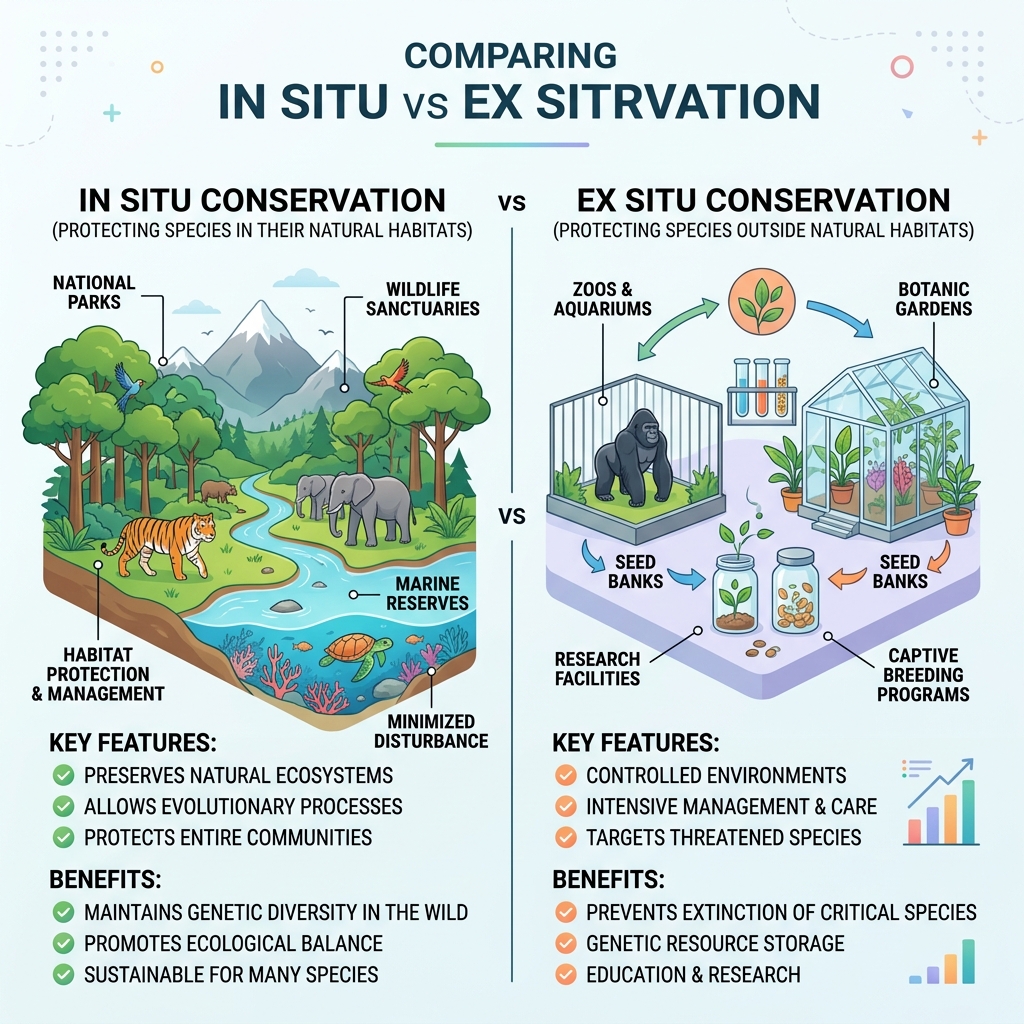
🛡️ In Situ (Habitat-Based)
Protect species within their natural habitats
- National parks & reserves (Kruger, Serengeti)
- Marine protected areas (Great Barrier Reef)
- Wildlife corridors (Yellowstone to Yukon)
- Community-managed conservancies
Advantages: Protects whole ecosystems; maintains ecological processes; natural evolution.
Disadvantages: Expensive to manage; hard to enforce; potential community displacement.
🏛️ Ex Situ (Species-Based)
Protect species outside natural habitats
- Zoos (San Diego Zoo — California condor)
- Botanic gardens (Kew — endangered plants)
- Seed banks (Svalbard Global Seed Vault)
- Captive breeding programs
Advantages: Immediate protection for CR species; controlled breeding; public awareness.
Disadvantages: Expensive; small genetic pool; loss of wild survival skills; does not protect habitat.
Key insight: Ex situ is a "backup" — it buys time while threats in natural habitats are addressed. It works best when paired with in situ restoration.
3.3.3
Mixed Conservation Approaches
Key UnderstandingSometimes a mixed conservation approach is adopted, where both habitat and particular species are considered.
🏛️ Ex situ breeding
→
📦 Population builds up
→
🌿 Reintroduction to wild
→
🛡️ In situ protection
Case Study: Giant Panda (China)
- Ex situ: Captive breeding at Chengdu Research Base — population grew from ~1,000 to ~1,800
- In situ: 67 panda reserves protecting bamboo forest habitat
- Mixed: Captive-bred pandas reintroduced to protected reserves → reclassified from EN to VU (2016)
- Flagship + umbrella species: Panda conservation protects the entire Sichuan ecosystem
Case Study: Arabian Oryx
Once extinct in the wild → captive breeding at Phoenix Zoo (1960s) → reintroduced to protected areas in Oman & Saudi Arabia → reclassified as Vulnerable. A textbook mixed-approach success story.
Species roles in conservation: Flagship species (pandas, tigers) attract funding. Keystone species (wolves, sea otters) are essential for ecosystem function. Umbrella species (pandas, tigers) need large habitats — protecting them protects everything beneath.
3.3.4
Convention on Biological Diversity (CBD)
Key UnderstandingThe Convention on Biological Diversity (CBD) is a UN treaty addressing both species-based and habitat-based conservation.
Established at the Rio Earth Summit (1992). 196 parties — one of the most widely adopted environmental agreements.
Three Core Objectives
🛡️ Conservation of biodiversity
+
♻️ Sustainable resource use
+
🤝 Equitable benefit sharing
| Key Mechanism | What It Does |
|---|
| NBSAPs | National Biodiversity Strategies & Action Plans — each country develops its own conservation roadmap |
| Aichi Targets (2010–2020) | 20 global targets to halt biodiversity loss — partially achieved; informed Post-2020 Kunming-Montreal framework |
| Nagoya Protocol | Fair and equitable sharing of benefits from genetic resources (prevents biopiracy) |
| Cartagena Protocol | Safe handling of genetically modified organisms (GMOs) to prevent biodiversity harm |
Challenges
- No enforcement: Targets are voluntary — countries set their own pace
- Funding gaps: Biodiversity-rich but resource-poor countries struggle to implement NBSAPs
- Slow progress: Biodiversity loss continues despite international frameworks
3.3.5
Habitat Conservation Strategies
Key UnderstandingHabitat conservation strategies protect species by conservation of their natural environment. This may require protection of wild areas or active management.
| Strategy | How It Works | Example |
|---|
| Protected areas | National parks, marine reserves restrict human activity | Kruger NP (South Africa); Great Barrier Reef MPA |
| Habitat restoration | Replanting native vegetation, rehabilitating wetlands | Everglades Restoration Project (Florida) |
| Wildlife corridors | Connect fragmented habitats → allow movement, gene flow | Yellowstone to Yukon Corridor (Y2Y) |
| Eco-sanctuaries | Fenced reserves excluding invasive predators | Zealandia (New Zealand) — predators excluded, native species recover |
| Sustainable land management | Agroforestry, buffer zones, sustainable fisheries | Buffer zones around Amazon reserves |
Key principle: Habitat conservation is more effective than species-based approaches because it protects entire communities and ecological processes, not just individual species.
3.3.6
Reserve Design & UNESCO Biosphere Reserves
Key UnderstandingEffective conservation of biodiversity in nature reserves and national parks depends on an understanding of the biology of target species and on the effect of the size and shape of conservation areas.
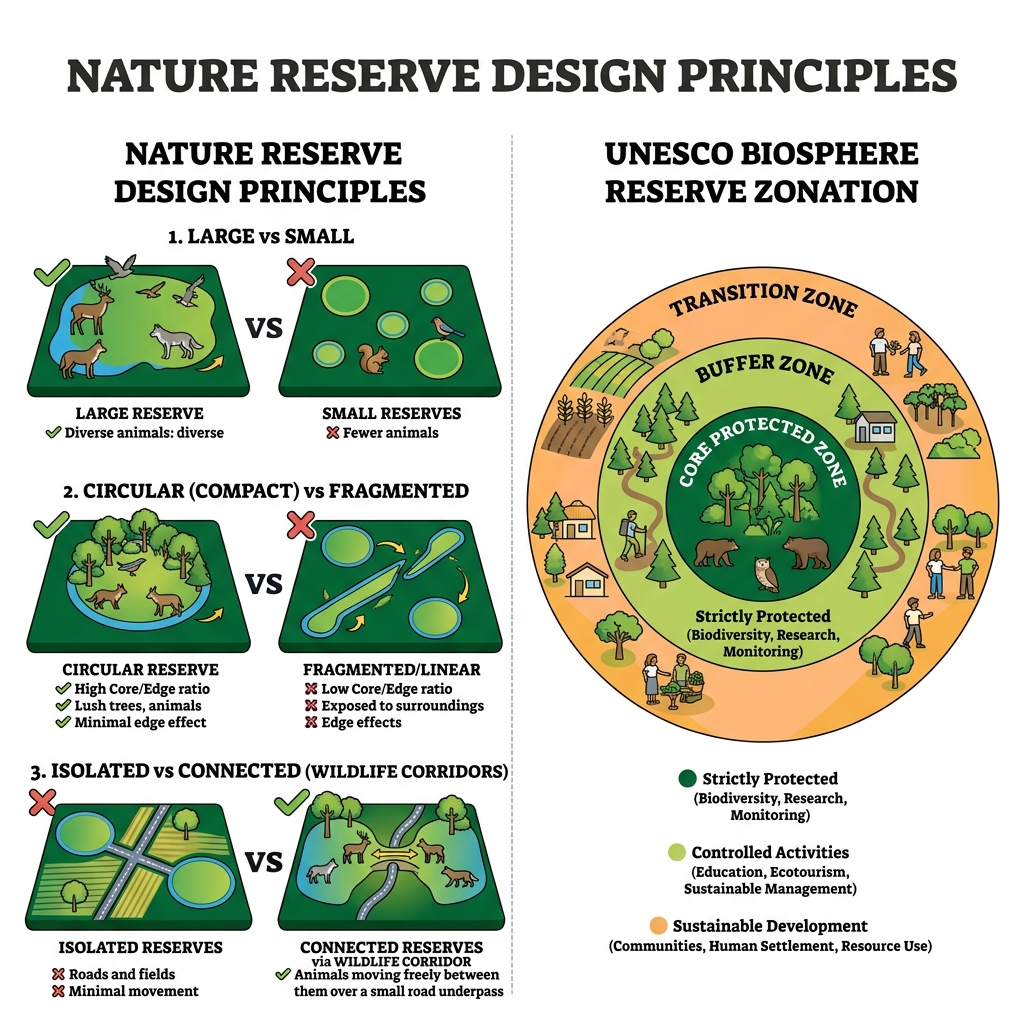
Design Criteria for Protected Areas
| Factor | Consideration |
|---|
| Size | Larger reserves support more species, wider-ranging animals, and more habitats |
| Shape | Circular = least edge effects; long/thin = more edge exposed to human disturbance |
| Edge effects | Boundary zones have different conditions (light, wind, invasive species) — minimize by increasing interior-to-edge ratio |
| Connectivity | Corridors link reserves → allow migration, gene flow, seasonal movement |
| Community involvement | Without local support, reserves fail — must provide alternatives and jobs |
SLOSS Debate
Single Large vs Several Small: Is one large reserve better, or several smaller ones? A large reserve supports wide-ranging species and minimizes edge effects. Several smaller reserves may cover more habitat types. Best answer: depends on the species and landscape — corridors connecting small reserves can combine benefits of both.
3.3.7
Rewilding
Key UnderstandingNatural processes in ecosystems can be regenerated by rewilding.
Rewilding = restoring ecosystems by reintroducing species, reconnecting habitats, and minimizing human intervention — allowing natural processes to self-regulate.
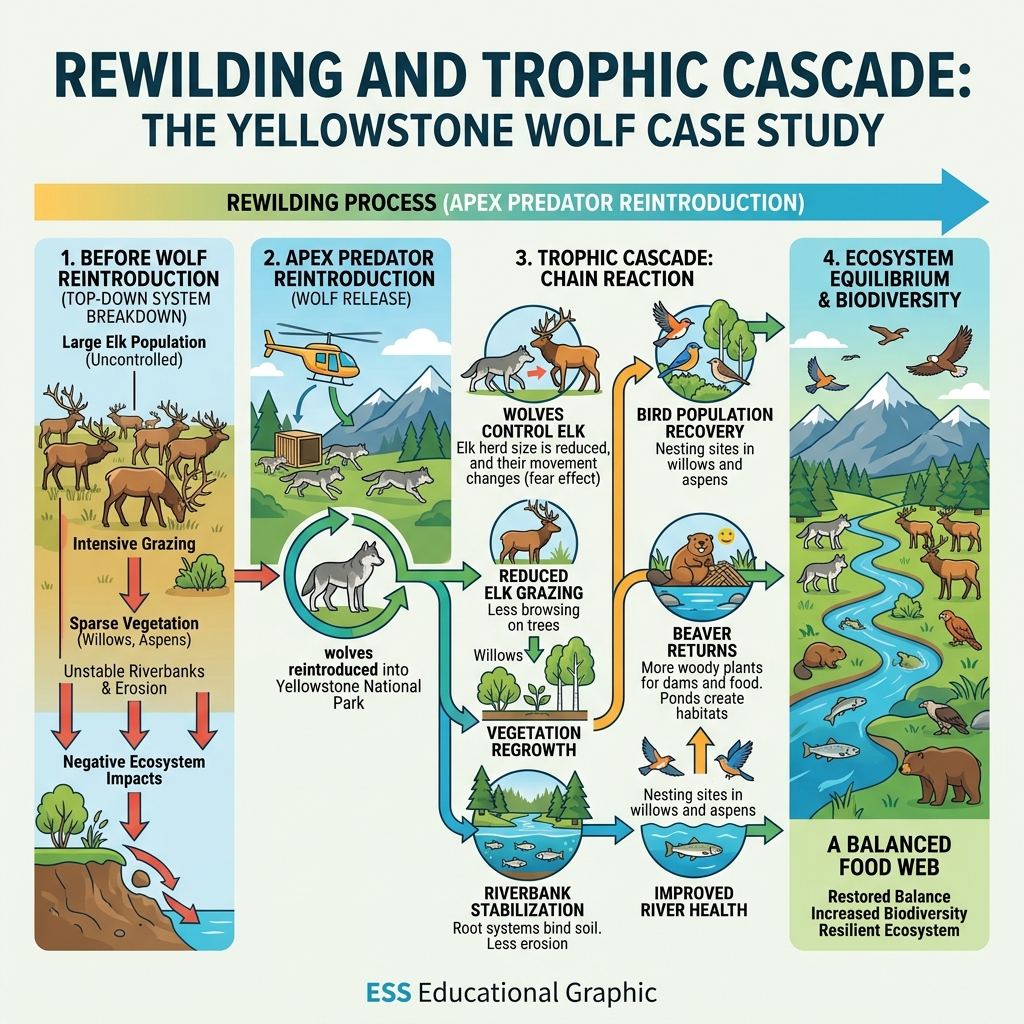
Rewilding Methods
| Method | Mechanism | Example |
|---|
| Reintroduce apex predators | Regulate prey populations → trophic cascade restores balance | Yellowstone wolves — controlled elk → vegetation recovered → beavers, songbirds returned |
| Reconnect habitats | Corridors allow species movement, gene flow, migration | Yellowstone to Yukon Corridor (Y2Y) |
| Cessation of agriculture | Stop farming → allow natural succession to proceed | Oostvaardersplassen (Netherlands) — farmland → self-regulating grassland |
| Minimize human intervention | Hands-off management → ecosystem self-regulates | Knepp Estate (England) — abandoned farmland → nightingales, turtle doves return |
3.3.8
Conservation at Multiple Levels
Key UnderstandingConservation and regeneration measures can be used to reverse the decline in biodiversity to ensure a safe operating space for humanity within the biodiversity planetary boundary.
| Level | Actions | Example |
|---|
| Individual | Plant native species, reduce plastic, volunteer, citizen science | Gardening for pollinators; bird count participation |
| Community | Local reforestation, habitat restoration, community conservancies | Green Belt Movement (Kenya) — community tree planting |
| National | Laws, protected areas, endangered species protection | Brazil's Forest Code; India's Project Tiger |
| International | Treaties, shared targets, funding mechanisms | CBD, CITES, Paris Agreement, Aichi Targets |
🛡️ Conservation
Protect what exists — prevent further loss. Maintains current biodiversity levels.
Example: India's Project Tiger — reserves protect Bengal tigers from poaching and habitat loss.
🌱 Regeneration
Restore what was lost — rebuild damaged ecosystems. Increases biodiversity beyond current levels.
Example: China's Loess Plateau — eroded land restored to productive farmland and forest.
3.3.9
Environmental Perspectives & Conservation
Key UnderstandingEnvironmental perspectives and value systems can impact the choice of conservation strategies selected by a society.
| Perspective | Conservation Approach | Example |
|---|
| Ecocentric | Focus on intrinsic value of ecosystems; minimal intervention; in situ conservation; rewilding | Oostvaardersplassen — hands-off rewilding; national parks with no human interference |
| Anthropocentric / Technocentric | Value biodiversity for human benefit; ex situ strategies; scientific intervention; sustainable use | Zoos, seed banks, ecotourism, gene banks; captive breeding for species recovery |
Key Success Factors
- Community support: Without local buy-in, conservation fails — must align with community needs
- Adequate funding: Long-term financial commitment required
- Education & awareness: Public understanding drives sustainable behavior
- Legislation: Strong legal frameworks protect biodiversity
- Scientific research: Data-driven decisions guide interventions
HL — 3.3.10
Factors Affecting Conservation SuccessHL
Key UnderstandingSuccess in conserving and restoring biodiversity by international, governmental and non-governmental organizations depends on their use of media, speed of response, diplomatic constraints, financial resources and political influence.
| Factor | How It Affects Success |
|---|
| Media use | Public awareness campaigns drive funding and political pressure (e.g. WWF panda campaigns) |
| Speed of response | Rapid action can prevent extinction (emergency captive breeding); slow responses allow decline |
| Diplomatic constraints | International politics can slow or block conservation (e.g. whale hunting quotas in IWC) |
| Financial resources | Funding determines scale of operations — protected area management, anti-poaching patrols, research |
| Political influence | Lobbying for legislation, trade agreements (CITES), international treaties |
Comparing Organizations
| Org | Type | Strengths | Limitations |
|---|
| WWF | NGO | Global brand, media savvy, flagship species campaigns | Depends on donations; may prioritize charismatic species |
| IUCN | Intergovernmental | Scientific credibility, Red List, policy influence | No enforcement power; relies on member states |
| CITES | Treaty | Legally binding trade regulations | Enforcement varies; illegal trade persists |
| National agencies | Government | Legal authority, on-the-ground management | Political changes can reverse protections; underfunding |
HL — 3.3.11
Positive Feedback Loops from RewildingHL
Key UnderstandingPositive feedback loops that enhance biodiversity and promote ecosystem equilibrium can be triggered by rewilding and habitat restoration efforts.
Rewilding can create self-reinforcing cycles where initial improvements trigger further gains — a trophic cascade.
🐺 Apex predator reintroduced
→
🦌 Herbivores controlled
→
🌿 Vegetation recovers
→
🔄 Ecosystem equilibrium
Case Study: Yellowstone Wolves (Positive Feedback Loop)
- Step 1: Wolves reintroduced (1995) → elk populations reduced
- Step 2: Willow and aspen recovered along rivers → stabilized banks
- Step 3: Beavers returned (building dams from recovered willows) → created new ponds
- Step 4: Ponds supported fish, amphibians, insects → more birds returned
- Step 5: Increased vegetation → cooler water temperatures → improved aquatic habitat
- Step 6: Self-sustaining — the ecosystem now maintains itself with minimal intervention
Key concept: A single intervention (wolf reintroduction) triggered a cascade of positive feedback loops — each improvement reinforced the next, creating a self-sustaining cycle of recovery.
HL — 3.3.12
Rewilding: Benefits & LimitationsHL
Key UnderstandingRewilding projects have both benefits and limitations.
✅ Benefits
- Restores natural processes and ecosystem function
- Increases biodiversity through trophic cascades
- Enhances ecosystem resilience to climate change
- Carbon sequestration in recovering vegetation
- Economic opportunities through ecotourism
- Cheaper long-term than intensive management
⚠️ Limitations
- Conflict with local communities (land use, livestock predation)
- Slow process — results may take decades
- Unpredictable outcomes — ecosystems may not recover as expected
- Requires large land areas
- Reintroduced predators may conflict with agriculture
- Political and public opposition (fear of predators)
Case Study: Knepp Estate (England)
- Before: Intensive arable farming — unsustainable, soil degradation, low biodiversity
- Rewilding (2001–): Abandoned farming → allowed natural succession → introduced free-roaming cattle, pigs, horses (as proxy wild herbivores)
- Results: Nightingales, turtle doves, purple emperor butterflies returned; soil quality improved; species diversity increased dramatically
Exam tip: When evaluating rewilding, always present both sides — benefits AND limitations — with specific examples. The IB rewards balanced analysis.
HL — 3.3.13
Assessing Conservation SuccessHL
Key UnderstandingThe success of conservation or regeneration measures needs to be assessed.
| Indicator | What It Shows |
|---|
| Species population trends | Are target species increasing, stable, or declining? |
| Species richness & diversity | Is the number and evenness of species improving? |
| Habitat area & quality | Has protected area expanded? Is habitat condition improving? |
| Ecosystem function | Are ecological processes (nutrient cycling, pollination) restored? |
| Community well-being | Are local communities benefiting (income, food security, participation)? |
Case Studies for Assessment
| Site | Conservation Effort | Assessment |
|---|
| Sichuan Giant Panda Sanctuaries (China) | Mixed approach: 67 reserves + captive breeding | Population ↑ from ~1,000 to ~1,800; reclassified EN → VU; habitat protection effective but climate change threatens bamboo |
| Virachey NP (Cambodia) | WCS-managed protected area | Challenges: illegal logging, poaching, limited funding; some species stable but overall biodiversity still under pressure |
| Bukit Piton Forest Reserve (Malaysia) | WWF habitat restoration | Reforestation increased forest cover; orangutan population recovering; community engagement improving |
Exam skill: When asked to "evaluate success," discuss what has improved AND what still needs work. A balanced answer acknowledges both achievements and ongoing challenges.
HL — 3.3.14
EcotourismHL
Key UnderstandingEcotourism can increase interdependence of local communities and increase biodiversity by generating income and providing funds for protecting areas, but there can also be negative societal and ecological impacts.
✅ Benefits
- Funding: Revenue supports protected area management and anti-poaching
- Local employment: Guides, lodges, crafts — alternative to resource extraction
- Education: Tourists become conservation advocates
- Incentive: Communities value live animals over dead ones
- Example: Costa Rica — ecotourism generates $4B/year; forest cover doubled from 26% to 52%
⚠️ Negative Impacts
- Ecological: Wildlife disturbance, habitat degradation from infrastructure
- Social: Displacement of local communities, cultural commodification
- Economic: Revenue leakage to international operators
- Over-tourism: Visitor numbers exceeding ecological carrying capacity
- Example: Galápagos — visitor numbers growing faster than infrastructure can handle
Successful Ecotourism Model
- Revenue stays local (community-owned lodges, guide cooperatives)
- Visitor numbers limited (carrying capacity respected)
- Strict codes of conduct (distance from wildlife, no feeding)
- Education integrated into the experience
- Benefits reach marginalized groups, not just elites
Key Terms Glossary
Essential Vocabulary
| Term | Definition |
|---|
| Ecosystem services | Benefits provided by ecosystems: provisioning, regulating, cultural, supporting |
| In situ conservation | Protecting species within their natural habitats (national parks, reserves) |
| Ex situ conservation | Protecting species outside natural habitats (zoos, seed banks, captive breeding) |
| Mixed conservation approach | Combining in situ and ex situ methods (e.g. captive breed then release) |
| CBD | Convention on Biological Diversity — UN treaty for biodiversity conservation (1992) |
| NBSAP | National Biodiversity Strategy and Action Plan — each CBD country's conservation roadmap |
| Wildlife corridor | Strip of habitat connecting fragmented reserves → allows migration and gene flow |
| Edge effects | Changes in community composition at habitat boundaries due to adjacent land use |
| SLOSS debate | Single Large vs Several Small reserves — which is more effective for conservation? |
| Biosphere reserve | UNESCO-designated area with core, buffer, and transition zones balancing conservation and development |
| Rewilding | Restoring ecosystems through species reintroduction, habitat connectivity, and minimal human intervention |
| Trophic cascade | Indirect effects across trophic levels triggered by a top predator |
| Ecotourism | Responsible tourism that generates income while protecting biodiversity and benefiting local communities |
Exam Preparation
Key Takeaways & Exam Tips
Must-Know Relationships
- Arguments for conservation = aesthetic + ecological + economic + ethical + social
- In situ (habitat) vs ex situ (species) — mixed approaches combine both
- Reserve design = size + shape + edge effects + connectivity + community involvement
- Rewilding → trophic cascades → positive feedback loops → self-sustaining recovery
- Ecotourism = income + biodiversity protection + community benefit — all three required
- Perspectives matter: Ecocentric → rewilding, parks; Anthropocentric → zoos, sustainable use
For 9-mark essays: Always link conservation strategy to an environmental perspective (ecocentric vs anthropocentric). Use named case studies. Discuss trade-offs, not just benefits.
You've covered all 14 syllabus points ✅
3.3.1 – 3.3.9 (SL) + 3.3.10 – 3.3.14 (HL)
🎉 Topic 3: Biodiversity & Conservation is complete!