IB DP Environmental Systems & Societies — Topic 4: Water
Water Access, Use
& Security
Subtopic 4.2 — New Syllabus (First Assessment 2026)
Standard Level + Higher Level
8 SL Points
4.2.1 – 4.2.8
11 HL Extensions
4.2.9 – 4.2.19
Overview
What You Need to Know
This subtopic defines water security, examines how social/economic/political factors shape access, explores conservation strategies at domestic and industrial levels, and — at HL — covers water stress, planetary boundaries, transboundary disputes, and governance.
A. Water Security & Access
SDG 6, social/economic/political drivers, demand growth
B. Scarcity & Solutions
Physical vs economic scarcity, dams, desalination, drip irrigation, domestic conservation
C. Governance & Stress (HL)
Planetary boundary, water footprints, transboundary disputes, citizen science
Guiding Questions
- What issues of water equity exist, and how can they be addressed?
- How do human populations affect the water cycle, and how does this impact water security?
Time allocation: minimum 2 hours SL + additional HL hours. Second subtopic in Topic 4: Water.
4.2.1
Water Security
Key UnderstandingWater security is having access to sufficient amounts of safe drinking water.
Water security = reliable availability of adequate quantity + acceptable quality water for health, livelihoods, and production.
🎯 SDG 6 Goal
Clean Water and Sanitation for All by 2030 (UN Sustainable Development Goal 6).
⚠️ Global Reality
785 million people lack basic drinking water; 2.2 billion lack safely managed water services.
| Component | Definition |
|---|
| Quality | Safe, uncontaminated water free from pathogens and toxic chemicals |
| Quantity | Adequate volume to meet domestic, agricultural, and industrial needs |
| Accessibility | Equitable availability without physical, economic, or social barriers |
| Sustainability | Water use that does not deplete aquifers or degrade ecosystems for future generations |
4.2.2
Factors Affecting Water Access
Key UnderstandingSocial, cultural, economic and political factors all have an impact on the availability of, and equitable access to, the freshwater required for human well-being.
| Factor | Impact on Water Access | Example |
|---|
| Social | Urbanization outpaces infrastructure; women and girls bear 80% of water-collection burden | Delhi & Mumbai slums — chronic shortages and water tanker dependency |
| Cultural | Traditional water management knowledge (qanat systems); spiritual values attached to rivers | Indigenous water rights in North America; traditional qanats in Iran |
| Economic | Privatization raises costs beyond affordable levels for poor households; agricultural exports displace local supply | Cochabamba "Water Wars" (Bolivia) against privatized utility rate hikes |
| Political | Governance quality, corruption, transboundary river conflicts, infrastructure investments | Nile Basin dispute between Egypt, Sudan, and Ethiopia (GERD dam) |
Case Study: Flint Water Crisis (USA)
A 2014 cost-saving decision switched Flint's water supply to the corrosive Flint River, leaching lead into drinking water and disproportionately affecting low-income minority residents. Demonstrates political and economic inequality in water access even in MEDCs.
4.2.3
Demand: Population Growth & Development
Key UnderstandingHuman societies undergoing population growth or economic development must increase the supply of water or the efficiency of its utilization.
| Sector | % Global Freshwater | Primary Uses | Key Challenge |
|---|
| Agriculture | ~70% | Crop irrigation, livestock watering, food processing | High waste from traditional flood irrigation |
| Industry | ~22% | Power plant cooling, manufacturing, mining | Heavy metal & chemical pollution discharge |
| Domestic | ~8% | Drinking, sanitation, cooking, municipal use | Infrastructure leakage & inequitable distribution |
📈 Population & Wealth Growth
→
💧 Surging Water Demand
→
Option A: Supply Increase
Option B: Efficiency Gains
4.2.4 & 4.2.7
Increasing Water Supply & Agricultural Efficiency
Key UnderstandingWater supplies can be increased by dams, rainwater catchment, desalination, and wetland restoration. Agricultural efficiency can be improved via drip irrigation and aquaponics.
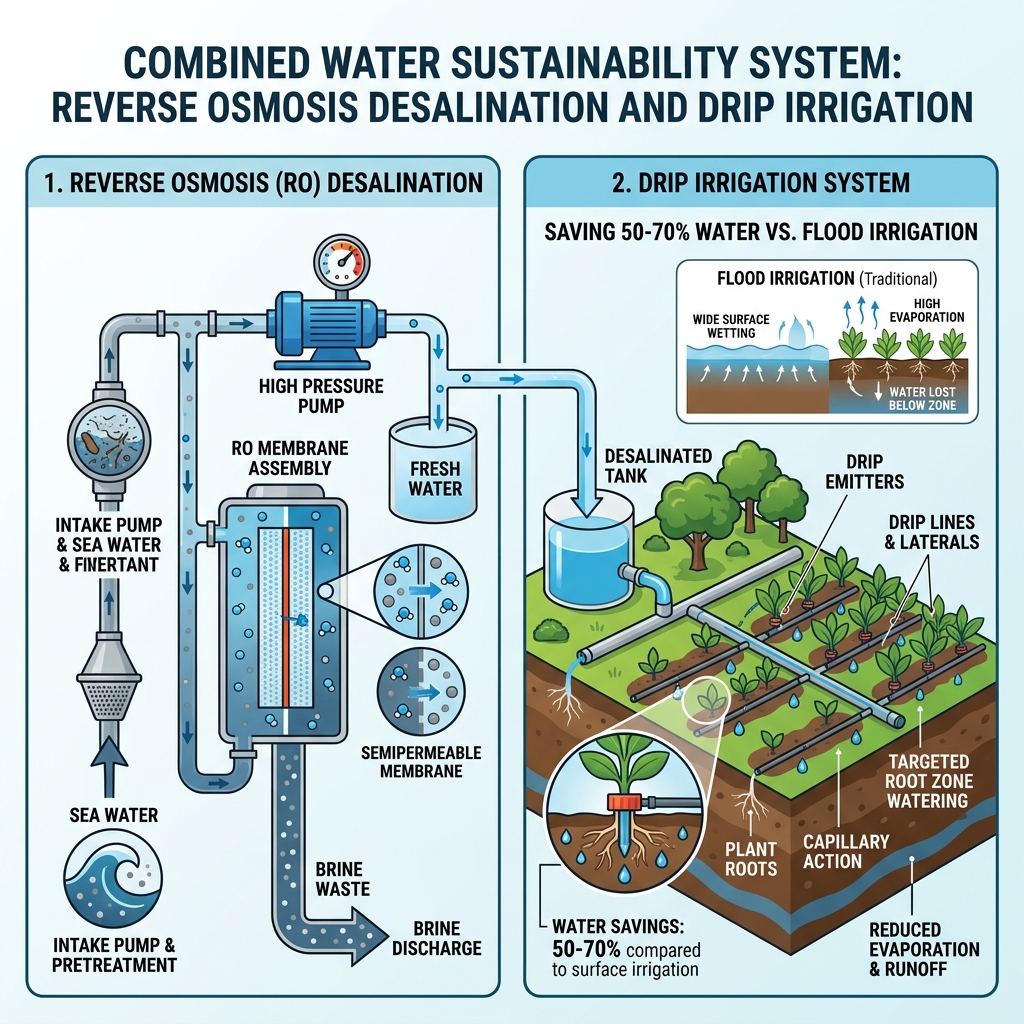
🧂 Desalination (Reverse Osmosis)
Seawater forced through semipermeable membrane under high pressure. Israel gets 85% of domestic water from desalination (Sorek plant: 627,000 m³/day). Challenges: high energy cost, toxic brine disposal.
🌱 Drip Irrigation
Delivers water directly to plant roots via perforated tubes. Saves 50–70% water compared to conventional flood irrigation and minimizes evaporation/weed growth.
4.2.5
Physical vs Economic Water Scarcity
Key UnderstandingWater scarcity refers to the limited availability of water to human societies and can be physical or economic.
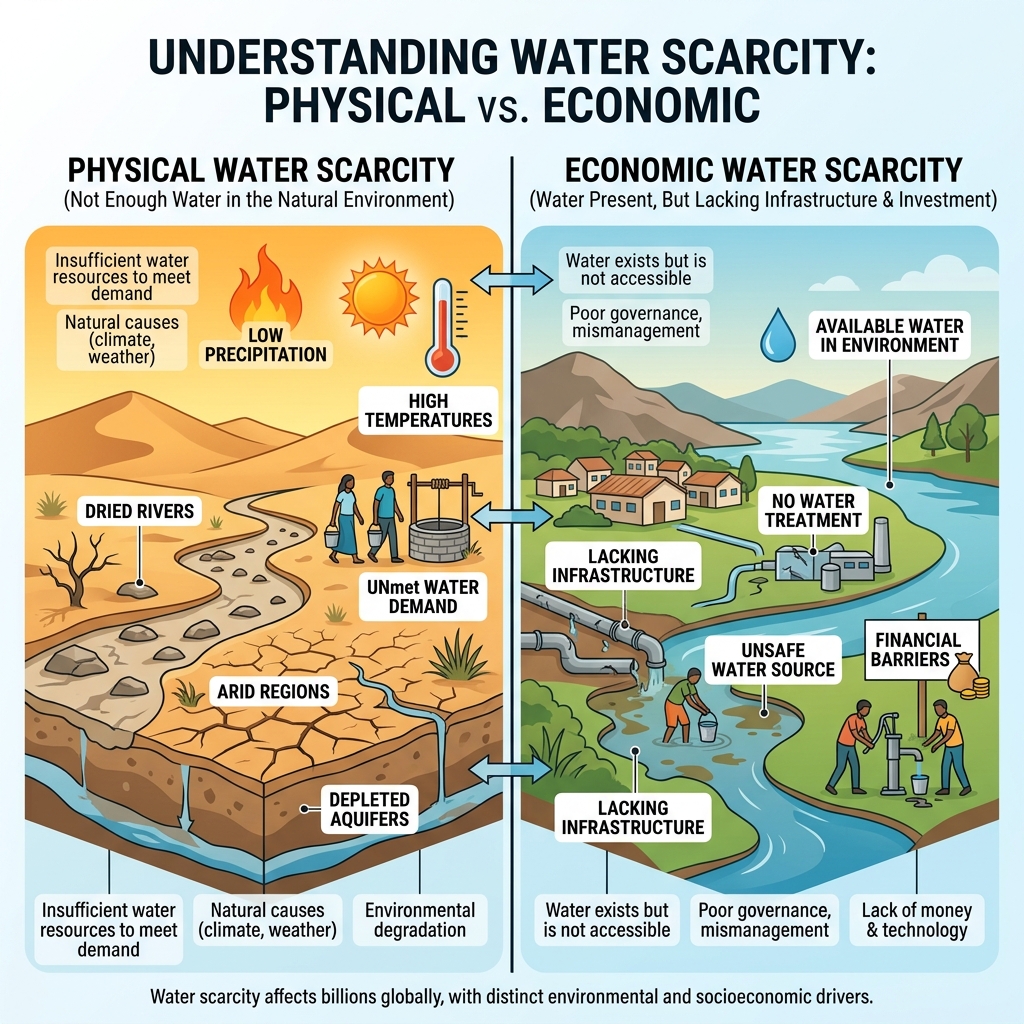
🏜️ Physical Scarcity
Natural water resources are insufficient to meet regional demand (arid climate, drought, overexploited aquifers). Example: Middle East, North Africa, Sahel region.
💰 Economic Scarcity
Water is physically present in the environment, but financial, infrastructural, or institutional barriers prevent people from accessing clean water. Example: Sub-Saharan Africa.
4.2.6 & 4.2.8
Domestic Conservation & National Mitigation
Key UnderstandingDomestic conservation techniques and national mitigation strategies exist to combat water scarcity.
| Country / City | Mitigation Strategy | Mechanism & Results |
|---|
| Israel | Desalination + Drip Irrigation + Recycling | 85% domestic water from RO desalination; 86% wastewater recycled for agriculture |
| Singapore | NEWater Advanced Recycling | Reclaims municipal wastewater using microfiltration & UV → supplies 40% of national water |
| Cape Town | Rationing & Crisis Management | Enforced 50L/day per person limit in 2018, averting "Day Zero" reservoir collapse |
| Domestic Homes | Greywater & Metering | Dual-flush toilets, rainwater harvesting, greywater recycling for garden/flushing |
Key takeaway: Effective water mitigation requires combining supply-side innovations (desalination, wastewater recycling) with demand-side conservation (water pricing, rationing).
HL — 4.2.9
Freshwater as a Planetary BoundaryHL
Key UnderstandingFreshwater consumption is one of the nine planetary boundaries (Rockström et al.). Exceeding it risks abrupt, irreversible ecological shifts.
📊 Safe Operating Limit
Boundary threshold: 4,000 km³/year of global freshwater consumption.
⚠️ Current Status: CROSSED
Current consumption: ~4,600 km³/year → BOUNDARY EXCEEDED.
Systemic Risks of Boundary Transgression
- Aquifer depletion faster than natural recharge rates
- Collapse of river delta ecosystems and drying of major water bodies (e.g. Aral Sea)
- Altered regional evapotranspiration, modifying rainfall and intensifying continental droughts
HL — 4.2.11
Water Footprints & Virtual WaterHL
Key UnderstandingWater footprints measure direct and indirect (virtual) water consumption, informing societal decision-making on water security.
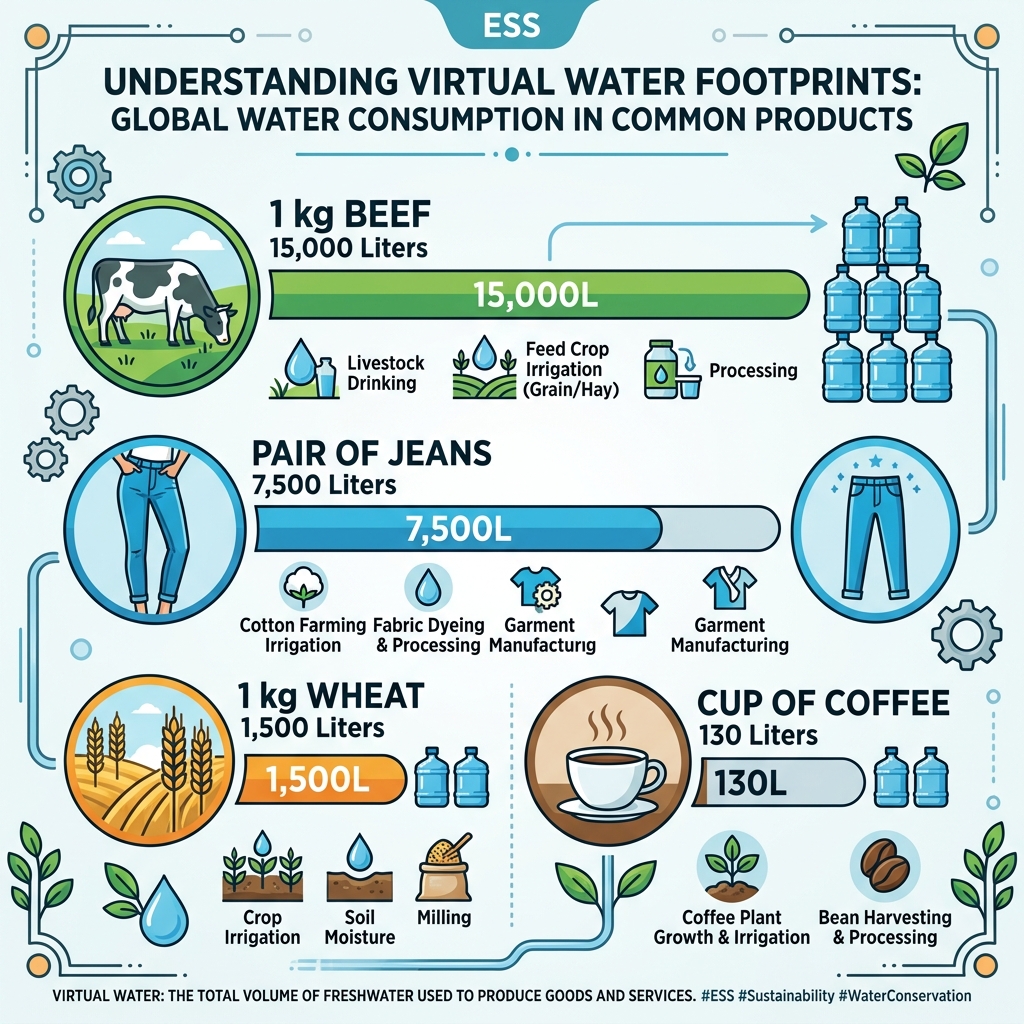
| Consumer Item | Embedded Virtual Water | Why It Is High |
|---|
| 1 kg Beef | ~15,000 Liters | Years of feed crop irrigation (grain/hay) + livestock drinking water |
| 1 Pair of Jeans | ~7,500 Liters | Water-intensive cotton crop irrigation + fabric dyeing & processing |
| 1 kg Wheat | ~1,500 Liters | Crop evapotranspiration & soil moisture consumption |
| 1 Cup of Coffee | ~130 Liters | Growing, harvesting, washing, and roasting coffee beans |
Virtual Water Trade Note: Importing water-intensive goods allows water-scarce nations to "import" water from water-rich nations, relieving local water stress.
HL — 4.2.13 & 4.2.14
Water Stress Thresholds & DimensionsHL
Key UnderstandingWater stress takes into account availability, quality, environmental flows, and accessibility. Defined as clean accessible supply under 1,700 m³/year per capita.
Falkenmark Water Stress Indicators
- >1,700 m³/capita/year: No Water Stress
- <1,700 m³/capita/year: Water Stress (periodic shortages)
- <1,000 m³/capita/year: Water Scarcity (chronic supply disruption)
- <500 m³/capita/year: Absolute Scarcity (human health & economic viability threatened)
| Dimension | Metric Focus |
|---|
| Scarcity | Volumetric availability per person per year |
| Quality | Freedom from chemical toxins, heavy metals, and bacterial pathogens |
| Environmental Flows | Minimum river discharge required to sustain aquatic ecosystem health |
| Accessibility | Physical distance and economic affordability of safe water sources |
HL — 4.2.15 & 4.2.16
Transboundary Water DisputesHL
Key UnderstandingOver 60% of international river basins are transboundary. Upstream water diversion or damming creates geopolitical conflict with downstream states.
| Transboundary Basin | Nations Involved | Core Conflict & Geopolitics |
|---|
| Nile River | Ethiopia, Sudan, Egypt | Ethiopia's Grand Ethiopian Renaissance Dam (GERD) vs Egypt's historical downstream water rights |
| Mekong River | China, Laos, Thailand, Cambodia, Vietnam | Upstream Chinese hydroelectric dams trap sediment and restrict water flow to downstream Vietnamese rice farming & fisheries |
| Colorado River | 7 US States & Mexico | Over-allocation among agriculture, cities (Las Vegas, LA), and Mexico; climate drought leaves Lake Mead at critical low levels |
HL — 4.2.18 & 4.2.19
Industrial Trade-offs & Inequitable AccessHL
Key UnderstandingIndustrial water production carries unavoidable environmental impacts. Inequitable water and sanitation access reinforces poverty traps, disease, and gender inequality.
⚠️ Industrial Environmental Costs
- Desalination: toxic brine discharge destroys benthic marine life; high fossil fuel energy use
- Wastewater treatment: chemical sludge disposal and high energy consumption
👧 Human & Gender Development Impact
- Women/girls spend 200 million hours/day collecting water globally → missed schooling & economic exclusion
- Unsafe water causes 842,000 diarrheal deaths annually, locking communities in poverty traps
Economic Multiplier: Every $1 invested in clean water and sanitation yields $8 in economic returns from reduced healthcare costs and increased productivity.
Key Terms Glossary
Essential Vocabulary
| Term | Definition |
|---|
| Water Security | Reliable access to sufficient, safe, affordable water for human well-being and ecosystems |
| Physical Scarcity | Inadequate natural water resources to satisfy regional water demand |
| Economic Scarcity | Lack of investment or infrastructure to access abundant natural water resources |
| Reverse Osmosis | High-pressure membrane filtration process removing salt from seawater |
| Drip Irrigation | Micro-irrigation system delivering water directly to plant root zones, saving 50-70% water |
| Virtual Water | Volume of freshwater embedded in the production of food, goods, or services |
| Planetary Boundary | Threshold for global freshwater consumption (4,000 km³/yr) — currently exceeded |
| Water Stress | Condition when annual water availability falls below 1,700 m³ per person |
| Transboundary Basin | River or aquifer system shared across national borders, prone to geopolitical conflict |
| Environmental Flows | Minimum river discharge required to sustain downstream ecosystem health |
Exam Preparation
Key Takeaways & Exam Tips
Must-Know Concepts
- Security components: Quality + Quantity + Accessibility + Sustainability.
- Scarcity distinction: Physical = nature lacks water; Economic = society lacks infrastructure/funds.
- Agriculture priority: Uses 70% of freshwater; drip irrigation & dietary shifts offer highest conservation potential.
- HL Transboundary & Boundaries: GERD/Nile dispute as a primary case study; freshwater planetary boundary exceeded (~4,600 km³/yr).
Exam tip: For 9-mark essay questions on water security, analyze both supply-side (desalination, dams) and demand-side (drip irrigation, pricing, conservation) approaches across MEDCs vs LEDCs.
You've covered all 19 syllabus points ✅
4.2.1 – 4.2.8 (SL) + 4.2.9 – 4.2.19 (HL)