IB DP Environmental Systems & Societies — Topic 4: Water
Aquatic Food
Production Systems
Subtopic 4.3 — New Syllabus (First Assessment 2026)
Standard Level + Higher Level
10 SL Points
4.3.1 – 4.3.10
6 HL Extensions
4.3.11 – 4.3.16
Overview
What You Need to Know
This subtopic examines aquatic food webs, human demand for seafood, overexploitation and fishery collapse, sustainable management (MSY, MPAs, policy), aquaculture, and climate change impacts on aquatic ecosystems.
A. Aquatic Food Webs
Phytoplankton & macrophytes, human demand, unsustainable harvesting
B. Fishery Collapse & Solutions
Grand Banks cod, MSY, MPAs, policy & aquaculture
C. Governance & Ethics (HL)
Stock assessments, MSY risks, UNCLOS EEZs, marine mammal ethics
Guiding Questions
- How are our diets impacted by our values and perspectives?
- To what extent are aquatic food systems sustainable?
Time allocation: minimum 4 hours SL + additional HL hours. Third subtopic in Topic 4: Water.
4.3.1
Aquatic Food Webs
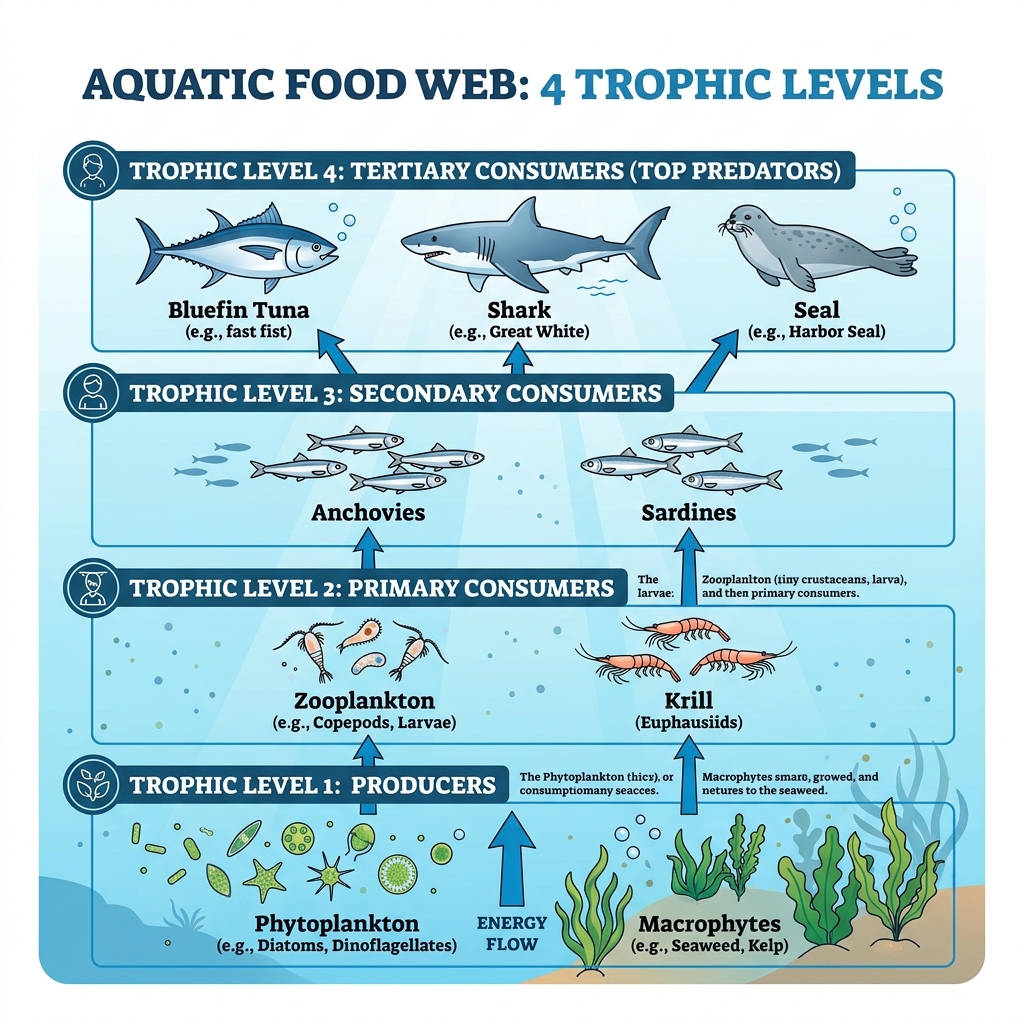
Key UnderstandingPhytoplankton and macrophytes provide energy for freshwater and marine food webs.
| Producer | Type & Description | Ecological Significance |
|---|
| Phytoplankton | Microscopic photosynthesizers (diatoms, dinoflagellates) floating in water column | Foundation of open-ocean & lake food webs; produce ~50% of Earth's oxygen |
| Macrophytes | Visible aquatic plants (seaweed, kelp, seagrass, water lilies) | Primary production in shallow coastal & freshwater zones; provide habitat & shelter |
4.3.2 & 4.3.3
Human Consumption & Surging Global Demand
Key UnderstandingGlobal demand for seafood and aquatic plants (seaweed, spirulina) is rising rapidly due to population growth, health awareness, and economic development.
📈 Rising Consumption
Per capita fish consumption has doubled since the 1960s (9.9 kg → 20.5 kg/year per person). Total global fish production reached 179 million tonnes.
🌿 Seaweed & Flora Boom
Seaweed farming exceeds 30 million tonnes/year, used for food (nori), bio-plastics, cosmetics, and carbon sequestration.
| Category | Examples | Nutritional & Social Value |
|---|
| Marine Fauna | Tuna, salmon, cod, shrimp, sardines | Essential animal protein, omega-3 fatty acids, micronutrients |
| Freshwater Fauna | Tilapia, carp, catfish, crawfish | Crucial local protein source in LEDCs and rural communities |
| Flora | Kelp, nori, spirulina, wakame | Rich in iodine, vitamins, minerals; low carbon footprint |
4.3.4 & 4.3.5
Unsustainable Harvesting & Fishery Collapse
Key UnderstandingIncreasing demand has driven destructive harvesting practices (bottom trawling, blast fishing, ghost gear) leading to major fishery collapses.
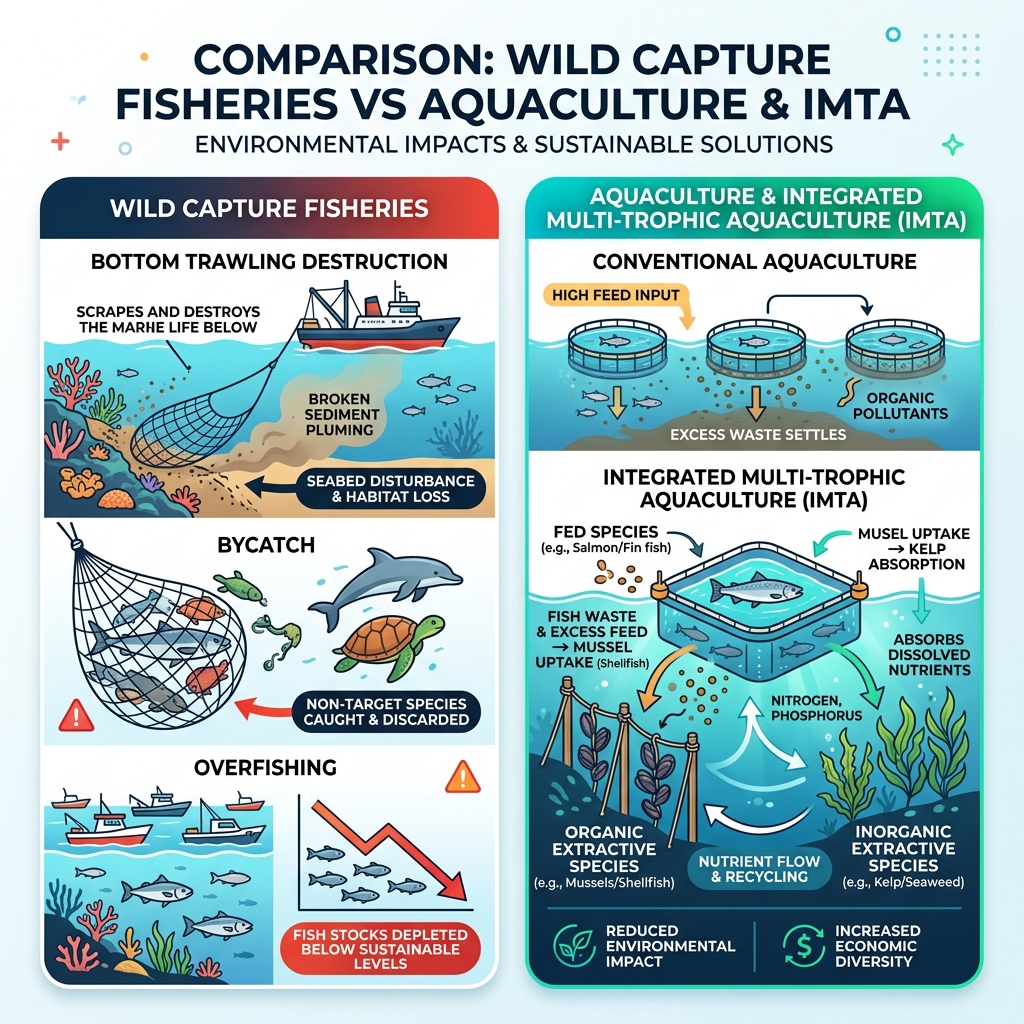
Classic Case Study: Grand Banks Cod Collapse (Newfoundland, 1992)
- Industrial trawling + sonar technology + government over-allocation depleted Atlantic cod by >99%.
- In 1992, Canada declared a complete fishing moratorium, laying off 30,000+ fishers (largest layoff in Canadian history).
- Even 30+ years later, cod stocks have failed to recover due to altered food web dynamics.
4.3.6
Maximum Sustainable Yield (MSY)
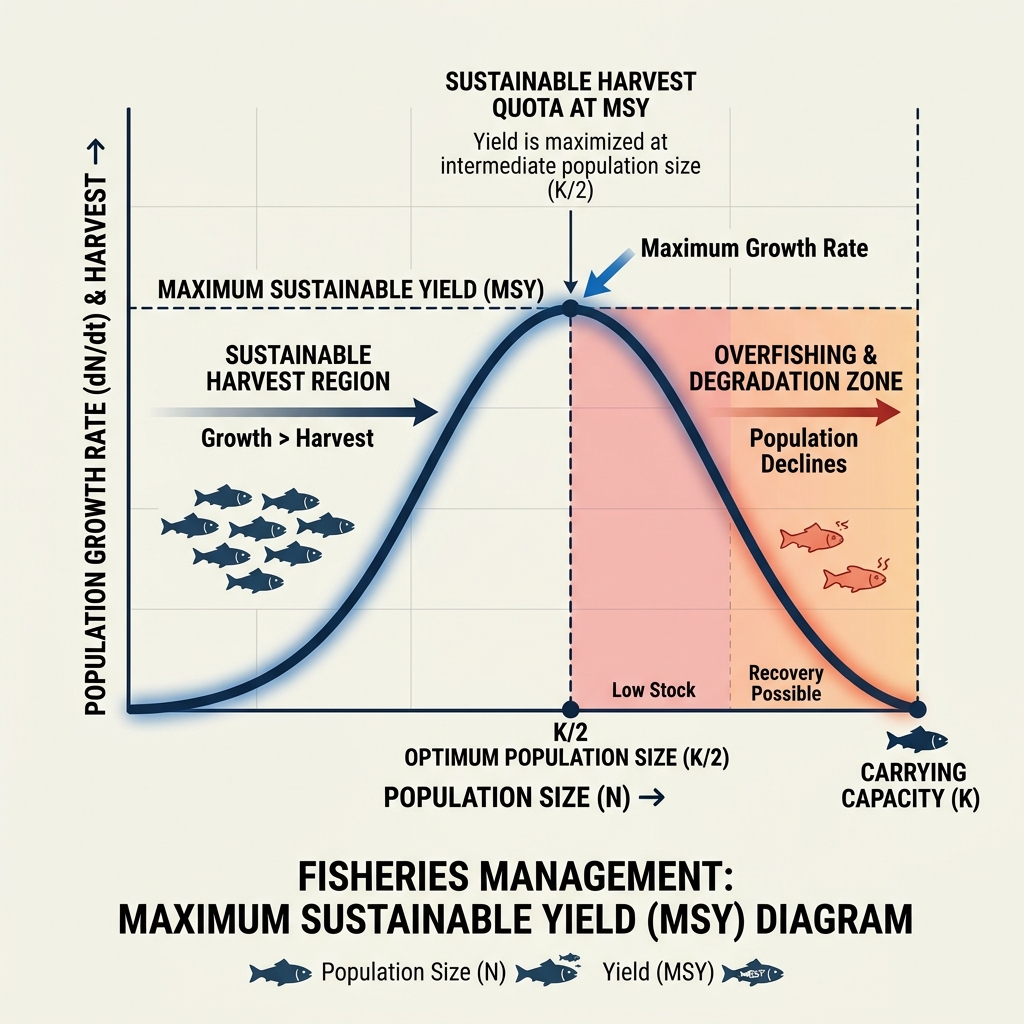
Key UnderstandingThe maximum sustainable yield (MSY) is the highest annual catch that can be sustained without long-term population decline (occurs at $K/2$).
🎯 Maximum Growth at $K/2$
Population growth rate is highest at intermediate density (half carrying capacity). Harvesting equal to this rate keeps stock constant.
⚠️ Overfishing Hazard
Catching above MSY reduces stock size below $K/2$, reducing reproduction speed and leading toward collapse.
4.3.7
Climate Change & Ocean Acidification
Key UnderstandingWarming water temperatures and ocean acidification disrupt aquatic ecosystems, risking widespread species mortality.
| Stress Driver | Mechanism | Ecosystem Impact |
|---|
| SST Warming | High sea surface temperatures cause corals to expel zooxanthellae algae | Mass coral bleaching (e.g. Great Barrier Reef lost ~50% corals) |
| Ocean Acidification | Dissolved CO₂ forms carbonic acid, reducing carbonate ions ($\text{CO}_3^{2-}$) | Shell dissolution & growth inhibition in pteropods, oysters, and reefs |
| Thermal Shifts | Fish species migrate poleward pursuing cooler water temperatures | Disrupts traditional fisheries & local marine food webs |
4.3.8 & 4.3.9
Policy, Marine Protected Areas (MPAs) & Consumer Power
Key UnderstandingMPAs, mesh size legislation, quotas, and MSC eco-labeling protect aquatic food webs and restore fish yields.
🛡️ Marine Protected Areas (MPAs)
No-take zones allow fish to reach maturity and reproduce. The "spillover effect" replenishes fish stocks in adjacent fishing zones (e.g. Ross Sea MPA, Great Barrier Reef).
🏷️ Policy & Consumer Labels
Enforcing net mesh size rules lets juvenile fish escape. Consumer choice via MSC (Marine Stewardship Council) certification incentivizes sustainable fishery practices.
4.3.10
Aquaculture & Sustainable Models
Key UnderstandingAquaculture (farming fish, crustaceans, algae) meets global demand but risks nutrient pollution, disease spread, and wild feed depletion.
✅ Benefits
- Relieves fishing pressure on wild marine stocks
- Provides 46%+ of global seafood supply
- Creates employment in coastal communities
⚠️ Environmental Risks
- Eutrophication from uneaten feed & fish waste
- Sea lice & disease transmission to wild fish
- Mangrove deforestation for coastal shrimp ponds
Sustainable Innovation: Integrated Multi-Trophic Aquaculture (IMTA)
IMTA combines finfish (fed species) with mussels/oysters (organic extractors) and kelp/seaweed (inorganic nutrient absorption) in a single integrated system, turning waste into valuable co-products.
HL — 4.3.11 & 4.3.12
Interconnected Dynamics & Stock AssessmentsHL
Key UnderstandingStratification, nutrient mixing, and upwellings dictate aquatic primary productivity. Stock assessments require rigorous scientific monitoring.
🌡️ Thermal Stratification
→
🚫 Blocks Nutrient Mixing
→
📉 Low Surface Phytoplankton
→
🐟 Reduced Fish Biomass
Stock Assessment Tools
Fisheries use acoustic sonar surveys, catch-per-unit-effort (CPUE) logs, and environmental DNA (eDNA) sampling to estimate biomass. Inaccurate data leads to quota over-allocation and stock collapse.
HL — 4.3.13 & 4.3.14
Risks of Harvesting at MSY & Multi-Stakeholder RecoveryHL
Key UnderstandingHarvesting at exactly MSY leaves no safety buffer for bad climate years. Fishery recovery requires multi-stakeholder cooperation.
⚠️ MSY Management Risks
- Ignores annual environmental fluctuations (El Niño, warming)
- Assumes perfect population data without accounting for illegal (IUU) fishing
- Precautionary approach advocates fishing below MSY
🤝 Recovery Alliance
- Governments (strict quota enforcement & MPAs)
- Industry (selective gear & vessel tracking)
- Supermarkets & Retailers (sourcing only MSC-certified fish)
HL — 4.3.15 & 4.3.16
UNCLOS EEZs & Marine Mammal Harvesting EthicsHL
Key UnderstandingUNCLOS grants 200 nautical mile (370 km) EEZs to coastal states, leaving 60% of oceans as high seas. Marine mammal harvesting sparks ethical conflicts.
UNCLOS Maritime Zones
- Exclusive Economic Zone (EEZ): Coastal nation controls all living and mineral resources up to 370 km from shore.
- High Seas (60% of oceans): Outside national jurisdiction; prone to "Tragedy of the Commons" and overfishing until recent High Seas Treaty agreements.
Ethical Conflicts in Marine Mammal Harvesting
Commercial whaling/sealing (Japan, Norway, Iceland) vs. International Whaling Commission (IWC) moratorium vs. Indigenous subsistence rights (Inuit whale hunting). Balances animal sentience rights against cultural heritage and food sovereignty.
Key Terms Glossary
Essential Vocabulary
| Term | Definition |
|---|
| Phytoplankton | Microscopic photosynthesizers forming the foundation of aquatic food webs |
| Overexploitation | Harvesting wild species faster than natural reproduction can replace them |
| Bottom Trawling | Dragging heavy weighted nets across seafloor, destroying benthic habitats and causing high bycatch |
| Maximum Sustainable Yield (MSY) | Highest annual catch rate that maintains stock equilibrium (at $K/2$) |
| Marine Protected Area (MPA) | Designated ocean zone restricting fishing to allow ecosystem recovery & spillover |
| Aquaculture | Farming aquatic organisms (fish, crustaceans, mollusks, algae) under controlled conditions |
| IMTA | Integrated Multi-Trophic Aquaculture combining fed species, shellfish, and seaweed to recycle waste |
| UNCLOS | UN Convention on the Law of the Sea establishing 200 nm (370 km) EEZs |
| EEZ | Exclusive Economic Zone where coastal states hold sovereign resource rights |
| IWC Moratorium | 1986 global ban on commercial whaling by International Whaling Commission |
Exam Preparation
Key Takeaways & Exam Tips
Must-Know Concepts
- Food web base: Phytoplankton produce 50% of Earth's O₂.
- Grand Banks Cod lesson: Tech + overcapacity + high quotas = total stock collapse.
- MSY mechanics: Occurs at $K/2$; harvesting at exact MSY carries high risk without safety buffers.
- HL UNCLOS & High Seas: EEZ = 370 km; High Seas = 60% of ocean subject to open-access depletion.
Exam tip: Evaluate aquaculture by contrasting traditional open-cage salmon farming (disease, pollution) with IMTA systems (waste recycling, multi-product revenue).
You've covered all 16 syllabus points ✅
4.3.1 – 4.3.10 (SL) + 4.3.11 – 4.3.16 (HL)