Soil Systems & Ecosystems
Subtopic 5.1 — New Syllabus (First Assessment 2026)
Standard Level + Higher Level
What You Need to Know
This subtopic models soil as an open dynamic system — examining its composition, profile horizons, inputs, outputs, transfers, transformations, role in biogeochemical cycles, texture, humus, and function as a global carbon sink.
Dynamic open system, composition, horizons (O, A, B, C, R)
Inputs/outputs, transfers/transformations, texture triangle, humus
Soil classification (-isols), 5 formation factors, soil analysis, CO₂ vs $\text{CH}_4$ release
Guiding Questions
- How do soils play a role in sustaining natural systems?
- How are human activities affecting the stability of soil systems?
Soil as a Dynamic System & Composition
| System Component | Function & Ecological Role |
|---|---|
| Inorganic Minerals | Derived from rock weathering; provide structural support and mineral nutrients ($\text{K}^+, \text{Ca}^{2+}, \text{Mg}^{2+}$) |
| Organic Matter & Humus | Provides plant nutrients ($\text{N, P}$), enhances water retention, feeds decomposers, improves soil crumb structure |
| Soil Water & Air | Dissolves nutrients for root absorption; provides oxygen for root and microbial respiration |
Soil Profile & Horizons
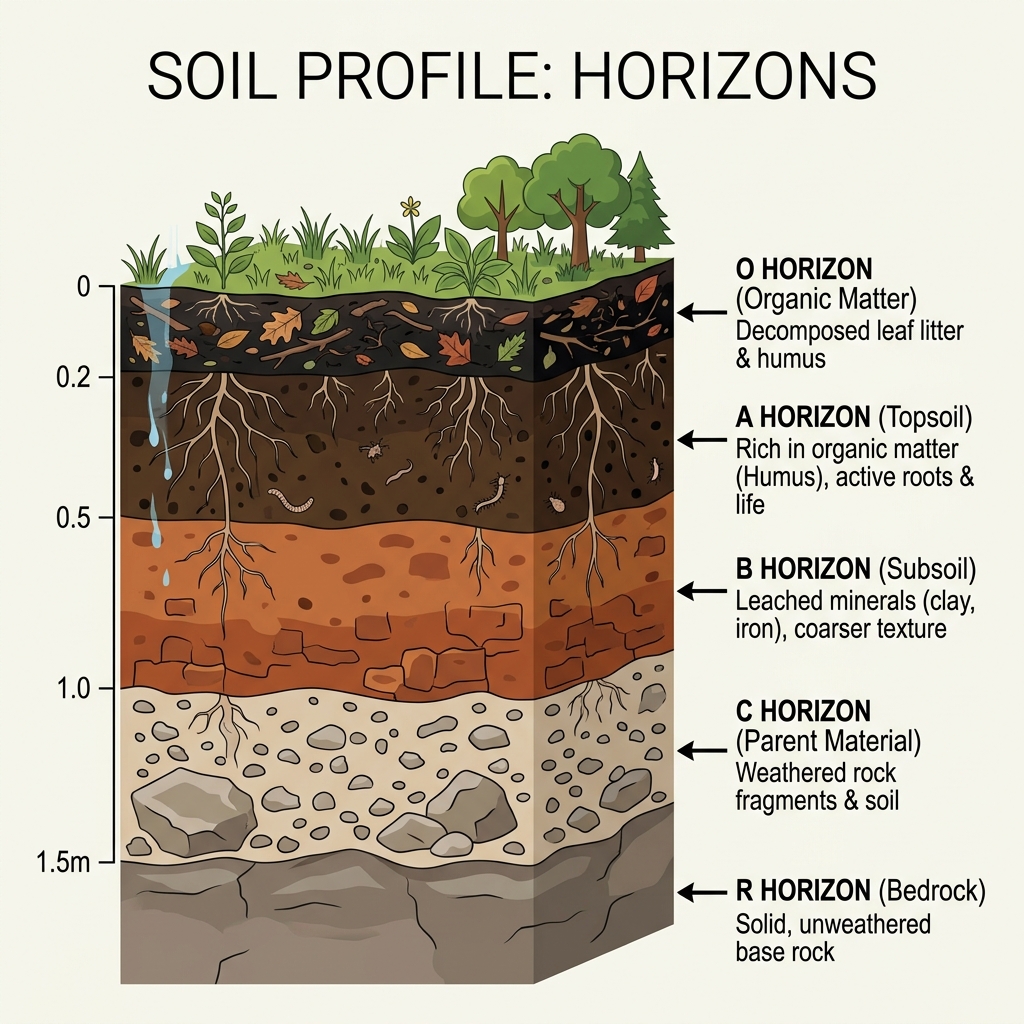
| Horizon | Layer Name | Key Characteristics |
|---|---|---|
| O Horizon | Organic Layer | Decomposed leaf litter, plant residues, and dark humus accumulation |
| A Horizon | Topsoil / Mixed Layer | Rich in organic humus, active plant roots, and soil life. Most fertile & most vulnerable layer |
| B Horizon | Subsoil | Accumulates leached minerals (iron, aluminum oxides, clay) washed down from A horizon |
| C Horizon | Parent Material | Partially weathered bedrock and coarse rock fragments with minimal organic content |
| R Horizon | Bedrock | Solid unweathered bedrock layer foundation |
System Inputs, Outputs, Transfers & Transformations
📥 Inputs & Transfers
- Inputs: Plant litterfall, organic manure, precipitation minerals, nitrogen fixation
- Transfers: Infiltration, downward percolation, earthworm biological mixing, leaching
📤 Outputs & Transformations
- Outputs: Wind & water topsoil erosion, nutrient leaching, plant harvesting, $\text{CO}_2/\text{CH}_4$ gas release
- Transformations: Organic decomposition to humus, rock weathering, nitrification
Soil in Biogeochemical Cycles & Plant Medium
| Biogeochemical Cycle | Soil Storage & Flow Role |
|---|---|
| Water Cycle | Infiltration, soil water storage, percolation to aquifers, uptake for plant transpiration |
| Carbon Cycle | Stores organic carbon in humus & peat; releases CO₂ via root and microbial respiration |
| Nitrogen Cycle | $\text{N}_2$-fixing bacteria convert nitrogen to $\text{NH}_4^+$; nitrifying bacteria convert $\text{NH}_4^+$ to $\text{NO}_3^-$ for plant absorption |
Soil Biodiversity & Ecosystem Functions
| Soil Organism Group | Ecological Role & Ecosystem Service |
|---|---|
| Decomposers & Fungi | Break down complex lignin & cellulose into plant-available nutrients and humus |
| Mycorrhizal Fungi | Symbiotic association with plant roots — greatly expands root surface area for phosphorus & water absorption |
| Earthworms & Burrowers | Biological mixing of O & A horizons, creating macropores for aeration and water infiltration |
| $\text{N}_2$-Fixing Bacteria | Rhizobium in legume root nodules convert atmospheric $\text{N}_2$ gas into bio-available nitrates |
Soil Texture Triangle & Productivity
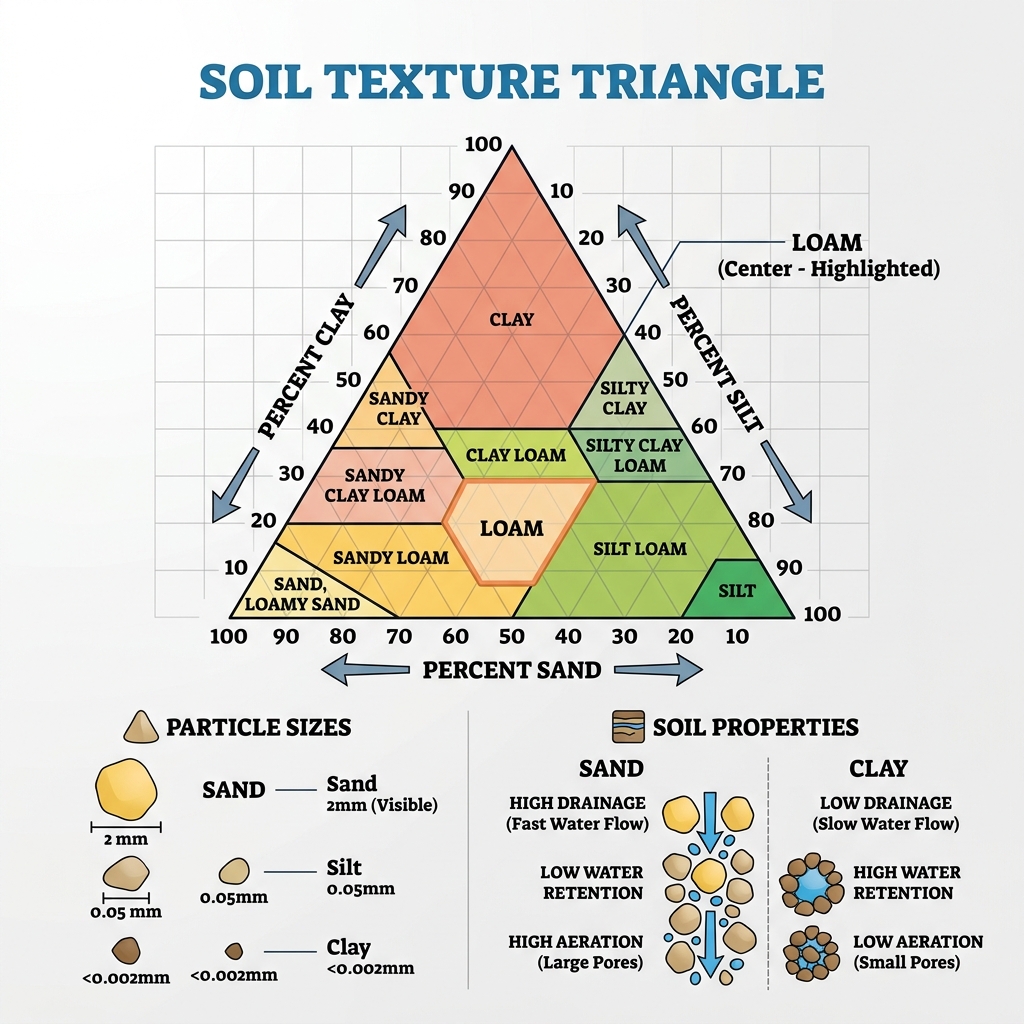
| Particle Type | Particle Size | Water Retention | Drainage & Aeration | Nutrient Holding |
|---|---|---|---|---|
| Sand | 0.05 – 2.0 mm | Low | Excessive / High | Low |
| Silt | 0.002 – 0.05 mm | Moderate | Moderate | Moderate |
| Clay | < 0.002 mm | Very High | Poor / Waterlogged | High ($\text{CEC}$) |
| Loam (Balanced) | Mix + Humus | Optimum | Optimum | High |
Soils as Carbon Sinks, Stores & Sources
❄️ Cold Permafrost & Peatlands
Decomposition is extremely slow due to freezing or anaerobic conditions $\rightarrow$ massive long-term carbon sink (e.g. Arctic tundra, peat bogs).
🌴 Tropical Rainforest Soil
Warmth and moisture accelerate decomposition $\rightarrow$ organic carbon rapidly recycled into biomass $\rightarrow$ thin soil carbon store.
🔥 Degraded Agricultural Soil
Deforestation, heavy tillage, and wetland drainage accelerate oxidation $\rightarrow$ turns soil from carbon sink to net CO₂ source.
Soil Classification & 5 Formation FactorsHL
| Soil Order (-isol) | Associated Biome | Profile Features |
|---|---|---|
| Oxisol | Tropical Rainforest | Deep, highly weathered, red/yellow iron oxide rich, nutrient-depleted topsoil |
| Mollisol | Temperate Grassland (Prairie) | Deep, dark, humus-rich A horizon; exceptionally high fertility |
| Spodosol | Boreal Forest (Taiga) | Acidic, leached ash-gray A horizon with mineral accumulation in B horizon |
| Aridisol | Desert | Arid, alkaline, minimal organic matter with salt/calcium carbonate crusts |
A Horizon Value & VulnerabilityHL
Topsoil Vulnerability & Degradation Cascade
- Plowing and vegetation removal expose loose A horizon particles to wind and water erosion.
- Erosion removes dark humus $\rightarrow$ loss of Cation Exchange Capacity ($\text{CEC}$) and water-holding ability.
- Subsoil (B horizon) exposure results in poor seedling germination and agricultural desertification.
Soil Analysis & Greenhouse Gas ReleaseHL
| Soil Analysis Parameter | Measurement Method | Ecological Meaning |
|---|---|---|
| Bulk Density | Core dry mass / core volume | High bulk density indicates severe soil compaction, restricting root growth |
| Organic Content (%) | Loss-on-ignition (dry burning at 500°C) | Higher % indicates greater humus content, fertility, and carbon storage |
| Gas Emission Mode | Aerobic vs Anaerobic respiration | Aerobic soils release CO₂; flooded rice paddies/peatlands release $\text{CH}_4$ (28× GHG potency) |
Essential Vocabulary
| Term | Definition |
|---|---|
| Soil Profile | Vertical cross-section showing distinctive soil horizons (O, A, B, C, R) |
| Humus | Dark, crumbly organic material formed by fully decomposed plant and animal matter |
| A Horizon (Topsoil) | Fertile mixed organic-mineral layer essential for root growth; highly vulnerable to erosion |
| Leaching | Downward removal of dissolved mineral nutrients out of root reach by percolating water |
| Loam | Optimal agricultural soil texture combining balanced sand, silt, clay, and organic humus |
| Mycorrhizae | Symbiotic fungal-plant root association enhancing nutrient (phosphorus) and water uptake |
| Oxisol / Mollisol | Soil orders characteristic of tropical rainforests (Oxisol) and temperate grasslands (Mollisol) |
| Bulk Density | Dry soil mass per unit volume; indicator of soil compaction and aeration pore space |
| Permafrost Carbon Sink | Frozen Arctic soils storing massive amounts of organic carbon under low decomposition rates |
Key Takeaways & Exam Tips
Must-Know Concepts
- Soil System Model: Inputs (litter, rain) $\rightarrow$ Transfers (leaching, percolation) $\rightarrow$ Transformations (decomposition, weathering) $\rightarrow$ Outputs (erosion, gas release).
- Plant Nutrients Exception: Plants absorb mineral nutrients ($\text{N, P, K}$) from soil water, but carbon is taken from atmospheric CO₂.
- Texture Triangle: Practice reading Sand %, Silt %, Clay % coordinates to identify Loam vs Clay soil.
- HL Formation Factors: Remember CLORPT (Climate, Organisms, Relief, Parent Material, Time).
You've covered all 21 syllabus points ✅
5.1.1 – 5.1.14 (SL) + 5.1.15 – 5.1.21 (HL)