Agriculture & Food Systems
Subtopic 5.2 — New Syllabus (First Assessment 2026)
Standard Level + Higher Level
What You Need to Know
This subtopic covers global food production systems, land scarcity, food equity, traditional farming vs Green Revolution monoculture, soil conservation techniques, trophic efficiency, food security, and — at HL — regenerative farming, high-tech vertical agriculture, and malnutrition.
Land scarcity, food waste (~30%), food distribution equity, Maasai land rights
Green Revolution, synthetic fertilizers, 6 soil conservation techniques
Permaculture, zero tillage, vertical farming, diet sustainability, malnutrition
Guiding Question
- To what extent can the production of food be considered sustainable?
Land Scarcity, Equity & Food Distribution
🗑️ Global Food Waste (~30%)
Developing nations lose food post-harvest due to storage & transport gaps; MEDCs waste food at retail and consumer levels.
⚖️ Inequitable Access
Marginalized groups (such as indigenous pastoralists) are disproportionately displaced by commercial land-use decisions without input.
Case Study: Maasai Pastoralist Dispossession (East Africa)
Traditional Maasai grazing lands have been increasingly converted to commercial agriculture, national parks, and safari tourism, restricting their seasonal nomadic mobility and creating localized food insecurity.
Agricultural Systems & Traditional Practices
| Farming System | Input & Energy Intensity | Outputs & Sustainability |
|---|---|---|
| Subsistence Farming | Low inputs (family labor, manure, saved seed) | Local family food supply; high ecological sustainability at low density |
| Nomadic Pastoralism | Low inputs (seasonal livestock herding) | Meat, milk, blood; sustainable in arid grasslands with low population |
| Slash-and-Burn (Shifting) | Low inputs (forest clearance & burning) | Ash-fertilized crops for 2-3 yrs; forest regenerates if fallow period is long |
| Commercial Monoculture | High inputs (fossil fuels, synthetic NPK, pesticides, hybrid seeds) | High single-crop yield for market; high risk of soil degradation & pollution |
The Green Revolution
✅ Benefits
- Saved millions from acute famine in India, Mexico, and Southeast Asia
- Dramatically increased crop yield per hectare without expanding land area
- Lowered global grain market prices
⚠️ Environmental & Social Costs
- Heavy soil degradation, salinization, and chemical runoff eutrophication
- High fossil fuel dependency & groundwater depletion
- Smallholder farmer debt traps due to expensive patented seeds & inputs
Synthetic Fertilizers & 6 Soil Conservation Techniques
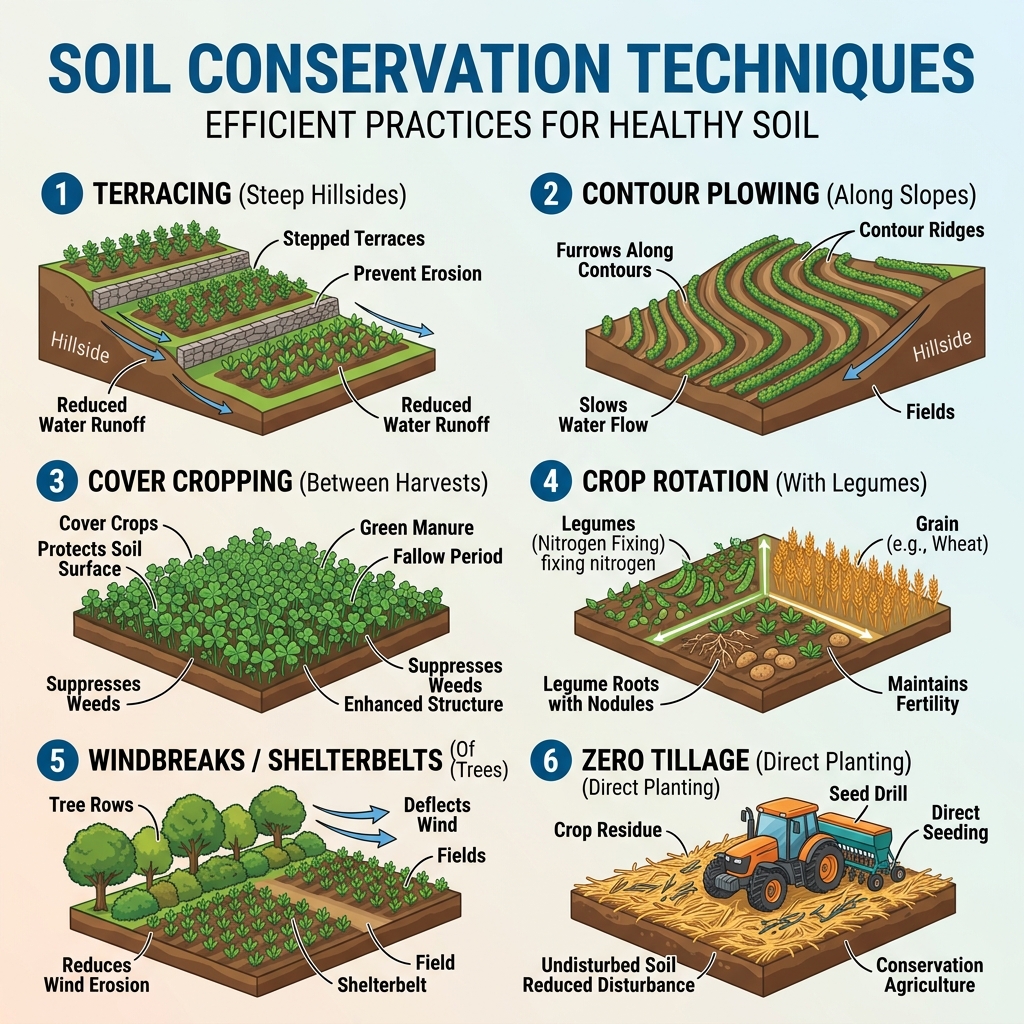
| Technique | Mechanism & How It Works | Key Environmental Benefit |
|---|---|---|
| Terracing | Carving step-like flat benches into steep hillsides | Prevents severe water runoff and soil washing downhill |
| Contour Plowing | Plowing furrows horizontally across land contours | Slows surface runoff water speed, trapping sediment |
| Cover Cropping | Planting clover or rye between main harvest seasons | Protects bare topsoil from wind/water erosion; adds organic matter |
| Crop Rotation | Alternating grain crops with nitrogen-fixing legumes | Breaks pest cycles and naturally replenishes soil nitrates |
| Shelterbelts / Windbreaks | Planting rows of tall trees along field borders | Deflects wind, preventing topsoil wind erosion |
| Zero Tillage (No-Till) | Seeding directly into unplowed crop residue | Preserves soil structure, earthworms, and soil carbon storage |
Trophic Efficiency & Diet Sustainability
Virtual Water & Land Footprint per kg Food
- 1 kg Beef: ~15,400 Liters of water + 10-20× more land than grains (Trophic Level 3/4)
- 1 kg Pork / Chicken: ~4,300 - 6,000 Liters of water
- 1 kg Wheat / Cereals: ~1,500 Liters of water (Trophic Level 1 - Producer)
- 1 kg Vegetables / Potatoes: ~290 - 400 Liters of water
Sustainable Supply & The 4 Pillars of Food Security
| Pillar of Food Security | Focus & Definition |
|---|---|
| 1. Availability | Sufficient global/local food production supply |
| 2. Access | Economic affordability and physical access to market supplies |
| 3. Utilization | Nutritional quality, clean water, and sanitation for proper absorption |
| 4. Stability | Consistent food access over time without climate or conflict disruptions |
Regenerative Agriculture & PermacultureHL
🌿 Permaculture Principles
Design agricultural systems modeled on natural ecosystems: polycultures, closed nutrient loops, rainwater harvesting, zero chemical inputs.
🐂 Regenerative Mob Grazing
Concentrating livestock in small paddocks for short periods mimics wild herds, trampling organic matter into soil and building topsoil carbon.
High-Tech & Vertical AgricultureHL
| Technology | Mechanism & Advantages | Key Trade-offs |
|---|---|---|
| Vertical Farming | Stacked indoor layers using LED lighting & hydroponics; 90% less water, zero soil erosion, urban proximity | High energy consumption for lights/climate control; high capital startup cost |
| Precision AI Farming | Drones, sensors, and GPS targeting water & fertilizers to exact plant needs | Reduces chemical waste; expensive digital infrastructure required |
Diet Sustainability, Wild Harvest & MalnutritionHL
⚠️ Undernourishment (~735M)
Chronic caloric deficit causing stunting & wasting in impoverished, climate-shocked, or war-torn regions.
🍔 Overnourishment (~1.9B)
Excess caloric intake from cheap, ultra-processed, energy-dense foods leading to obesity and cardiovascular diseases.
Essential Vocabulary
| Term | Definition |
|---|---|
| Arable Land | Land suitable for growing agricultural crops |
| Green Revolution | 1950s-70s agricultural shift to high-yielding seeds, synthetic fertilizers, pesticides, and heavy irrigation |
| Subsistence Farming | Agriculture practiced to provide food for the farmer's family with minimal market surplus |
| Contour Plowing | Plowing across sloping land along elevation contour lines to reduce water runoff erosion |
| Zero Tillage (No-Till) | Planting seeds directly into undisturbed crop residue without plowing |
| Food Security | Condition where all people have physical and economic access to safe, nutritious food |
| Permaculture | Ethical agricultural design system mimicking natural self-sustaining ecosystems |
| Vertical Farming | Indoor urban farming growing crops in vertically stacked layers using hydroponics and LEDs |
| Malnutrition | Deficiencies, excesses, or imbalances in a person's intake of energy and/or nutrients |
Key Takeaways & Exam Tips
Must-Know Concepts
- Food Equity: Global agriculture produces enough food; starvation stems from poor distribution, poverty, and 30% food waste.
- Green Revolution Trade-off: High crop yields vs soil salinization, chemical runoff, and farmer debt.
- 6 Soil Conservation Methods: Terracing, Contour Plowing, Cover Cropping, Crop Rotation, Shelterbelts, Zero Tillage.
- Trophic Energy: Eating plant-based foods directly saves 90% energy compared to livestock consumption.
- HL Malnutrition Spectrum: Contrast undernourishment (hunger) with overnourishment (obesity).
You've covered all 20 syllabus points ✅
5.2.1 – 5.2.12 (SL) + 5.2.13 – 5.2.20 (HL) · Complete Topic 5: Land!