IB DP Environmental Systems & Societies — Topic 6: Atmosphere
Introduction to
the Atmosphere
Subtopic 6.1 — New Syllabus (First Assessment 2026)
Standard Level + Higher Level
4 SL Points
6.1.1 – 6.1.4
5 HL Extensions
6.1.5 – 6.1.9
Overview
What You Need to Know
This subtopic examines the atmospheric boundary layer, gas composition ($\text{N}_2, \text{O}_2, \text{CO}_2, \text{H}_2\text{O}$), the tricellular circulation model, the greenhouse energy budget, and — at HL — lapse rates, Milankovitch orbital cycles, Quaternary climate shifts, and life-atmosphere co-evolution.
A. Composition & Layers
78% $\text{N}_2$, 21% O₂, Troposphere, Stratosphere, Mesosphere, Thermosphere
B. Circulation & Greenhouse
Hadley, Ferrel & Polar cells, shortwave vs longwave IR energy budget
C. Orbital Cycles & Evolution (HL)
Standard lapse rate (6.5°C/km), Milankovitch cycles, Great Oxygenation Event
Guiding Questions
- How do atmospheric systems contribute to the stability of life on Earth?
- How do atmospheric processes interact with Earth's surface and oceans to regulate global climate?
Time allocation: minimum 1 hour SL + additional 2 hours HL. First subtopic in Topic 6: Atmosphere.
6.1.1
Composition & Layers of the Atmosphere
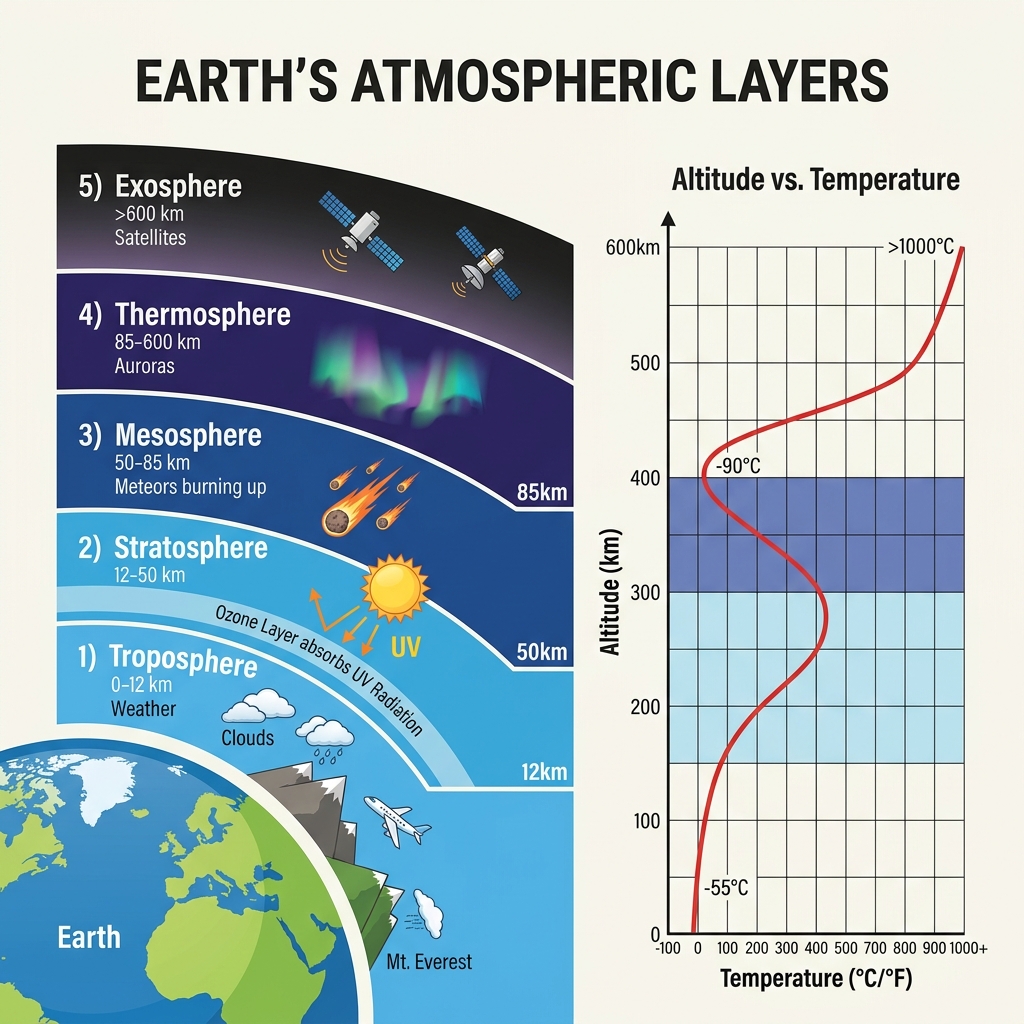
Key UnderstandingThe atmosphere is a dynamic mixture of gases supporting terrestrial life, structured into distinct thermal layers (Troposphere, Stratosphere, Mesosphere, Thermosphere, Exosphere).
| Layer | Altitude Range | Key Characteristics & Functions |
|---|
| Troposphere | 0 – 12 km | Contains 75% of atmospheric mass, all water vapor & weather. Temperature drops with height (-6.5°C/km) |
| Stratosphere | 12 – 50 km | Contains the protective Ozone Layer ($\text{O}_3$) absorbing harmful solar UV radiation. Temperature warms with height |
| Mesosphere | 50 – 85 km | Coldest atmospheric layer (-90°C). Meteors burn up due to friction with gas molecules |
| Thermosphere | 85 – 600 km | Absorbs high-energy X-rays and cosmic radiation. Site of auroras and space station orbit |
6.1.2
Differential Heating & The Tricellular Model
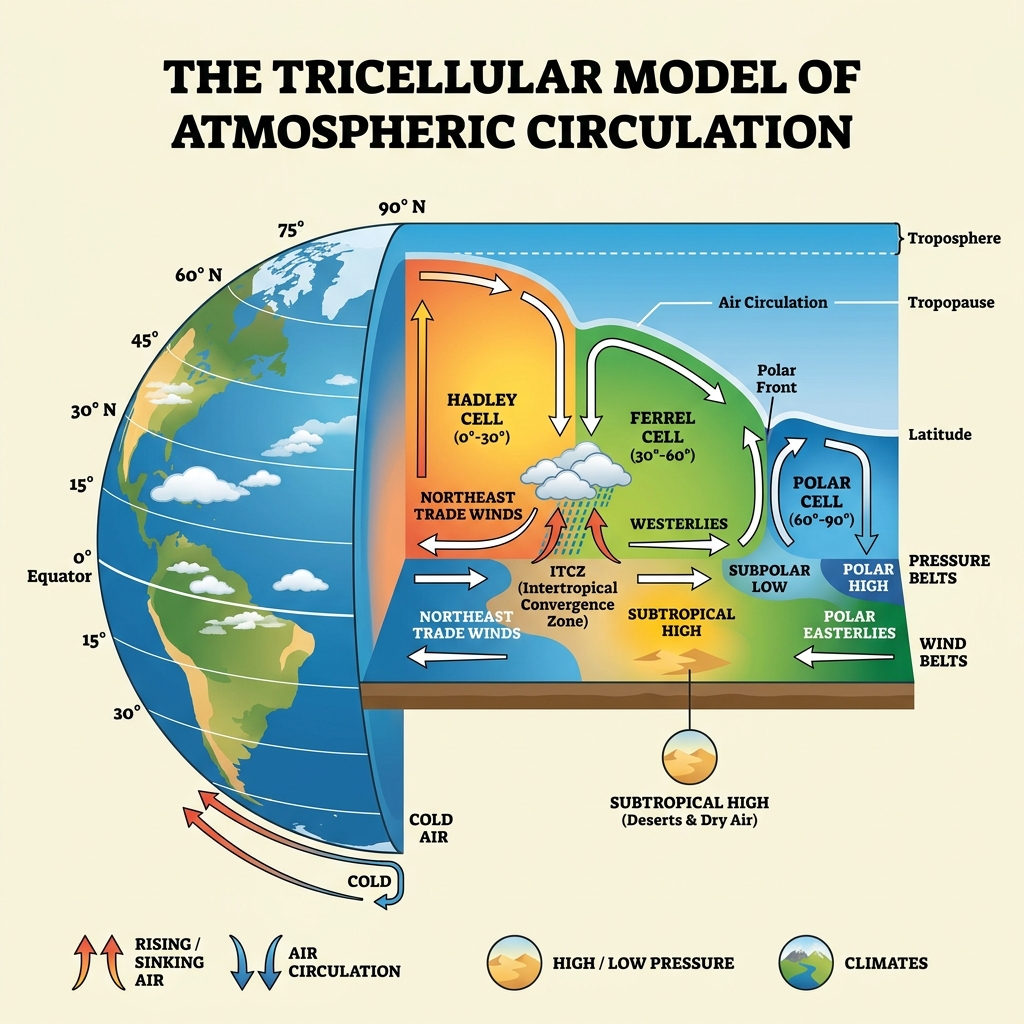
Key UnderstandingUneven solar heating between the Equator and Poles drives thermal circulation via the Tricellular Model (Hadley, Ferrel, Polar cells), redistributing global heat.
Hadley Cell (0°–30°)
Intense equatorial heating creates rising air (ITCZ low pressure rain) $\rightarrow$ sinks at 30° latitude forming dry subtropical deserts.
Ferrel Cell (30°–60°)
Mid-latitude circulation driven by adjacent cells, generating prevailing Westerly winds across temperate zones.
Polar Cell (60°–90°)
Cold, dense air sinks at the poles (high pressure) and flows equatorward, rising at the polar front (60°).
6.1.3 & 6.1.4
The Greenhouse Effect & Radiation Budget
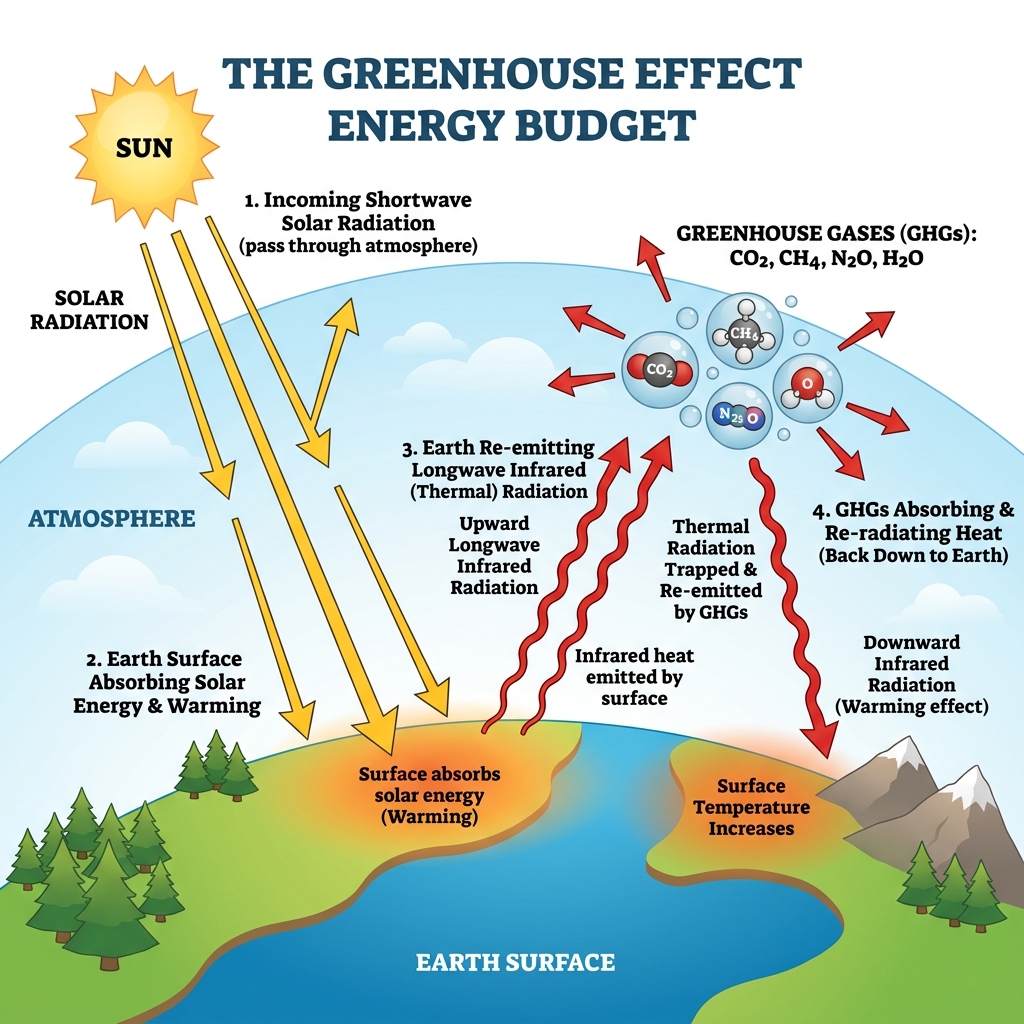
Key UnderstandingShortwave solar radiation warms Earth's surface. The warmed surface re-emits longwave infrared (IR) radiation, which is absorbed and re-radiated back by Greenhouse Gases (GHGs).
| Greenhouse Gas | Natural / Human Sources | Global Warming Potential (GWP 100yr) |
|---|
| Water Vapor ($\text{H}_2\text{O}$) | Evaporation from oceans & lakes (natural feedback) | Variable (largest contributor to natural effect) |
| Carbon Dioxide (CO₂) | Fossil fuel combustion, deforestation, respiration | 1 (Reference baseline) |
| Methane ($\text{CH}_4$) | Livestock enteric fermentation, rice paddies, landfills | 28× CO₂ equivalent |
| Nitrous Oxide ($\text{N}_2\text{O}$) | Synthetic nitrogen fertilizers, industrial processes | 265× CO₂ equivalent |
HL — 6.1.5 & 6.1.6
Dynamic System, Lapse Rate & GravityHL
Key UnderstandingGravity compresses atmospheric molecules near sea level. In the troposphere, temperature drops at the Standard Lapse Rate (~6.5°C per 1,000m).
🏔️ Tropospheric Lapse Rate
As altitude increases, air pressure drops and distance from the warm surface heat source increases $\rightarrow$ temperature cools by 6.5°C for every 1 km gain in altitude.
☀️ Stratospheric Inversion
In the stratosphere, temperature increases with height because the ozone layer absorbs high-energy solar UV radiation, releasing thermal heat.
HL — 6.1.7 & 6.1.8
Milankovitch Cycles & Quaternary Climate ShiftsHL
Key UnderstandingMilankovitch cycles (Eccentricity, Obliquity, Precession) drive long-term natural glacial-interglacial cycles over 10,000–100,000 year timescales.
| Orbital Cycle | Periodicity | Mechanism & Climate Impact |
|---|
| Eccentricity | ~100,000 Years | Earth's orbit shifts between circular and elliptical, altering distance from the Sun |
| Obliquity (Tilt) | ~41,000 Years | Axial tilt varies between 22.1° and 24.5°, altering seasonal temperature intensity |
| Precession (Wobble) | ~26,000 Years | Axial wobble alters which hemisphere points toward the Sun at perihelion |
Exam distinction: Milankovitch cycles operate over tens of thousands of years. Modern post-industrial warming is occurring in decades, driven by anthropogenic GHG emissions.
HL — 6.1.9
Life-Atmosphere Co-EvolutionHL
Key UnderstandingThe evolution of photosynthetic life altered Earth's atmosphere, which in turn enabled terrestrial colonization and evolutionary diversification.
🌋 Pre-biotic Atmosphere
($\text{CO}_2, \text{CH}_4$, No O₂)
→
🦠 Cyanobacteria Photosynthesis
(2.4 Ga)
→
📈 Great Oxygenation Event
(O₂ accumulation)
→
🛡️ Stratospheric Ozone Layer
Formed
→
🌿 Terrestrial Land Life
Colonization
Key Terms Glossary
Essential Vocabulary
| Term | Definition |
|---|
| Troposphere | Lowest atmospheric layer (0-12 km) containing 75% of air mass, weather, and greenhouse gases |
| Stratosphere | Atmospheric layer (12-50 km) containing the UV-absorbing Ozone Layer ($\text{O}_3$) |
| Hadley Cell | Equatorial circulation cell driving rising air at ITCZ and sinking air at 30° desert belts |
| Greenhouse Effect | Natural process where GHGs absorb outgoing longwave IR radiation, keeping Earth ~33°C warmer |
| Lapse Rate | Rate of temperature decrease with altitude in the troposphere (~6.5°C/km) |
| Milankovitch Cycles | Orbital variations (eccentricity, obliquity, precession) driving natural glacial-interglacial cycles |
| Great Oxygenation Event | Geological period (~2.4 Ga) when cyanobacterial oxygen accumulated in the atmosphere |
Exam Preparation
Key Takeaways & Exam Tips
Must-Know Concepts
- Radiation wavelength distinction: Sun emits shortwave radiation (visible/UV); Earth re-emits longwave infrared (IR) radiation.
- Tricellular connection: Connect Hadley cell descending air at 30° N/S to global desert biomes.
- HL Milankovitch vs Anthropogenic: Natural orbital cycles act over $10^4-10^5$ years; human warming acts over $10^1-10^2$ years.
You've covered all 9 syllabus points ✅
6.1.1 – 6.1.4 (SL) + 6.1.5 – 6.1.9 (HL)