IB DP Environmental Systems & Societies — Topic 6: Atmosphere
Climate Change:
Mitigation & Adaptation
Subtopic 6.3 — New Syllabus (First Assessment 2026)
Standard Level + Higher Level
5 SL Points
6.3.1 – 6.3.5
7 HL Extensions
6.3.6 – 6.3.12
Overview
What You Need to Know
This subtopic addresses societal responses to climate change through mitigation (reducing emissions & enhancing sinks) and adaptation (reducing vulnerability to unavoidable impacts), international UN frameworks, decarbonization, and — at HL — stakeholder policy, IPCC Shared Socioeconomic Pathways (SSPs), geoengineering, and implementation barriers.
A. Global Action & Decarbonization
Paris Agreement, Net-Zero, phase out fossil fuels for renewables
B. Mitigation & Adaptation Strategies
Carbon sinks, structural flood barriers, NAPAs, drought-resistant crops
C. Geoengineering & SSPs (HL)
SRM (solar reflection) vs CDR (direct air capture), IPCC SSP1-5 scenarios
Guiding Question
- How can human societies address the causes and consequences of climate change?
Time allocation: minimum 4 hours SL + additional 4 hours HL. Third subtopic in Topic 6: Atmosphere.
6.3.1 & 6.3.2
Global Action, Mitigation & Decarbonization
Key UnderstandingAvoiding catastrophic warming requires worldwide decarbonization — shifting energy infrastructure from fossil fuels to renewables to achieve Net-Zero.
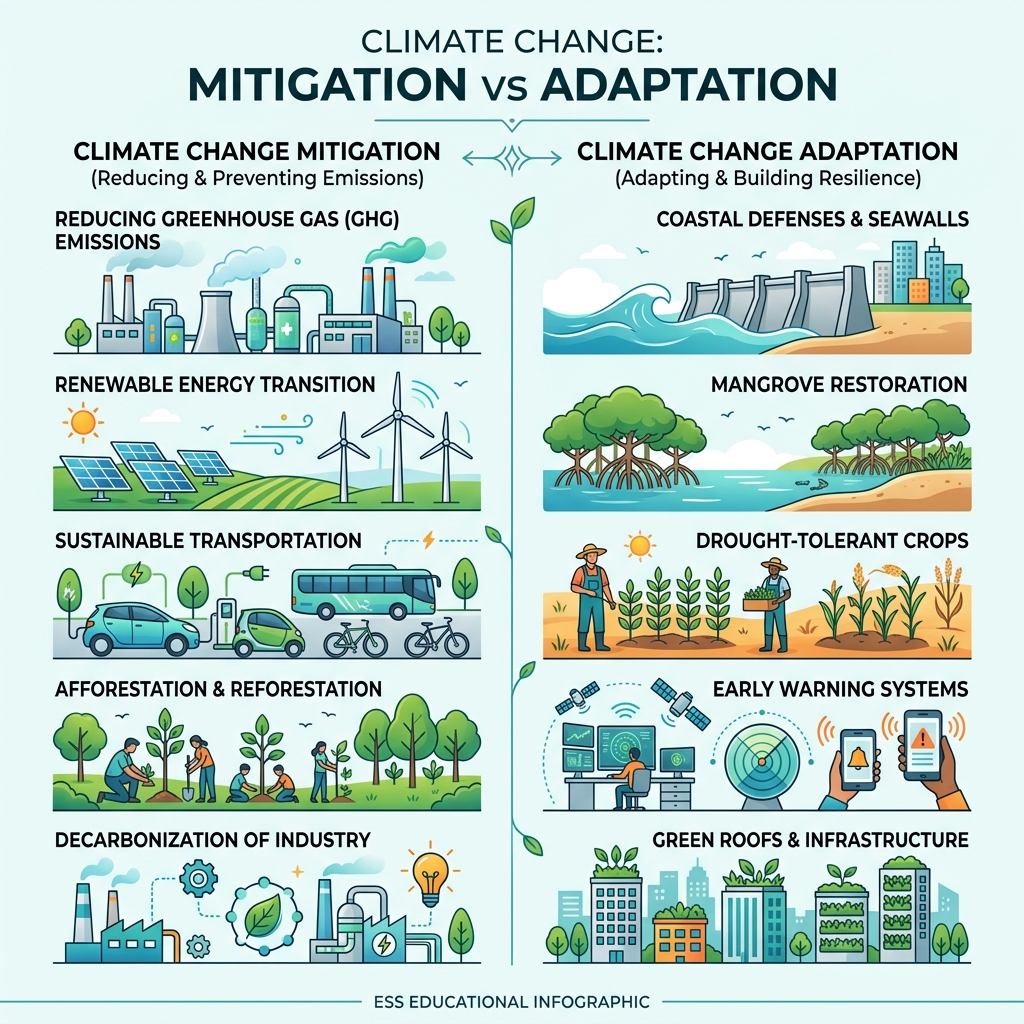
🌱 Mitigation (Addressing Causes)
Interventions to reduce anthropogenic GHG sources (renewable energy, EV transport) or enhance carbon sinks (reforestation, soil sequestration).
🛡️ Adaptation (Managing Impacts)
Adjustments in natural or human systems to cope with actual or expected climate impacts (seawalls, drought-tolerant crops, flood zoning).
6.3.3 & 6.3.4
Specific Mitigation & Adaptation Strategies
Key UnderstandingSocieties deploy a mix of technical, behavioral, structural, and non-structural strategies to manage climate risk.
| Category | Approach & Method | Practical Examples |
|---|
| Mitigation: Reduction | Energy efficiency, solar/wind renewables, plant-based diets | Germany Energiewende, electric vehicle mandates, carbon taxes |
| Mitigation: Removal | Protecting & expanding biological & physical carbon sinks | Afforestation, mangrove restoration, Carbon Capture & Storage (CCS) |
| Adaptation: Structural | Physical infrastructure engineered to resist climate hazards | London Thames Barrier, Israel Sorek Desalination Plant, green roofs |
| Adaptation: Non-Structural | Policy, land-use zoning, insurance, and warning systems | Bangladesh cyclone early warning systems, flood-plain building codes |
6.3.5
National Adaptation Programmes of Action (NAPAs)
Key UnderstandingNAPAs provide a process for Least Developed Countries (LDCs) to identify and prioritize urgent adaptation needs responding to climate vulnerability.
| Scale | Adaptation Planning Mechanism | Key Objectives |
|---|
| International / UN | Green Climate Fund (GCF) & Paris Agreement NDCs | Channeling financial resources from developed to developing nations |
| National Level (NAPAs) | LDC National Adaptation Programmes | Prioritizing immediate resilience in agriculture, water supply, and coastal defense |
| Local / Municipal | Urban Resilience & Heatwave Action Plans | Installing cooling centers, permeable urban pavement, rainwater harvesting |
HL — 6.3.6 & 6.3.7
Stakeholders & UN FrameworksHL
Key UnderstandingClimate responses are led by governments (carbon pricing, regulations), businesses (B Corp, net-zero supply chains), NGOs, and UN bodies (UNFCCC, IPCC).
| UN Entity / Accord | Primary Role | Key Milestones |
|---|
| UNFCCC | Intergovernmental treaty body organizing annual COP summits | 1997 Kyoto Protocol, 2015 Paris Agreement |
| IPCC | Scientific body reviewing climate data for policy assessment | 6th Assessment Reports (AR6), Shared Socioeconomic Pathways |
| Kigali Amendment | Phase-down of Hydrofluorocarbons (HFCs) under Montreal Protocol | Legally binding global treaty targeting potent refrigerant GHGs |
HL — 6.3.8
IPCC Shared Socioeconomic Pathways (SSPs)HL
Key UnderstandingThe IPCC models 5 Shared Socioeconomic Pathways (SSPs) projecting future GHG emission trajectories and resulting 2100 global warming levels.
| Scenario | Socioeconomic Trajectory | Projected 2100 Warming |
|---|
| SSP1 - 1.9 | Sustainability — Shift toward green growth & rapid decarbonization | ~1.5°C (Safe Threshold) |
| SSP2 - 4.5 | Middle of the Road — Moderate historical trends continue | ~2.7°C (Moderate Risk) |
| SSP5 - 8.5 | Fossil-Fueled Development — High energy demand & zero mitigation | ~4.4°C (Catastrophic Risk) |
HL — 6.3.9 & 6.3.10
Mitigation Technology & Implementation BarriersHL
Key UnderstandingImplementation of climate technology (smart grids, IoT, DAC) faces financial constraints, leadership gaps, misinformation, and geopolitical divides.
🏙️ Smart Urban Systems
IoT sensors, smart energy grids (e.g. Copenhagen), and building energy automation optimize energy use and lower carbon footprints.
⚠️ Implementation Barriers
Socioeconomic hurdles include high capital costs, fossil-fuel industry lobbying, political election cycles, and North-South equity divides.
HL — 6.3.11 & 6.3.12
Geoengineering & Changing PerspectivesHL
Key UnderstandingGeoengineering (SRM vs CDR) addresses symptoms rather than root causes. Activists, media, and local groups play a key role in shifting public perspectives.
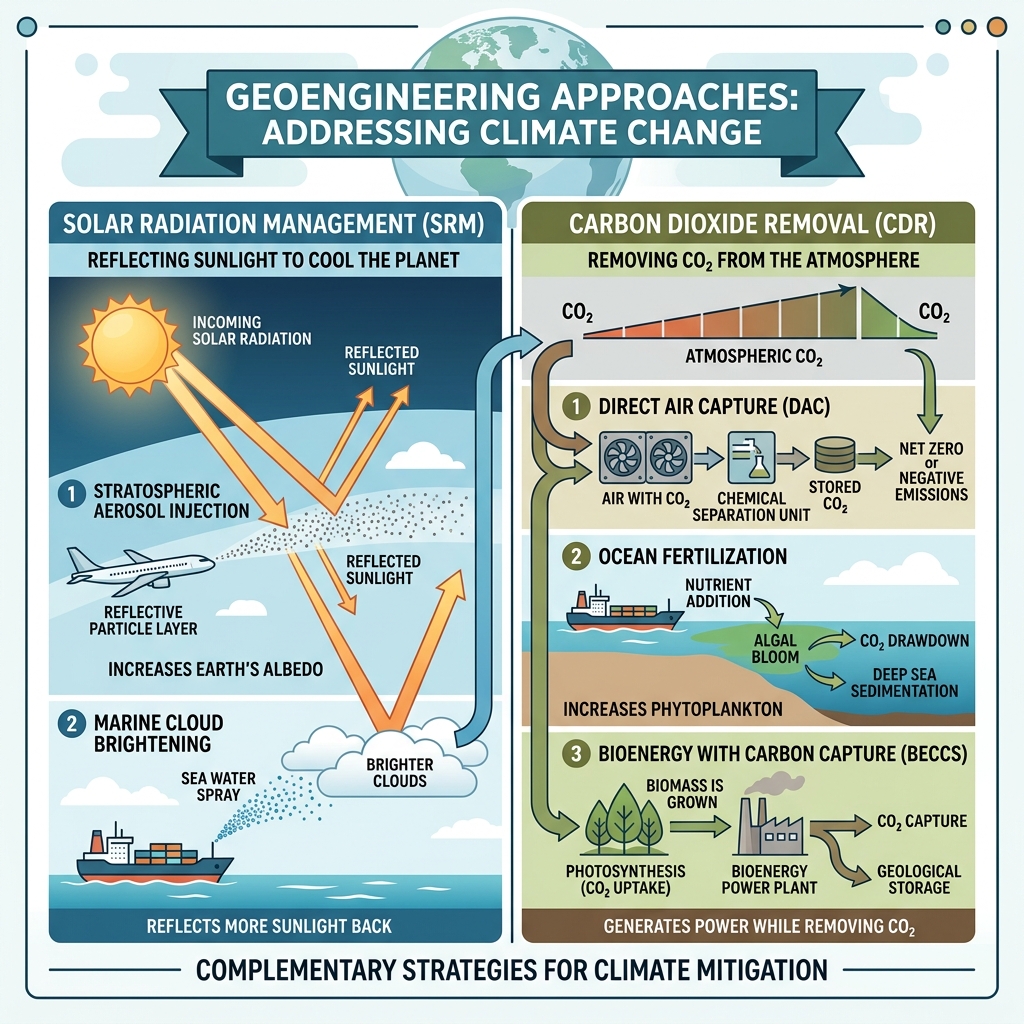
☀️ Solar Radiation Management (SRM)
Stratospheric aerosol injection & marine cloud brightening reflect sunlight back to space to cool the surface rapidly.
🌱 Carbon Dioxide Removal (CDR)
Direct Air Capture (DAC), Ocean Fertilization, and BECCS extract CO₂ directly from the atmosphere for underground storage.
Key Terms Glossary
Essential Vocabulary
| Term | Definition |
|---|
| Mitigation | Interventions aimed at reducing anthropogenic GHG emissions or enhancing carbon sinks |
| Adaptation | Adjustments in natural or human systems to reduce vulnerability to climate impacts |
| Decarbonization | Phasing out carbon-emitting fossil fuels and transitioning to 100% renewable energy |
| NAPA | National Adaptation Programme of Action — identifying urgent climate needs for LDCs |
| Geoengineering | Large-scale technological interventions in Earth systems (SRM / CDR) to alter climate |
| Direct Air Capture (DAC) | Chemical technology extracting CO₂ directly from ambient air for geological storage |
| SSP Scenarios | IPCC Shared Socioeconomic Pathways modeling future climate and emissions trends |
Exam Preparation
Key Takeaways & Exam Tips
Must-Know Concepts
- Mitigation vs Adaptation: Mitigation targets the causes (CO₂ emissions); Adaptation targets the symptoms (flooding, droughts). Both are required.
- Structural vs Non-Structural: Structural = physical engineering (seawalls, dams); Non-structural = policy/zoning/education.
- Geoengineering Risk (HL): SRM treats temperature symptoms without reducing ocean acidification; stopping SRM triggers rapid termination shock warming.
You've covered all 12 syllabus points ✅
6.3.1 – 6.3.5 (SL) + 6.3.6 – 6.3.12 (HL) · Complete Unit 6: Atmospheric Systems!