Subtopic 6.4 — New Syllabus (First Assessment 2026)
Standard Level + Higher Level
This subtopic examines the UV radiation spectrum, the stratospheric ozone layer ($\text{O}_3$), natural formation and destruction equilibrium, catalytic breakdown by Ozone-Depleting Substances (ODSs like CFCs), the Montreal Protocol success, and — at HL — halogen chemistry, polar stratospheric clouds (PSCs), HFCs, and air conditioning impacts.
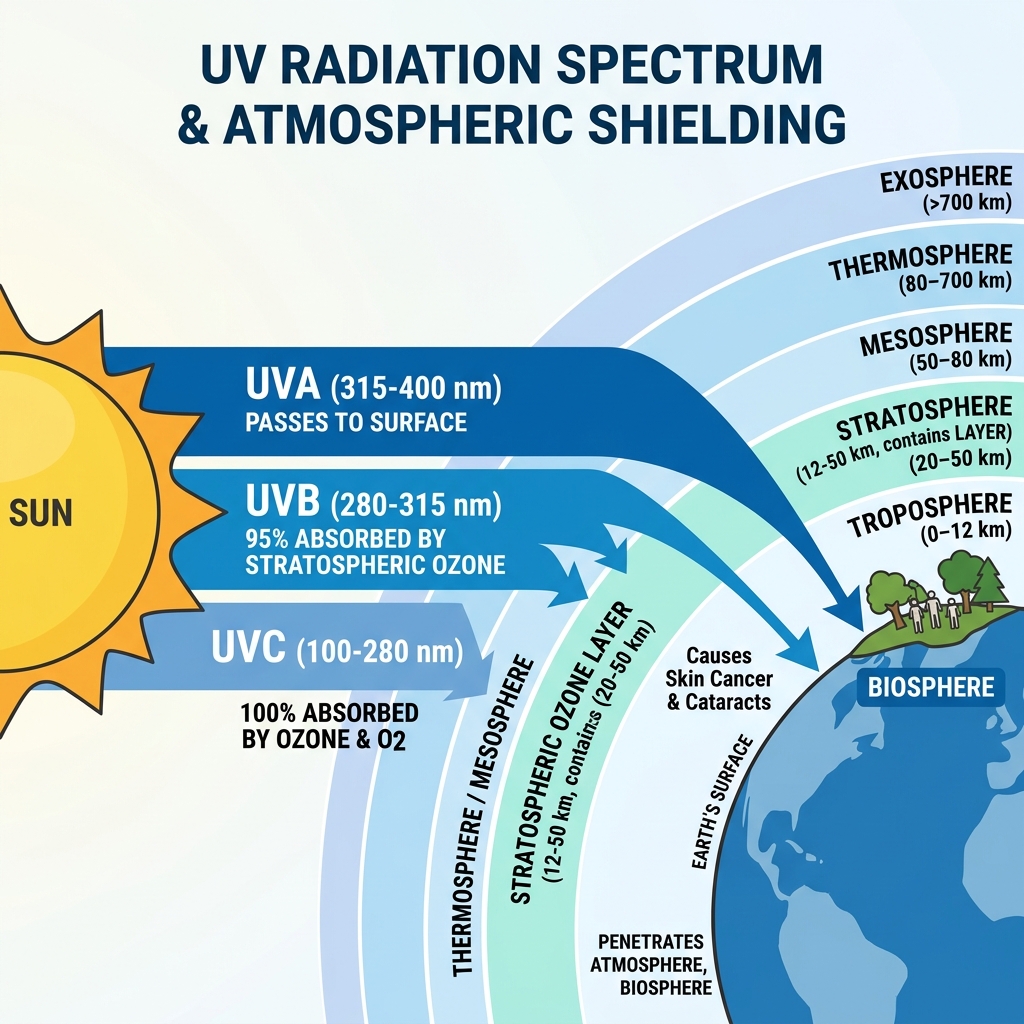
| UV Band | Wavelength Range | Atmospheric Stratospheric Absorption | Biological Danger & Health Impacts |
|---|---|---|---|
| UVC | 100 – 280 nm | 100% Absorbed by O₂ and $\text{O}_3$ | Lethal / Mutagenic; zero reaches Earth's surface |
| UVB | 280 – 315 nm | 95% Absorbed by Ozone Layer ($\text{O}_3$) | Skin cancer (melanoma), eye cataracts, DNA mutations, phytoplankton damage |
| UVA | 315 – 400 nm | 0% Absorbed (Passes through) | Premature skin aging, low-level DNA damage; stimulates Vitamin D synthesis |
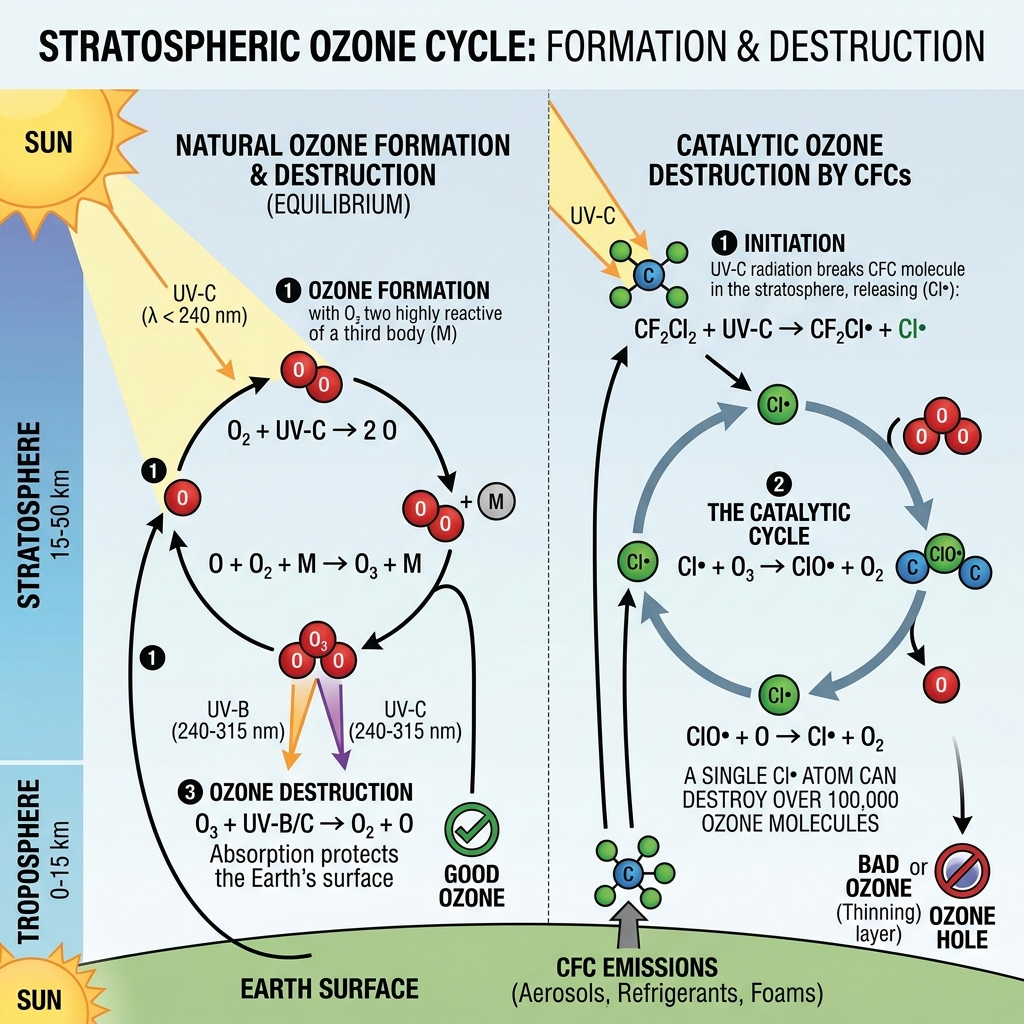
Formation: $\text{O}_2 + \text{UV-C} \rightarrow 2\text{O}$; $\text{O} + \text{O}_2 \rightarrow \text{O}_3$
Breakdown: $\text{O}_3 + \text{UV-B/C} \rightarrow \text{O}_2 + \text{O}$
Rates of formation and breakdown remain equal.
1. $\text{CF}_2\text{Cl}_2 + \text{UV-C} \rightarrow \text{CF}_2\text{Cl}^\bullet + \text{Cl}^\bullet$
2. $\text{Cl}^\bullet + \text{O}_3 \rightarrow \text{ClO}^\bullet + \text{O}_2$
3. $\text{ClO}^\bullet + \text{O} \rightarrow \text{Cl}^\bullet + \text{O}_2$
Single $\text{Cl}^\bullet$ destroys ~100,000 $\text{O}_3$ molecules!
| Polar Season | Atmospheric & Chemical Mechanism | Ozone State |
|---|---|---|
| Polar Winter (June–Aug) | Polar vortex isolates air; temperatures fall below -78°C forming ice/nitric acid PSCs | Inactive reservoir $\text{HCl}$ & $\text{ClONO}_2$ convert to active $\text{Cl}_2$ gas on PSC surfaces |
| Polar Spring (Sept–Nov) | Sunlight returns; UV-C photolyzes $\text{Cl}_2 \rightarrow 2\text{Cl}^\bullet$ starting massive catalytic destruction | Ozone Hole Forms (drop below 220 Dobson Units) |
| Polar Summer (Dec) | Polar vortex breaks down; warmer mid-latitude air replenishes stratospheric ozone | Ozone hole temporarily fills until next winter cycle |
HFCs contain no chlorine atoms ($\text{ODP} = 0$), so they do not destroy ozone. However, HFCs are super-pollutants with Global Warming Potentials up to 14,800× CO₂.
Legally binding amendment to the Montreal Protocol committing countries to phase down HFC production by 80%+ over 30 years, avoiding up to 0.5°C of global warming by 2100.
| Term | Definition |
|---|---|
| Ozone Layer ($\text{O}_3$) | Stratospheric concentration of triatomic oxygen absorbing 95%+ of solar UV-B and 100% of UV-C |
| ODSs | Ozone-Depleting Substances (CFCs, Halons, HCFCs, Methyl Bromide) releasing reactive halogens |
| Dynamic Equilibrium | Steady state where rate of natural ozone formation equals rate of UV-driven ozone breakdown |
| Catalytic Cycle | Chain reaction where a single free chlorine radical ($\text{Cl}^\bullet$) destroys ~100,000 ozone molecules |
| Dobson Unit (DU) | Unit measuring column ozone thickness; concentrations under 220 DU define an "Ozone Hole" |
| PSCs | Polar Stratospheric Clouds forming below -78°C providing ice surfaces for chlorine activation |
| Kigali Amendment | 2016 Montreal Protocol extension establishing binding phase-down targets for climate-warming HFCs |
You've covered all 13 syllabus points ✅
6.4.1 – 6.4.9 (SL) + 6.4.10 – 6.4.13 (HL) · Complete Topic 6: Atmosphere & Climate Change!