Subtopic 7.1 · New Syllabus (First Assessment 2026) Standard Level + Higher Level
11
SL Syllabus Points
8
HL Extensions
19
Total Understandings
Overview
What You Need to Know
This subtopic explores what natural resources are, how they are classified, and why understanding their value matters for building a sustainable future. It connects directly to climate change, biodiversity loss, and resource scarcity across the syllabus.
Guiding Questions
How does the renewability of natural capital have implications for its sustainable use?
How might societies reconcile competing perspectives on natural resource use?
To what extent can human societies use natural resources sustainably?
Content Map
A. Natural Resources & Capital
Definitions, natural capital, income, goods vs services, perspective critique
B. Ecosystem Services & Classification
Life-supporting services, renewable vs non-renewable, finiteness
⏱ Time allocation: minimum 6 hours for this subtopic.
7.1.1 — Natural Resources
Natural Resources Are the Raw Materials & Energy Used by Society
Key Understanding
Natural resources are the raw materials and sources of energy used and consumed by society.
Natural resources are materials and energy sources found in nature that humans use for food, shelter, energy, and industrial production. They are the foundation of life on Earth and of human civilization.
Categories
Type
Source
Examples
Biotic
Living things
Forests, animals, crops, fish
Abiotic
Non-living things
Sunlight, water, air, minerals, soil
Key Examples
Sunlight — drives photosynthesis and solar power
Water — drinking, agriculture, hydropower, habitat
Natural Capital Is the Stock of Natural Resources on Earth
Key Understanding
Natural capital is the stock of natural resources available on Earth.
Think of natural capital like a bank account. The stock (principal) is the total resources available; the natural income (interest) is the flow of goods and services generated each year.
Three Types of Natural Capital
Type
Regeneration
Examples
Renewable
Regenerated naturally over time
Forests, fisheries, freshwater, solar energy
Non-renewable
Fixed stock; not replenished on human timescale
Fossil fuels, minerals, metal ores
Replenishable
Replaceable but slow to regenerate
Groundwater, soil, ozone layer
⚠ Exam Hint Replenishable resources sit between renewable and non-renewable. Groundwater can be recharged by rainfall, but if extraction exceeds recharge, it becomes effectively non-renewable.
7.1.3 — Natural Income
Natural Capital Provides Goods & Services
Key Understanding
Natural capital provides natural income in terms of goods and services.
Natural Capital (stock)
→
Natural Income (flow)
→
Goods (tangible)
+
Services (intangible)
Goods (tangible)
Services (intangible)
Timber, fish, grain, minerals, fossil fuels
Water replenishment, flood protection, climate regulation, carbon sequestration, pollination
🌱 Case Study — The Amazon Rainforest
The Amazon produces goods (timber, rubber, medicinal plants) and services (carbon sequestration generating ~6% of the world's O₂, regulating rainfall across South America, housing 10% of all species on Earth). Deforestation depletes both the stock and the income.
7.1.4 — Perspective on Nature
"Natural Capital" Implies a Particular Perspective
Key Understanding
The terms "natural capital" and "natural income" imply a particular perspective on nature.
Calling nature "capital" frames it as an economic asset that exists to produce goods and services for humans. This is useful for resource management but carries philosophical implications.
Perspective
View of Nature
Implication
Anthropocentric
Nature exists primarily for human use
Can lead to exploitation if unchecked
Ecocentric
Nature has intrinsic value independent of humans
Challenges the "capital" framing
Benefits of the Natural Capital Model
Promotes sustainable use by valuing natural income
Integrates environmental considerations into economic planning
Makes ecosystem services visible in policy decisions
⚠ Exam Hint In essay questions, acknowledge the anthropocentric assumption embedded in the language "natural capital" — then explain why the framework is still useful. This demonstrates the critical thinking the mark scheme rewards at higher bands.
7.1.5 — Ecosystem Services
Ecosystems Provide Life-Supporting Services
Key Understanding
Ecosystems provide life-supporting ecosystem services.
Ecosystem services are the benefits humans receive from functioning ecosystems. They are generally categorized into four types:
Category
Description
Examples
Provisioning
Products obtained from ecosystems
Food, timber, freshwater, fibre, medicines
Regulating
Benefits from regulation of ecosystem processes
Climate regulation, flood control, water purification, pollination
🌊 Case Study — Mangroves in Southeast Asia
Mangrove forests provide ~$65 billion/year in flood protection services globally. After the 2004 Indian Ocean tsunami, areas with intact mangroves suffered significantly less damage than areas where mangroves had been cleared for shrimp farming.
7.1.6 — Renewable vs Non-Renewable
All Resources Are Finite
Key Understanding
All resources are finite. Resources can be classified as either renewable or non-renewable.
Renewable
Non-Renewable
Definition
Can regenerate at a rate ≥ rate of use
Fixed geological stock; cannot be replenished on human timescale
Examples
Solar, wind, forests, fish stocks, freshwater
Coal, oil, natural gas, minerals, metal ores
Key risk
Can become non-renewable if overused
Depletion is permanent (on human timescales)
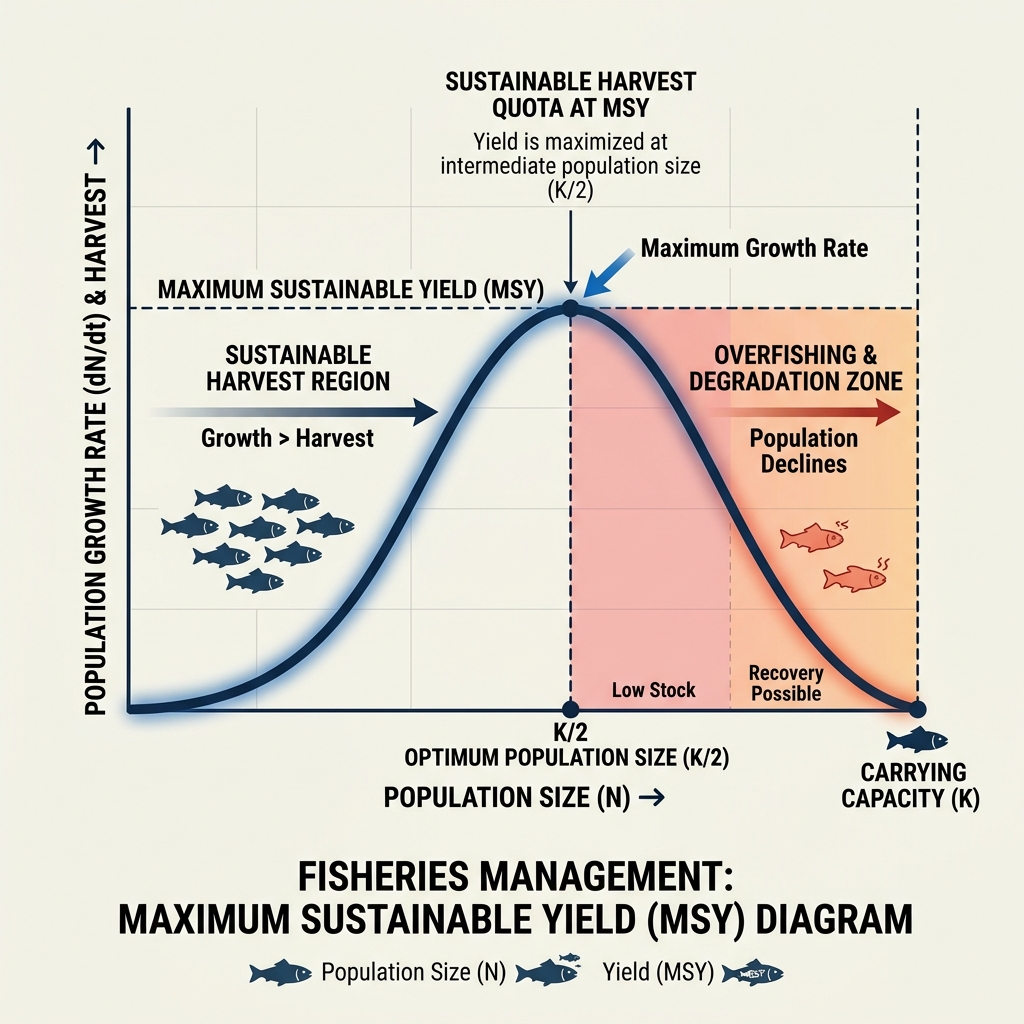
⚠ Critical Insight Renewable resources can become effectively non-renewable if used beyond their regeneration rate. The Atlantic cod fishery collapse is a classic example — a renewable resource turned into a depleted one.
🐟 Case Study — North Sea Cod Collapse
Overfishing of Atlantic cod off Newfoundland in the 1980s–90s exceeded the Maximum Sustainable Yield. The population collapsed by 99%, devastating coastal communities. The fishery remains closed decades later — a renewable resource became functionally non-renewable.
7.1.7 — Multiple Values
Natural Capital Has Many Forms of Value
Key Understanding
Natural capital has aesthetic, cultural, economic, environmental, health, intrinsic, social, spiritual and technological value. The value of natural capital is influenced by these factors.
🎨 AestheticBeauty and visual appeal of landscapes — tourism, inspiration, well-being
🏛 CulturalCultural identities, traditions, art, folklore tied to nature
💰 EconomicMarket value of goods and services — jobs, GDP, trade
🌍 EnvironmentalEcological processes: nutrient cycling, water purification, biodiversity
❤️ HealthClean air, water, medicinal resources, spaces for physical/mental health
✨ IntrinsicInherent worth independent of human use — all species have a right to exist
🤝 SocialCommunity cohesion, shared stewardship, social interaction
🙏 SpiritualSacred environments central to religious beliefs and practices
🔬 TechnologicalBiomimicry, raw materials for innovation, new solutions
🏛 Case Study — Sacred Groves of India
Forests protected by religious beliefs for centuries. Their cultural and spiritual value has preserved biodiversity that would otherwise have been cleared for agriculture — demonstrating how non-economic values can drive conservation.
7.1.8 — Dynamic Value
The Value of Natural Capital Changes Over Time
Key Understanding
The value of natural capital is dynamic in that it can change over time.
Resource values shift according to cultural, social, economic, environmental, technological and political factors.
Era / Context
Resource
Value Then
Value Now
Stone Age
Flint for arrowheads
Extremely high (hunting = survival)
Minimal economic value
Stone Age
Fossil fuels
Worthless (no combustion technology)
Critical for global energy
Pre-2010
Lithium
Niche industrial mineral
Booming — EV batteries, smartphones
Pre-plastic
Whale oil
Primary lubricant and lighting fuel
Commercially banned; cultural shift
🔋 Case Study — Lithium's Rising Value
Lithium prices surged from ~$6,000/tonne (2020) to over $70,000/tonne (2022) due to the electric vehicle revolution. A mineral that was once niche became strategically critical — illustrating how technology dynamically reshapes resource value.
⚠ Exam Hint When discussing dynamic value, always specify which factor caused the change (technology, culture, politics, economics) and give a named example.
7.1.9 — Managing for Sustainability
Natural Capital Must Be Managed for Sustainability
Key Understanding
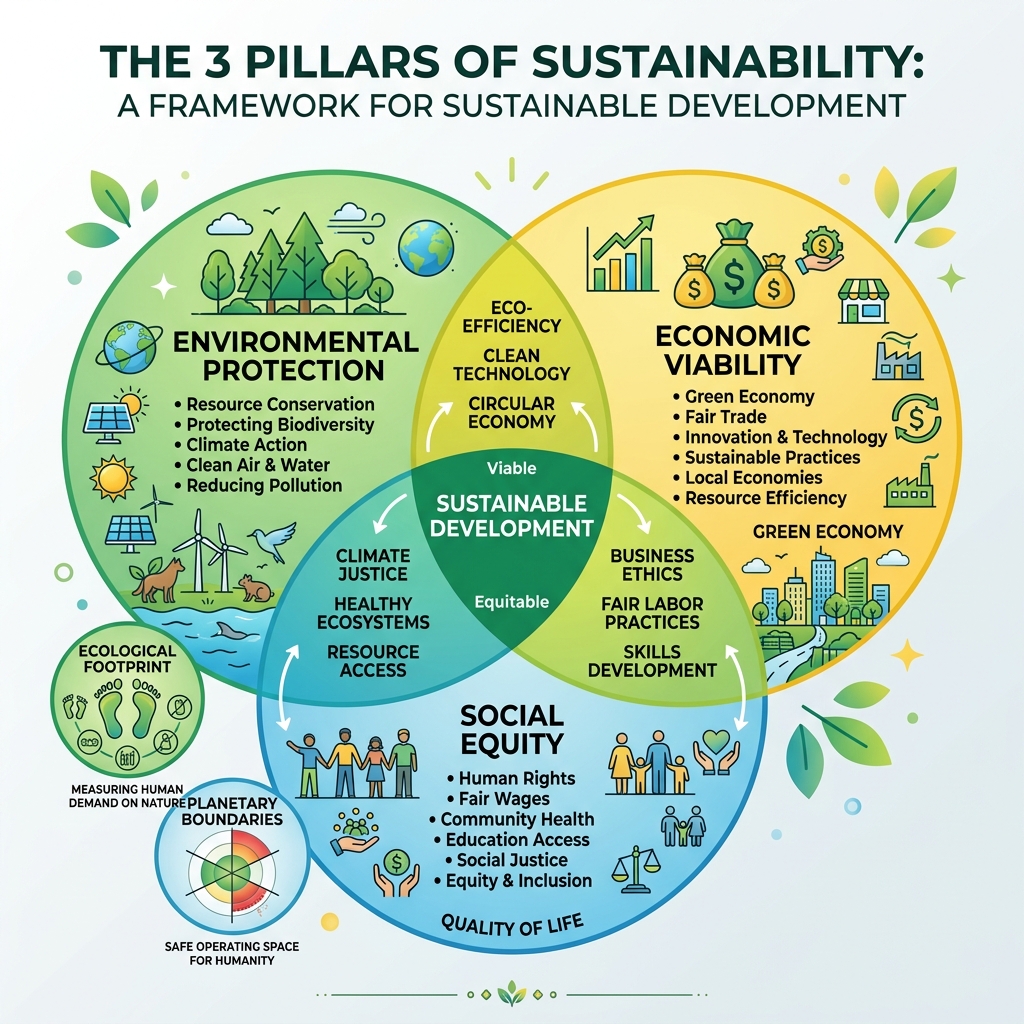
The use of natural capital needs to be managed in order to ensure sustainability.
Two conditions for sustainable resource use:
Resources must not be used faster than they regenerate Waste must not be emitted faster than the environment can absorb it
Key Concept: Maximum Sustainable Yield (MSY)
MSY is the largest harvest that can be taken from a population indefinitely without depleting it. Exceeding MSY leads to resource collapse.
Strategy
Description
Example
Quotas
Legal limits on extraction/harvest
EU Common Fisheries Policy — Total Allowable Catches
Marine Protected Areas
Exclusion zones where resources recover
Galápagos Marine Reserve — visitor limits and zoning
Certification
Third-party sustainability standards
FSC certification for sustainable forestry (Canada)
Indigenous Collaboration
Integrating traditional ecological knowledge
Boreal forest management with First Nations communities
🏝 Case Study — Galápagos Islands
Tourism generates vital income, but uncontrolled tourism threatens endemic species. Ecuador implemented strict visitor limits, zoning of protected areas, and sustainable tourism practices — balancing economic benefit with natural capital preservation.
7.1.10 — Resource Security
Resource Security = Long-Term Availability
Key Understanding
Resource security depends on the ability of societies to ensure the long-term availability of sufficient natural resources to meet demand.
Resource security primarily concerns food, water and energy. A country's resource security depends on supply and demand of natural resources.
Factor
How It Affects Security
Geographical
Natural availability of fertile land, freshwater, mineral deposits
Stable governments manage resources, ensure equitable distribution
Technology
Innovation in agriculture, desalination, efficiency
💧 Case Study — Israel's Water Security
Despite minimal freshwater, Israel achieved water security through: desalination (provides ~40% of domestic water), 85% wastewater recycling, and drip irrigation. Technology transformed a water-insecure nation into a water-surplus one.
🌾 Case Study — Ethiopia's Food Insecurity
Frequent droughts, conflict, and limited infrastructure leave Ethiopia chronically food-insecure. Despite agricultural development programs, the population remains vulnerable — illustrating how political and geographical factors compound resource insecurity.
7.1.11 — Factors in Resource Choices
Resource Choices Reflect Diverse Perspectives
Key Understanding
The choices a society makes in using given natural resources are affected by many factors and reflect diverse perspectives.
Factor
Influence
Named Example
Economic
Profitability, jobs, GDP contribution
US natural gas — fracking made shale gas economically viable
Sociocultural
Cultural traditions, sacred sites, social norms
Sacred groves of India — religious beliefs protect forests
Political
Government policy, energy independence goals
France — nuclear energy for energy independence post-1970s oil crisis
Environmental
Climate change concerns, biodiversity protection
Germany's Energiewende — shift from nuclear/fossil to renewables
Geographical
Natural endowments, terrain, climate
Norway — mountainous terrain and rivers → 90%+ hydropower
Technological
New extraction methods, efficiency gains
Lithium extraction for EV batteries
Historical
Past conflicts, colonial legacies, long-standing practices
Oil-dependent economies shaped by colonial resource extraction
⚠ Exam Hint When asked about resource choices, identify at least two influencing factors and explain how they interact. The best answers show that factors rarely act in isolation — economic interests may clash with environmental concerns, political decisions may override cultural values.
7.1.12 — HL Extension
Management & Intervention Strategies HL
Key Understanding (HL)
A range of different management and intervention strategies can be used to directly influence society's use of natural capital.
Governments, organisations and communities use various tools to manage resource use. These range from voluntary approaches to strict regulatory controls.
Strategy Type
Mechanism
Example
Market-based
Taxes, subsidies, tradeable permits
Carbon pricing, fuel taxes, cap-and-trade systems
Regulatory
Laws, bans, quotas, zoning
Fishing quotas, logging bans in protected areas, CITES trade restrictions
Voluntary
Certification, agreements, corporate pledges
FSC timber certification, Roundtable on Sustainable Palm Oil (RSPO)
Community-based
Local management, traditional knowledge
Indigenous land stewardship, community-managed forests
🐋 Case Study — International Whaling Commission
A global regulatory intervention: the IWC imposed a commercial whaling moratorium (1986) to prevent whale population collapse. Despite violations by some nations, most great whale species have recovered — demonstrating that international regulation can work when enforced.
7.1.13 — HL Extension
Overexploitation Depletes Natural Capital HL
Key Understanding (HL)
Overexploitation and excessive consumption can lead to the depletion of natural capital.
When extraction or consumption exceeds the regeneration rate, natural capital declines — sometimes to the point of irreversible collapse.
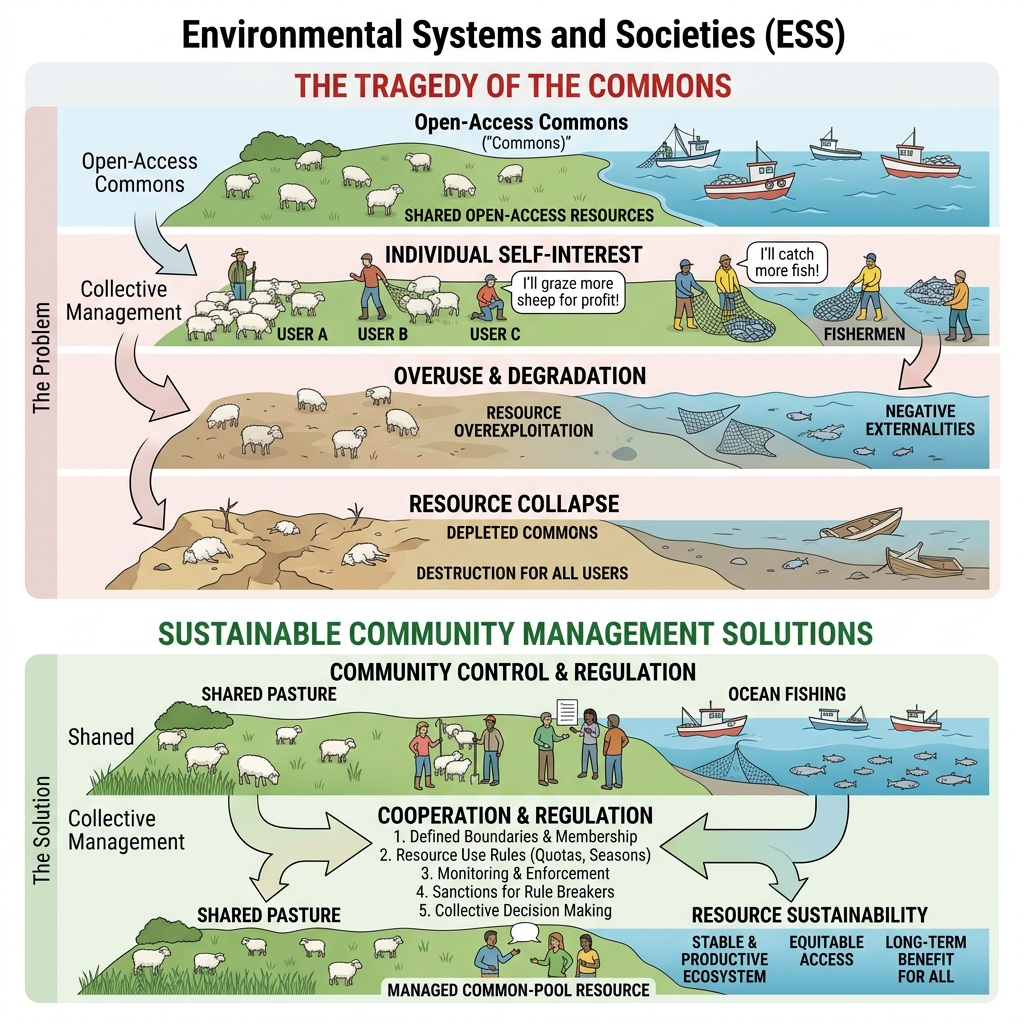
The Tragedy of the Commons
Hardin's concept: when a shared resource is accessible to all, individuals acting in self-interest will overexploit it, even when it's clear that this destroys the resource for everyone.
Open Access
→
Individual Overuse
→
Resource Depletion
→
Collapse
Resource
Overexploitation
Consequence
Atlantic cod (Newfoundland)
Industrial trawling exceeded MSY
99% population collapse (1992); fishery still closed
Water table dropping ~1m/year; agricultural crisis imminent
7.1.14 — HL Extension
Environmental Impact Assessment (EIA) HL
Key Understanding (HL)
Sustainable resource management in development projects is addressed in an environmental impact assessment (EIA).
An EIA evaluates the likely environmental, social and economic consequences of a proposed project before it is approved. Most countries legally require EIAs for major development projects.
Stages of an EIA
1. Screening Is an EIA needed?
→
2. Scoping What impacts matter?
→
3. Baseline Current conditions
→
4. Prediction Impact assessment
→
5. Mitigation Reduce impacts
→
6. Monitoring Post-approval
🏗 Case Study — EU EIA Directive
The European Union requires EIAs for projects likely to have significant environmental effects (roads, dams, power plants, waste facilities). The 2014 revision strengthened requirements for climate impact assessment and public participation.
7.1.15 — HL Extension
EIAs Consider Three Dimensions HL
Key Understanding (HL)
EIAs consider the environmental, social and economic impacts of any proposed project.
Will the project destroy wetland habitat? How much CO₂ will it emit?
Social
Community impacts, health, displacement, cultural sites
Will communities be displaced? Are there archaeological sites?
Economic
Costs, benefits, jobs, long-term viability
Will the project create sufficient employment to offset environmental costs?
Standards Vary Between Countries
EIA requirements differ significantly based on governance capacity, wealth and regulatory frameworks. This is an environmental justice issue — communities in countries with weak governance may receive less protection.
⚖️ Comparison — Germany vs Kenya
Germany's EIA process is rigorous: detailed modelling, public hearings, independent review, long-term monitoring. In rural Kenya, EIAs for agricultural projects may focus on basic impacts with limited post-approval monitoring — due to resource constraints. The outcome: the same type of project receives very different environmental scrutiny.
7.1.16 — HL Extension
Public Participation in EIAs HL
Key Understanding (HL)
Making EIAs public allows local citizens to have a role as stakeholders in decision-making.
Public participation ensures that affected communities can provide input, raise concerns, and influence project design. This connects to environmental justice and the rights of marginalised groups, including indigenous communities.
Levels of Participation
Tokenistic Information only
→
Consultation Feedback sought
→
Collaboration Co-design
→
Empowerment Decision authority
⚠ Exam Hint Distinguish between genuine and tokenistic consultation. Tokenistic participation means "we told you what we're going to do"; genuine participation means "your input changed the outcome."
🌳 Case Study — Pipeline Protests (Standing Rock, 2016)
The Dakota Access Pipeline EIA was criticised for inadequate consultation with the Standing Rock Sioux Tribe. Community opposition highlighted how marginalised groups can be excluded from decision-making — even when EIAs are technically conducted.
7.1.17 — HL Extension
Unsustainable Extraction of Renewable Resources HL
Key Understanding (HL)
While a given resource may be renewable, the associated means of extracting, harvesting, transporting and processing it may be unsustainable.
A resource can be renewable in theory, but the methods used to obtain it may cause environmental damage that undermines its renewability.
Destruction of seabed habitats, coral reef damage, bycatch
Water
Over-pumping from aquifers
Land subsidence, saltwater intrusion, ecosystem collapse
Biofuels
Deforestation for palm oil plantations
Peatland destruction, massive CO₂ emissions, orangutan habitat loss
Renewable resource ≠ Sustainable practice
🌴 Case Study — Palm Oil in Borneo
Palm oil is a renewable crop, but its expansion has driven massive deforestation in Borneo. Peatland draining releases vast amounts of CO₂, and the loss of rainforest has pushed orangutans to the brink of extinction. The resource is renewable; the extraction method is not.
7.1.18 — HL Extension
Economic Interests vs Long-Term Sustainability HL
Key Understanding (HL)
Economic interests often favour short-term responses in production and consumption which undermine long-term sustainability.
Markets reward short-term profit. Political cycles run 4–5 years. Ecosystems operate on decades to centuries. This mismatch creates powerful incentives for overexploitation.
Discount rates — future benefits are valued less than present benefits in economic models
Externalities — environmental costs (pollution, habitat loss) are often not included in market prices
Subsidies — governments may subsidise fossil fuel extraction, making unsustainable practices artificially profitable
Tragedy of the commons — shared resources are exploited because the profit is private but the cost is shared
🏭 Case Study — Global Fishing Subsidies
The UN estimates that $35 billion/year in fishing subsidies (fuel, vessel construction) make industrial fishing profitable in areas where it would otherwise be uneconomic. This directly drives overfishing — short-term economic incentives destroying long-term resource viability.
7.1.19 — HL Extension
Resource Insecurity & Geopolitical Tension HL
Key Understanding (HL)
Natural resource insecurity hinders socio-economic development and can lead to environmental degradation and geopolitical tensions and conflicts.
When resources become scarce, competition intensifies — between communities, regions, and nations. Resource insecurity amplifies existing inequalities and can trigger conflict.
Resource Scarcity
→
Economic Pressure
→
Social Unrest
→
Geopolitical Conflict
Resource
Region
Tension / Conflict
Oil
Middle East
Gulf Wars, OPEC geopolitics, Iran–US tensions
Water
Nile Basin
Ethiopia–Egypt–Sudan dispute over Grand Ethiopian Renaissance Dam
Territorial disputes partly driven by fishing rights and seabed resources
💧 Case Study — The Nile Water Dispute
Egypt depends on the Nile for 97% of its freshwater. Ethiopia's GERD dam will reduce downstream flow. Negotiations have been ongoing since 2011, with Egypt threatening military action. This illustrates how water insecurity can escalate to geopolitical crisis.
Key Terms
Glossary — Essential Vocabulary
Term
Definition
Natural resources
Raw materials and sources of energy used and consumed by society
Natural capital
The stock of natural resources available on Earth
Natural income
The annual flow of goods and services produced by natural capital
Ecosystem services
Benefits provided by functioning ecosystems that support human life
Renewable resource
A resource that can regenerate at a rate ≥ rate of use
Non-renewable resource
A fixed stock that cannot be replenished on a humanly meaningful timeframe
Replenishable resource
A resource intermediate between renewable and non-renewable (e.g. groundwater, soil)
Maximum Sustainable Yield (MSY)
The largest harvest that can be taken from a population indefinitely without depleting it
Resource security
Ensuring long-term availability of sufficient natural resources to meet demand
Tragedy of the commons
Overexploitation of a shared resource by individuals acting in self-interest
Environmental Impact Assessment (EIA)
A process evaluating the environmental, social and economic consequences of a proposed project
Overexploitation
Extraction or consumption of a resource beyond its regeneration rate
Intrinsic value
The inherent worth of something independent of its utility to humans
Anthropocentric
A human-centred perspective; nature valued primarily for human use
Ecocentric
An ecosystem-centred perspective; nature valued for its own sake
Externalities
Costs or benefits of an activity not reflected in market prices
Carbon sequestration
The process of capturing and storing atmospheric CO₂ in biomass or soils
Geopolitical tension
Political conflict arising from competition over natural resources between nations
Exam Preparation
Key Takeaways & Exam Tips
📝 Paper 1 — Case Study Skills
Identify which type of natural capital is being discussed (renewable, non-renewable, replenishable)
Classify the value(s) of the natural capital involved (economic, environmental, cultural, intrinsic…)
Use specific data from the case study — don't rely on general knowledge alone
Evaluate from multiple perspectives (anthropocentric vs ecocentric)
📝 Paper 2 — Structured Essay Tips
Define key terms early in your response — "Natural capital refers to the stock of natural resources…"
Use named examples — specific case studies score higher than generic references
Discuss factors — always consider at least two influencing factors (economic + environmental, political + cultural)
Evaluate — present both sides; use "on the other hand" and "however"
HL students: reference EIA stages, management strategies, and the short-term vs long-term economic tension
Common Exam Patterns
Pattern
Key Skill
Classify resources
Renewable / non-renewable / replenishable — with justification
Identify ecosystem services
Provisioning, regulating, cultural, supporting — with examples
Evaluate resource use
Consider multiple values and perspectives
Discuss sustainability
MSY, management strategies, trade-offs
HL: EIA analysis
Stages, stakeholder participation, three dimensions
HL: Geopolitical tension
Link resource scarcity to economic and political consequences
✅
You've Covered All 19 Syllabus Points
19
Understanding points completed
7.1.1 – 7.1.11 (SL) + 7.1.12 – 7.1.19 (HL)
IB ESS 7.1 — Natural Resources: Uses & Management
New Syllabus · First Assessment 2026