Subtopic 7.2 · New Syllabus (First Assessment 2026) Standard Level + Higher Level
6
SL Syllabus Points
4
HL Extensions
10
Total Understandings
Overview
What You Need to Know
This subtopic examines how societies generate, store and use energy. Students evaluate renewable and non-renewable energy sources, energy security, sustainability, nuclear power, battery storage, and the challenges of transitioning away from fossil fuels.
Guiding Questions
To what extent can energy consumption be equitable across the world?
How can energy production be sustainable?
A. Energy Sources & Classification
Renewable vs non-renewable, fossil fuels, renewables, global consumption trends
B. Sustainability & Choices
Environmental costs of each source, factors influencing energy decisions, storage systems
C. Conservation & Efficiency
Conservation vs efficiency, circular economy, reducing import dependence
D. HL Extensions
Energy security, fossil fuel depletion, nuclear power, battery storage consequences
⏱ Time allocation: minimum 3 hours for this subtopic.
7.2.1 — Energy Sources
Energy Sources Are Both Renewable & Non-Renewable
Key Understanding
Energy sources are both renewable and non-renewable.
All energy on Earth ultimately comes from the Sun. Fossil fuels are stored solar energy from millions of years ago. Most energy is converted to electricity — via mechanical energy (turbines) → electrical energy (generators).
Renewable Sources
Non-Renewable Sources
Definition
Replenished naturally on a human timescale
Finite; cannot be replenished on a human timescale
Examples
Solar, wind, hydro, tidal, geothermal, biomass
Coal, oil, natural gas, nuclear (uranium)
Key advantage
Continuous supply; low operational emissions
High energy density; established infrastructure
Key challenge
Intermittency; storage needed
Finite reserves; high emissions; pollution
Energy Conversion to Electricity
Energy Source
→
Mechanical Energy (turbine rotation)
→
Electrical Energy (generator)
Exceptions: solar PV cells convert sunlight directly to electricity (no turbine needed).
7.2.2 — Global Consumption
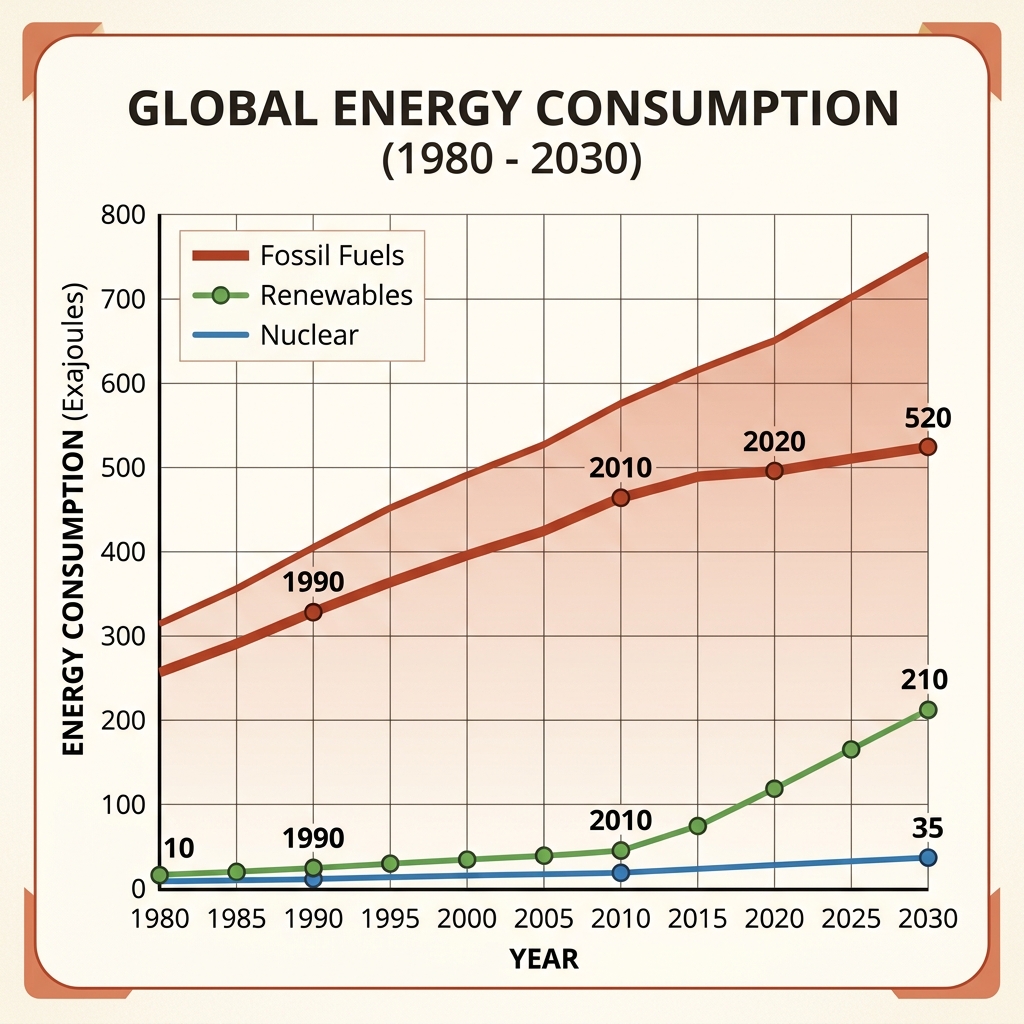
Global Energy Consumption Is Rising
Key Understanding
Global energy consumption is rising with increasing population and with per capita demand.
Two forces drive rising consumption: more people and more energy per person. Fossil fuels still dominate — providing ~80% of global primary energy — because they are deeply embedded in transport, heating, industry, and agriculture.
Why Fossil Fuels Are Hard to Replace
Industry
Role of Fossil Fuels
Why Transition Is Difficult
Steel
Coal as reducing agent in blast furnaces
Green hydrogen alternatives not yet commercially viable at scale
Concrete/Cement
Coal/gas fuel the calcination process
Calcination itself releases CO₂ independent of fuel source
Fertiliser
Haber-Bosch process uses natural gas as hydrogen source
Feeds ~4 billion people — no substitute at scale yet
Plastics
Petroleum as feedstock
Plastic production accounts for ~8% of global oil use
🌍 Developing Country Challenge
Transition away from fossil fuels is particularly difficult for developing countries: they need cheap, reliable energy for industrialisation, lack capital for renewable infrastructure, and have growing populations with rising per capita demand. The "energy ladder" shows that the poorest rely on biomass while the richest use electricity/gas — billions are stuck on the bottom rungs.
📊 Case Study — USA vs Kenya
US per capita energy use: ~85 kWh/day. Kenya: ~3 kWh/day. The US uses 28× more energy per person. As Kenya develops, its energy demand will surge — the question is whether that growth can be powered renewably.
7.2.3 — Sustainability
Sustainability of Energy Sources Varies Significantly
Key Understanding
The sustainability of energy sources varies significantly.
Sustainability includes not just resource longevity but the environmental, economic and social costs of extraction, use, and disposal.
Panel manufacturing uses toxic materials (cadmium, lead); land use for farms; 25–30yr lifespan; recycling limited
High
Wind
Bird/bat collisions; composite blade disposal challenging; construction footprint
High
Biomass
Deforestation if not managed; air pollution from combustion; land competition with food
Variable — depends on source
⛏ Case Study — Rare Earth Elements
REEs (neodymium, dysprosium) are essential for wind turbines and EV motors. China produces ~60% of global supply. Mining REEs involves toxic chemicals, radioactive waste, and habitat destruction — meaning "green" technology has its own environmental footprint.
7.2.4 — Energy Choices
Factors Affecting a Country's Energy Choices
Key Understanding
A variety of factors will affect the energy choices that a country makes.
Energy sources are not evenly distributed. Fossil fuels are concentrated: coal in China/US, oil in the Middle East, gas in Russia/Qatar. Many countries depend on imports — a vulnerability during political disruption.
Factor
Influence on Energy Choice
Named Example
Availability
Use what's geographically accessible
Norway → 90%+ hydropower (mountains + rivers)
Economics
Cost of production and infrastructure
US shale gas boom — fracking made gas cheaper than coal
Politics
Government policy, subsidies, energy independence
France → nuclear (70% of electricity) post-1970s oil crisis
Technology
Innovation enables new options
Saudi Arabia investing in solar despite vast oil reserves
Environment
Climate commitments, pollution concerns
Germany's Energiewende — shift to renewables after Fukushima
Culture
Public attitudes, acceptance
Japan — post-Fukushima anti-nuclear sentiment
Security
Desire to avoid import dependence
China's massive solar/wind investment to reduce coal reliance
🇩🇪 vs 🇸🇦 Case StudyGermany: Energiewende targets 80% renewables by 2030. Phase-out of nuclear + coal. Strong economy supports investment, but transition costs raise consumer prices. Saudi Arabia: World's cheapest oil production ($2–3/barrel). Economy depends on oil exports. Investing in solar (NEOM project) but transition is slow due to oil revenue dependence.
7.2.5 — Energy Storage
Intermittency Creates Need for Storage
Key Understanding
Intermittent energy production from some renewable sources creates the need for energy storage systems.
Wind and solar are variable — the sun doesn't shine at night, wind doesn't blow constantly. Without storage, renewables can't provide reliable 24-hour electricity.
Peak demand ≠ Peak renewable production → Storage bridges the gap ("peak-shaving")
Key Understanding
Energy conservation and energy efficiency may allow a country to be less dependent on importing a resource.
Energy Conservation
Energy Efficiency
Definition
Behavioural changes to reduce energy consumption
Technology/design to perform the same task with less energy
Example
Turning off lights, lowering thermostats, cycling instead of driving
LED lighting (75% less energy than incandescent), insulation, heat pumps
Key insight
Every 1°C reduction in heating saves ~10% of heating energy
Intelligent lighting with sensors can halve building electricity use
Circular Economy & Energy Efficiency
Designing goods for disassembly and recycling reduces the energy needed to produce new materials. Buildings designed with energy efficiency from the outset (passive house standards) use up to 90% less heating energy than conventional buildings.
💡 Case Study — Japan's Top Runner Programme
Japan sets minimum energy efficiency standards based on the best-performing products on the market. Manufacturers must meet these standards within a set timeframe. This has driven dramatic improvements in appliance efficiency, reducing national energy demand despite economic growth.
7.2.7 — HL Extension
Energy Security HL
Key Understanding (HL)
Energy security for a country means access to affordable and reliable sources of energy. Through energy-efficiency measures, decreasing reliance on imported energy supplies and diversification, a country can improve its energy security.
Three Strategies for Energy Security
Energy Efficiency Reduce demand
+
Domestic Production Reduce imports
+
Diversification Mix energy sources
Strategy
How It Improves Security
Energy efficiency
Lower demand = less need for imports; reduces costs for consumers and businesses
Decrease import reliance
Invest in domestic renewables (wind, solar, hydro); maintain strategic oil/gas reserves as buffer
Diversification
Mix of sources (renewable + nuclear + gas) reduces risk from any single supply disruption
⚡ Case Study — Russia–Ukraine Gas Dispute (2006, 2009, 2022)
Europe's dependence on Russian gas became a critical security vulnerability. After Russia's 2022 invasion of Ukraine, EU nations scrambled to diversify: accelerating LNG imports, expanding renewables, and restarting some coal plants. The crisis proved that energy dependence = geopolitical vulnerability.
🪜 Energy Poverty
~770 million people lack electricity access. Energy security also means equitable access. Clean cookstoves, solar mini-grids, and community solar can lift people off biomass fuels — reducing health impacts from indoor air pollution (4 million premature deaths/year).
7.2.8 — HL Extension
Fossil Fuel Dependence & Depletion HL
Key Understanding (HL)
The global economy mostly depends on finite reserves of fossil fuels as energy sources; these include coal, oil and natural gas.
Fossil fuels are embedded not only in electricity generation but in transport, heating, industrial processes, and as feedstocks for plastics, chemicals, and fertilisers. This pervasive dependence cannot be rapidly unwound.
Factors Determining Depletion Timescales
Factor
Effect on Depletion
Reserve discovery
New discoveries (e.g., deep-sea oil) extend reserves; fracking unlocked "unreachable" gas
If prices drop below extraction cost, reserves become "stranded assets"
Proven reserves of oil alone would generate ~3.5 trillion tonnes of CO₂ — 7× the remaining carbon budget for 1.5°C
⚠ Stranded Assets
If climate targets are met, much of the world's proven fossil fuel reserves will never be burned. These become "stranded assets" — coal mines, oil fields, and gas infrastructure worth billions that lose their economic value. This creates enormous financial risk for fossil-fuel-dependent economies.
7.2.9 — HL Extension
Nuclear Power HL
Key Understanding (HL)
Nuclear power is a non-renewable, low-carbon means of electricity production.
Nuclear fission splits uranium atoms, releasing heat → steam → turbine → electricity. Nuclear provides ~10% of global electricity and ~25% of low-carbon electricity worldwide.
The Nuclear Debate
Advantages
Disadvantages
Very low CO₂ during operation (~12 g CO₂/kWh vs coal ~820)
Radioactive waste remains hazardous for thousands of years
Extremely high construction costs and time overruns
Low land use compared to solar/wind farms
Decommissioning is expensive and complex
☢ Case Study — Fukushima Daiichi (2011)
Tsunami overwhelmed seawall → cooling systems failed → reactor meltdowns. 154,000 people evacuated. Estimated cleanup cost: $200+ billion over 30+ years. Led to Japan shutting all 54 reactors (only 12 restarted by 2025) and Germany accelerating its nuclear phase-out.
⚠ Exam Hint Nuclear power is a classic evaluation question. Avoid treating it as simply "good" or "bad". A strong answer acknowledges the low-carbon operational benefit while honestly addressing waste, accident risk, and cost. Link your evaluation to ecocentric vs technocentric perspectives (Topic 1.1).
7.2.10 — HL Extension
Battery Storage: Costs & Consequences HL
Key Understanding (HL)
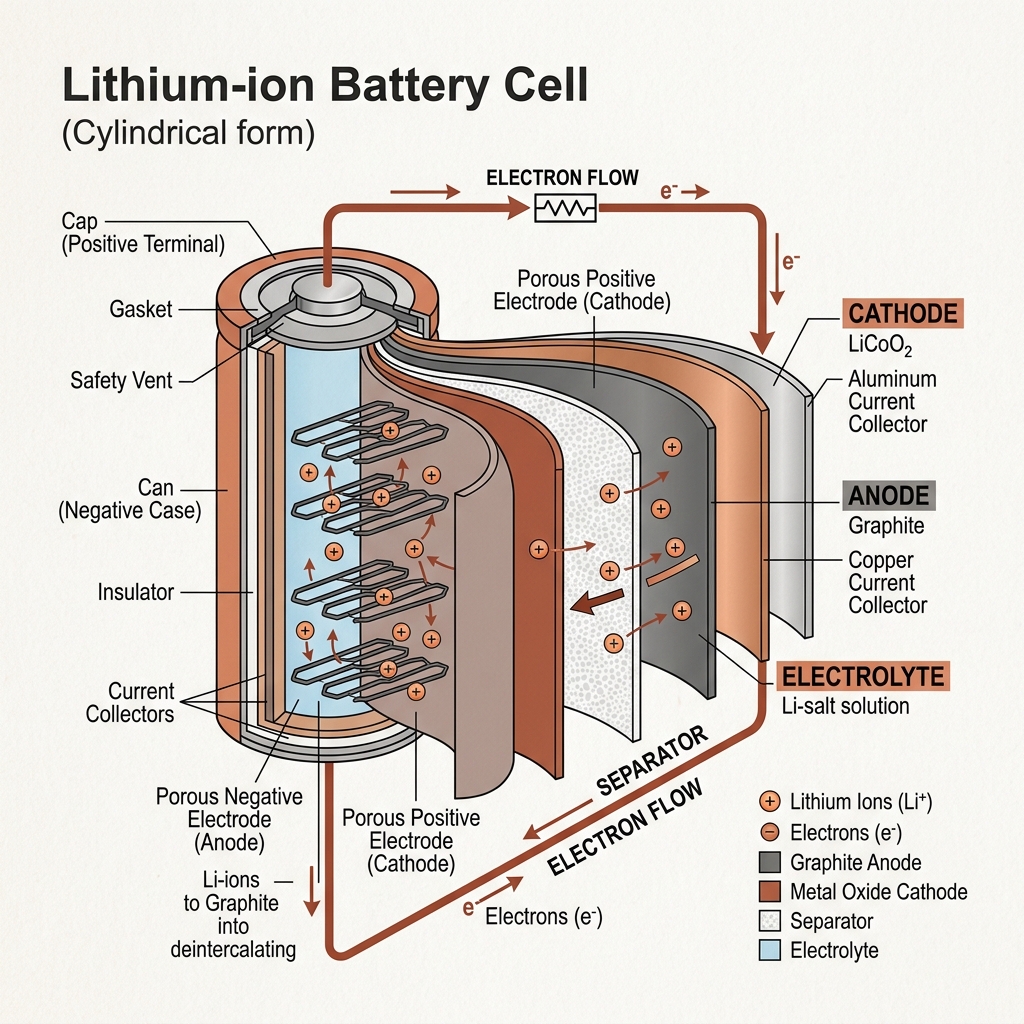
Battery storage is required on a large scale to meet global requirements for reduction of carbon emissions, but it requires mining, transporting, processing and construction, all of which produce emissions and pollution, and cause sociopolitical tensions.
Batteries are the critical link between intermittent renewables and reliable electricity. But the supply chain behind them has its own environmental and social costs.
The Battery Supply Chain
Mining Lithium, cobalt, nickel
→
Processing Chemical refining
→
Manufacturing Cell production
→
Use Grid / EV storage
→
End of Life Recycling?
Impact
Details
Lithium mining (Chile, Australia)
Water-intensive (500,000 litres per tonne); depletes aquifers in arid regions; local communities lose water access
Cobalt mining (DR Congo)
~70% of global supply; child labour documented; toxic dust causes respiratory disease; "blood cobalt" parallels "blood diamonds"
Processing emissions
Refining lithium, nickel, and cobalt is energy-intensive; often powered by coal in China
End-of-life waste
Battery recycling is nascent; ~5% of lithium-ion batteries recycled globally; toxic chemicals leach from landfill
Sociopolitical tensions
Geopolitical competition for mineral supply chains; "green colonialism" concerns in extraction countries
🇨🇴 Case Study — Cobalt in DR Congo
Artisanal mines employ ~200,000 Congolese, including an estimated 40,000 children. Exposure to cobalt dust causes lung disease. Despite contributing to the global energy transition, mining communities see little benefit — raising critical environmental justice questions about who bears the cost of "clean" energy.
Key Terms
Glossary — Essential Vocabulary
Term
Definition
Renewable energy
Energy from sources replenished naturally on a human timescale (solar, wind, hydro, tidal, geothermal, biomass)
Non-renewable energy
Energy from finite sources that cannot be replenished on a human timescale (coal, oil, gas, nuclear)
Fossil fuels
Coal, oil and natural gas formed from ancient organic remains over millions of years
Nuclear fission
Splitting uranium atoms to release energy for electricity generation
Intermittency
The variable, unpredictable nature of some renewable sources (wind, solar)
Peak demand
Periods of highest electricity consumption in a day
Peak-shaving
Using stored energy to meet demand when renewable production is low
Pumped hydro storage (PHS)
Storing energy by pumping water uphill; releasing it through turbines when needed
Energy conservation
Behavioural changes to reduce energy consumption
Energy efficiency
Using technology to perform the same task with less energy input
Energy security
Access to affordable, reliable energy sources to meet a country's needs
Energy poverty
Lack of access to sufficient, clean, affordable energy for basic needs
Stranded assets
Fossil fuel reserves that may never be burned due to climate policy
Circular economy
Designing products for reuse, repair and recycling to reduce energy and material demand
Baseload power
The minimum continuous electricity demand a grid must meet 24/7
Haber-Bosch process
Industrial process using natural gas to produce synthetic nitrogen fertiliser
Exam Preparation
Key Takeaways & Exam Tips
📝 Paper 1 — Case Study Skills
Identify the energy mix of the case study country — what % is fossil vs renewable vs nuclear?
Link to geography — what resources are available domestically vs imported?