
IB DP Environmental Systems & Societies
8.2 — Urban Systems & Planning
Subtopic 8.2 · New Syllabus (First Assessment 2026)
Standard Level + Higher Level
Overview
What You Need to Know
This subtopic examines cities as complex, interconnected systems. We will explore urbanization trends, how cities function as ecosystems, different city structure models, and the vital role of sustainable and equitable urban planning.
Guiding Questions
- To what extent are urban systems similar to natural ecosystems?
- How can reimagining urban systems create a more sustainable future?
- What role do social equity and inclusivity play in the success of sustainable urban planning?
A. Urban Ecosystems
Urban systems contain biotic and abiotic components and differ fundamentally from natural ecosystems.
B. Growth & Structure
Urbanization trends, rural-urban migration, and models of city structure.
C. Sustainable Planning
Green architecture, smart cities, resource management, and social equity.
D. HL Extensions
Doughnut economics, circular economies, and advanced social equity considerations.
8.2.1 — Urban Areas as Ecosystems
Urban Areas Contain Urban Ecosystems
Key UnderstandingUrban areas are characterised by interconnected systems that contain both biotic and abiotic components, functioning as urban ecosystems.
An urban area is a human settlement with a high population density and built infrastructure. But it is not just concrete—it is a functioning ecosystem.
Biotic Components (Living)
- Humans (the dominant species)
- Domesticated animals (pets)
- Urban wildlife (birds, rodents, insects)
- Plants (street trees, parks, green roofs)
Abiotic Components (Non-Living)
- Built infrastructure (buildings, roads)
- Air and microclimates (urban heat island)
- Water networks (drainage, pipes, rivers)
- Soil (often compacted or paved over)
Just like natural ecosystems, urban ecosystems involve complex flows of energy and matter, and intricate interactions between the living and non-living elements.
8.2.2 — Urban vs Natural Ecosystems
Comparing Urban & Natural Systems
Key UnderstandingUrban ecosystems differ from natural ecosystems in their heavy reliance on external inputs of resources and their significant generation of waste outputs.
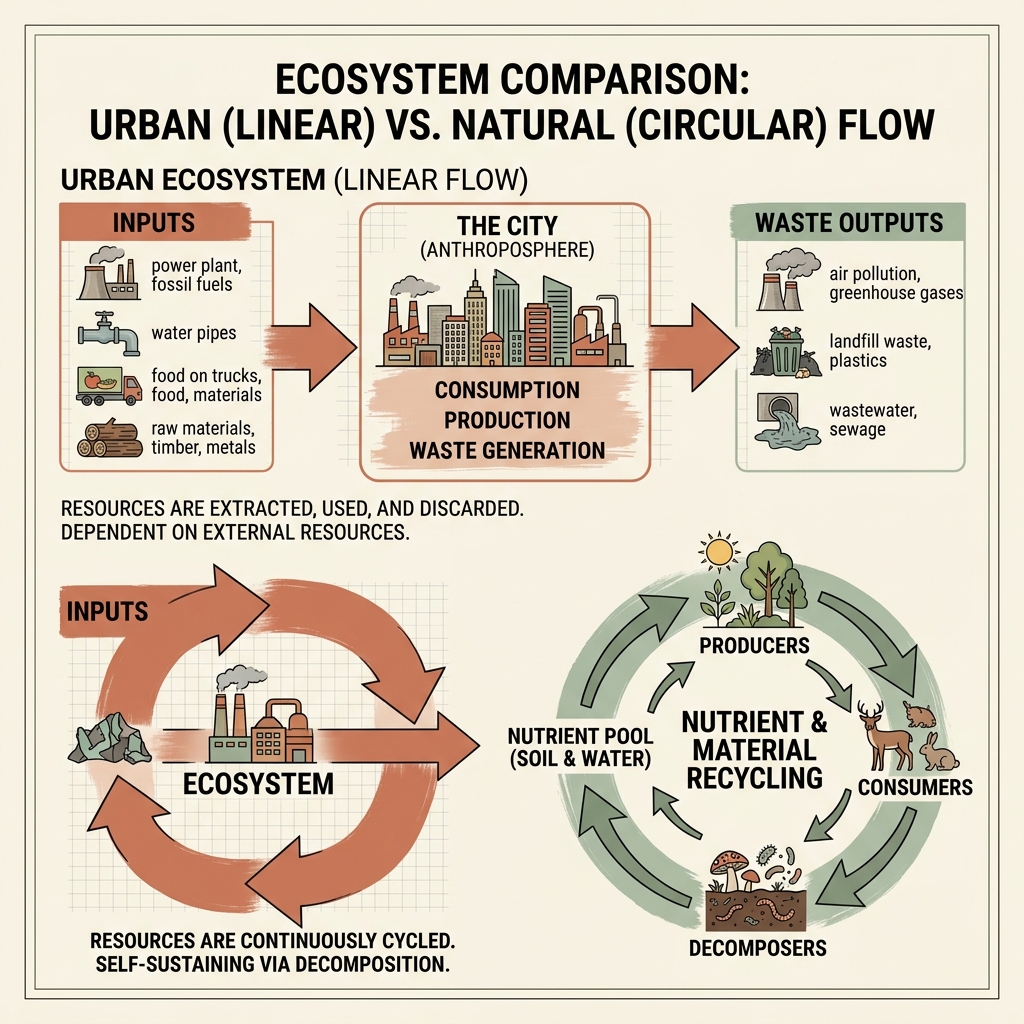
The Linear Urban Flow
- Natural Ecosystems are largely self-sustaining. Energy comes from the sun, and nutrients are perfectly cycled within the system (circular).
- Urban Ecosystems operate on a linear "take-make-dispose" model. They import vast amounts of food, water, and energy from the outside (their ecological footprint extends far beyond city limits).
- They output massive amounts of concentrated waste, sewage, and pollution (greenhouse gases) back into the environment.
8.2.3 — Urbanization Trends
Global Urbanization Trends
Key UnderstandingThe global trend of urbanization is driven by complex push and pull factors, primarily rural-urban migration and natural population increase.
For the first time in history, more than half of the world's population lives in urban areas, and this figure is projected to rise to 68% by 2050.
Drivers of Urbanization
| Factor Type | Examples | Effect |
|---|
| Push Factors (Why leave rural areas?) | Poverty, lack of jobs, crop failures, conflict, lack of services. | Forces people out of the countryside. |
| Pull Factors (Why go to the city?) | Employment opportunities, better healthcare, education, perceived higher standard of living. | Attracts people to urban centers. |
| Natural Increase | High birth rates among younger, newly migrated urban populations. | Drives internal city growth. |
Environmental ConsequenceRapid, unplanned urbanization often leads to the development of informal settlements (slums), loss of surrounding biodiversity, and extreme pressure on water and sanitation infrastructure.
8.2.4 — City Structure Models
City Structure and Planning Models
Key UnderstandingUrban areas are structured in predictable patterns that can be represented by city structure models.
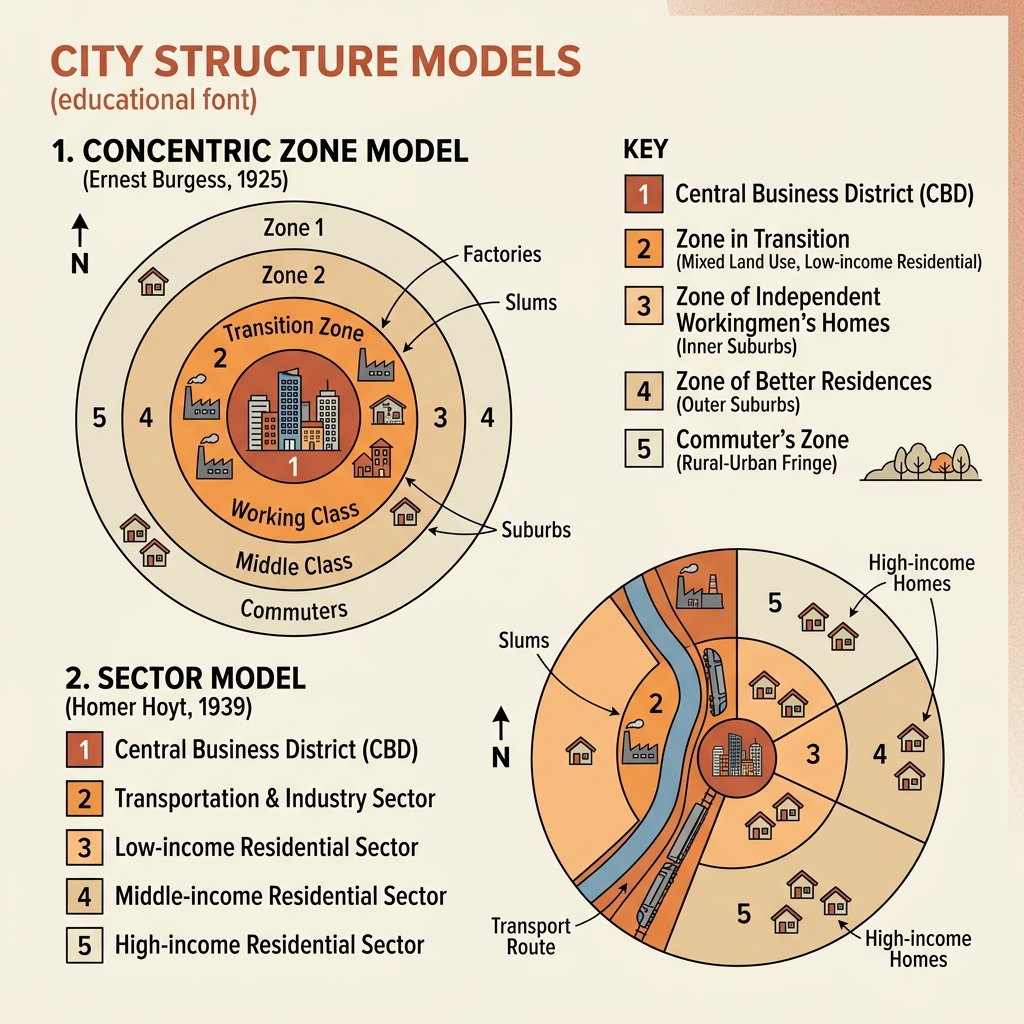
Geographers use models to understand how land use is organized within a city. Two foundational models include:
- Concentric Zone Model (Burgess): Cities grow outward from a Central Business District (CBD) in a series of concentric rings (e.g., transition zone, working-class housing, commuter zone).
- Sector Model (Hoyt): Cities develop in wedge-shaped sectors radiating from the CBD, often following transport routes (railways, rivers).
While these historical models were based on older industrial cities, modern cities are much more complex, often resembling Multiple Nuclei Models with several decentralized hubs.
8.2.5 — Sustainable Urban Planning
Sustainable & Resilient Planning
Key UnderstandingCreating resilient and sustainable cities requires integrated planning for transport, waste management, energy, and green spaces.
To shift urban ecosystems from a linear to a more circular model, planners must intervene at multiple levels:
Green Infrastructure
- Urban forests and parks to reduce the urban heat island effect.
- Permeable pavements and rain gardens to manage stormwater and prevent flooding.
Sustainable Transport
- Investing in mass transit (light rail, electric buses).
- Creating walkable neighborhoods and dedicated cycling infrastructure.
🌍 Case Study — Curitiba, BrazilCuritiba is famous for its Bus Rapid Transit (BRT) system and extensive network of green spaces, proving that sustainable urban planning is highly effective even in developing nations.
8.2.6 — Smart Cities
Green Architecture & Smart Cities
Key UnderstandingGreen architecture and smart city technologies are essential tools for reducing the environmental footprint of urban areas.
Green Architecture
Buildings consume massive amounts of energy and materials. Green architecture minimizes this impact through:
- Passive Design: Orienting buildings to maximize natural light and ventilation, reducing the need for heating and cooling.
- Sustainable Materials: Using recycled, locally sourced, or low-carbon materials (e.g., mass timber).
- Green Roofs & Walls: Integrating vegetation into the building envelope to improve insulation and biodiversity.
Smart Cities
Smart cities use digital technology and data sensors to optimize urban functions:
- Smart grids that efficiently distribute renewable energy.
- Intelligent traffic systems that reduce congestion and idling emissions.
- Automated waste management sensors that optimize collection routes.
8.2.7 — New Economic Models (HL)
Doughnut & Circular Economics HL
Key Understanding (HL)Achieving true urban sustainability requires adopting alternative economic paradigms, such as the circular economy and doughnut economics.
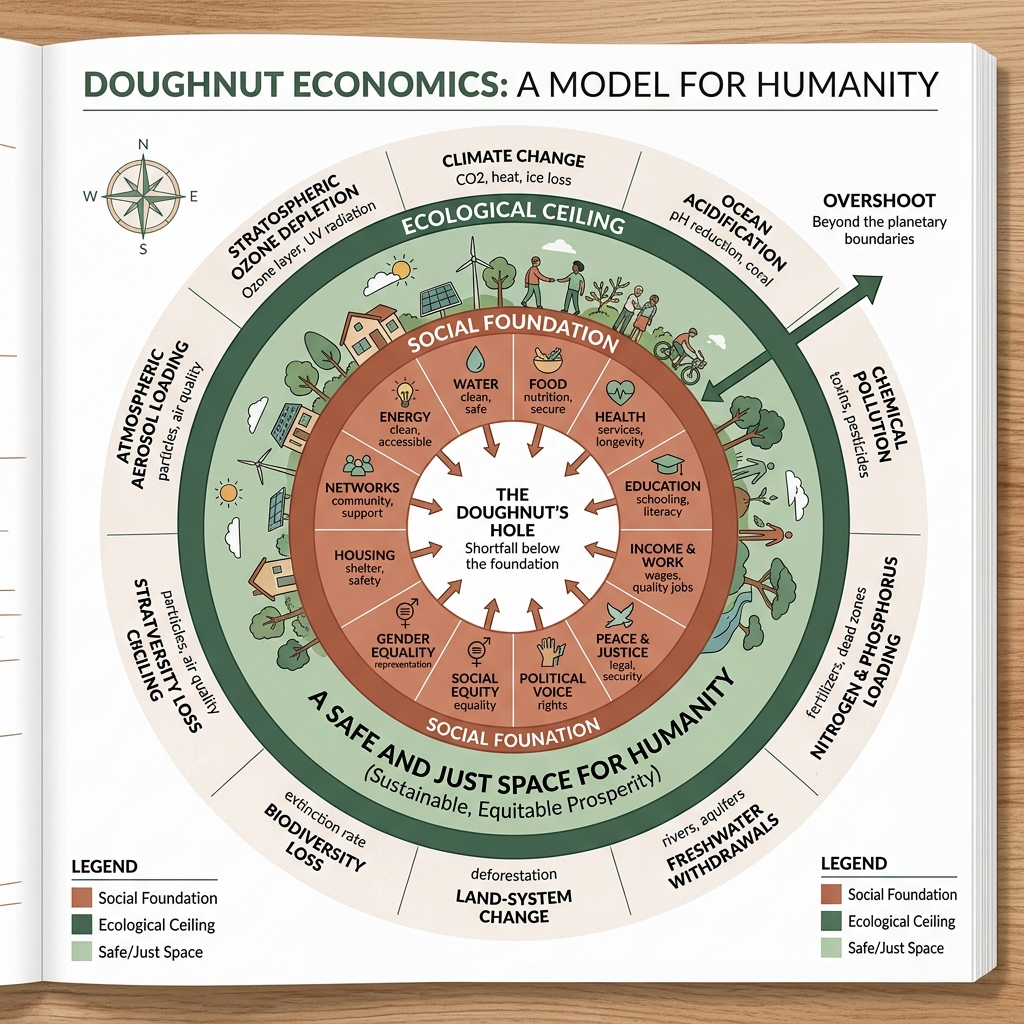
Traditional economic models focus on endless growth (GDP), which is incompatible with finite planetary resources. HL students must understand alternative models:
- Circular Economy: Designing out waste and pollution, keeping products and materials in use, and regenerating natural systems. It aims to close the loop in the urban ecosystem.
- Doughnut Economics (Kate Raworth): A model that visualizes human prosperity as a "doughnut." The inner ring represents the Social Foundation (no one falls short on life's essentials). The outer ring represents the Ecological Ceiling (we do not overshoot planetary boundaries like climate change and biodiversity loss). The goal of a city is to thrive in the "safe and just space" between the two.
8.2.8 — Social Equity (HL)
Social Equity in Urban Planning HL
Key Understanding (HL)Sustainable urban planning must prioritize social equity and inclusivity to ensure environmental benefits are shared by all residents.
Environmental improvements in cities can sometimes have unintended negative social consequences if equity is not considered.
Key Concepts
| Concept | Definition & Impact |
|---|
| Eco-Gentrification | When greening a neighborhood (e.g., adding parks) drives up property values, pushing out low-income residents who can no longer afford to live there. |
| Environmental Justice | Ensuring that marginalized communities do not bear a disproportionate burden of urban pollution (e.g., factories or highways located near low-income housing). |
| Inclusive Design | Planning cities that are accessible and safe for everyone, including the elderly, children, disabled individuals, and all socioeconomic groups. |
🤔 Think About It How can a city improve its green spaces without displacing the very people those spaces were meant to benefit?
Review
Glossary — Essential Vocabulary
| Term | Definition |
|---|
| Urban Ecosystem | An interconnected system within a city comprising both living (biotic) and non-living (abiotic) components. |
| Urbanization | The increasing proportion of people living in urban areas, typically driven by rural-to-urban migration. |
| Urban Sprawl | The uncontrolled expansion of urban areas into surrounding rural land. |
| Push/Pull Factors | Conditions that drive people away from a place (push) or attract them to a new place (pull). |
| Circular Economy | An economic system aimed at eliminating waste and the continual use of resources. |
| Doughnut Economics (HL) | An economic model balancing essential human needs (social foundation) with planetary boundaries (ecological ceiling). |
| Eco-Gentrification (HL) | The displacement of lower-income residents due to rising property values caused by environmental improvements. |
Review
Key Takeaways & Exam Tips
📝 Exam Hint: System Diagrams Be prepared to draw or evaluate system diagrams for urban areas. Make sure to clearly label inputs (energy, water, food), the system itself (the city), and the outputs (solid waste, sewage, pollution). Emphasize that it is an open, linear system.
- Compare and Contrast: You must be able to confidently compare urban ecosystems with natural ecosystems. Focus on energy flow, nutrient cycling, and reliance on external inputs.
- HL Focus: If you are HL, ensure you can explain the concept of Doughnut Economics and how it applies to city management. Don't just mention it; explain the balance between the social foundation and ecological ceiling.
- Case Studies: Always memorize at least two contrasting urban case studies (e.g., a sustainable city like Curitiba or Copenhagen, and a rapidly urbanizing city facing challenges like Mumbai or Lagos).
✅
Topic 8.2 Complete!
You have successfully reviewed Urban Systems & Planning.
9 / 9
Syllabus Understandings Covered