
IB DP Environmental Systems & Societies
8.3 — Urban Air Pollution
Subtopic 8.3 · New Syllabus (First Assessment 2026)
Standard Level + Higher Level
Overview
What You Need to Know
This subtopic examines how fossil fuel combustion in urban areas leads to complex air pollution problems. We will explore the differences between primary and secondary pollutants, the formation of photochemical smog, the impacts of acid rain, and strategies for managing these global issues.
Guiding Questions
- How do human activities and natural processes interact to create urban air pollution?
- What are the environmental and social impacts of photochemical smog and acid rain?
- How effective are different management strategies in mitigating urban air pollution?
A. Pollutants
Distinguishing between primary and secondary pollutants.
B. Photochemical Smog
The role of sunlight, VOCs, NOₓ, and thermal inversions in forming smog.
C. Acid Deposition
Causes and impacts of wet and dry acid deposition on ecosystems.
D. HL Extensions
Policy analysis and the application of economic/ethical lenses to pollution management.
8.3.1 — Primary & Secondary Pollutants
Primary vs Secondary Pollutants
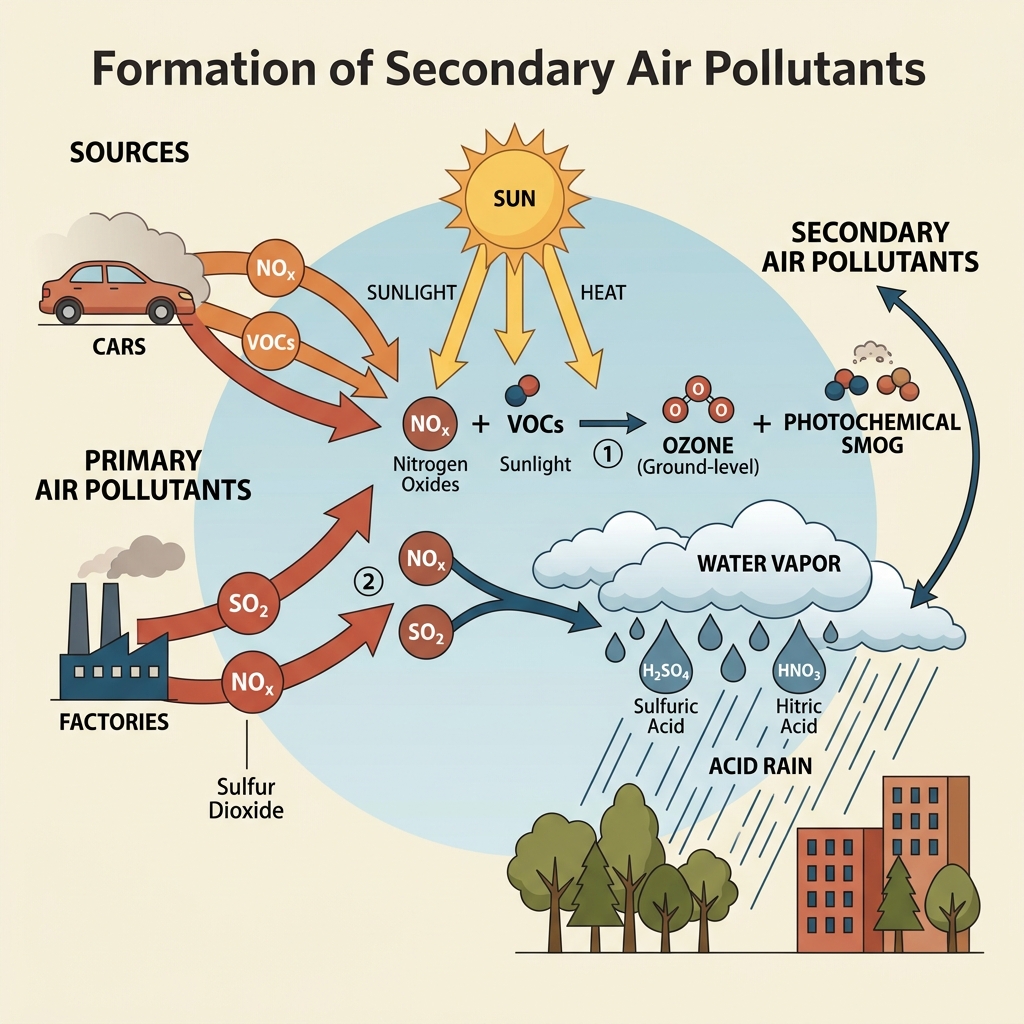
Key UnderstandingFossil fuel combustion produces primary pollutants, which can react in the atmosphere to form secondary pollutants.
Primary Pollutants
Emitted directly into the atmosphere from a source (e.g., a car exhaust or factory chimney).
- NOₓ (Nitrogen Oxides)
- SO₂ (Sulfur Dioxide)
- CO (Carbon Monoxide)
- PM (Particulate Matter like PM10, PM2.5)
- VOCs (Volatile Organic Compounds)
Secondary Pollutants
Formed when primary pollutants undergo chemical reactions in the atmosphere (often driven by sunlight or water).
- Tropospheric Ozone (O₃)
- Photochemical Smog
- Acid Rain (H₂SO₄, HNO₃)
8.3.2 — Photochemical Smog
Formation of Photochemical Smog
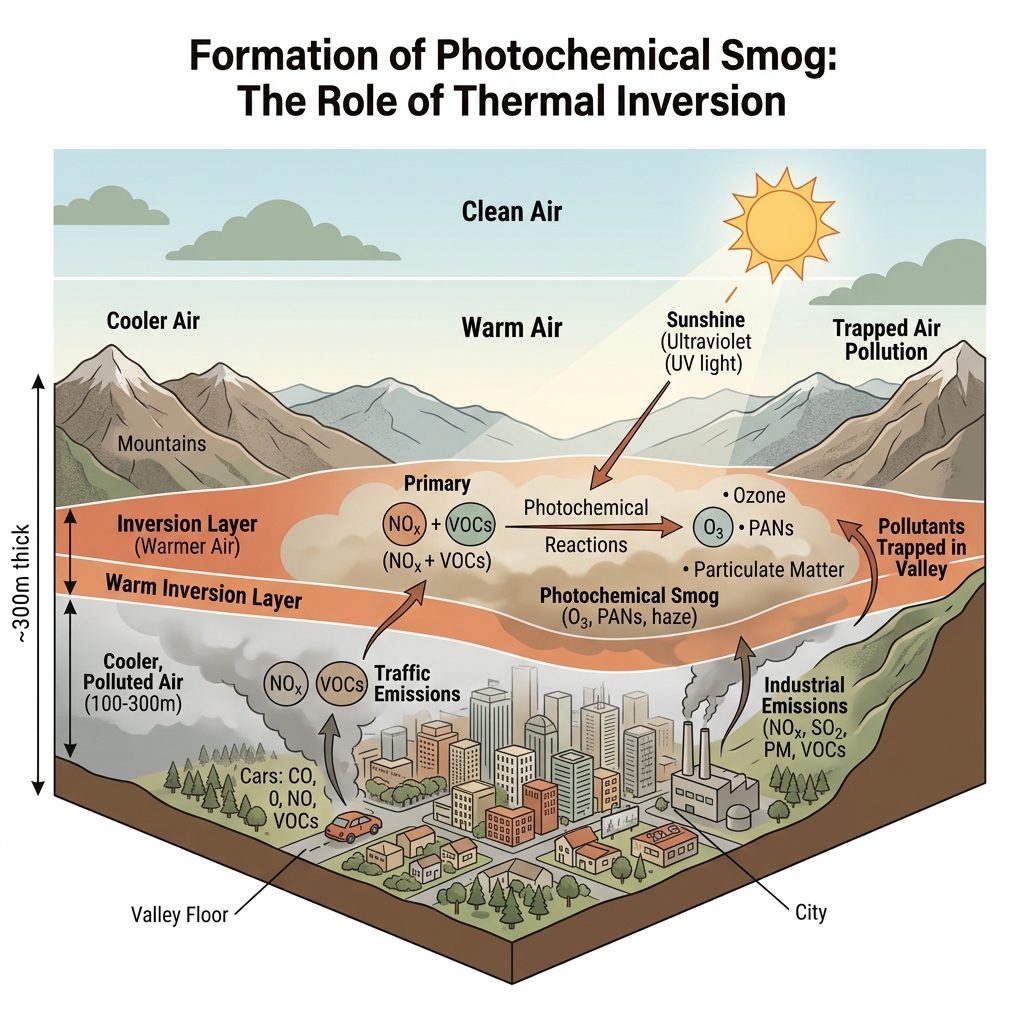
Key UnderstandingPhotochemical smog is a mixture of primary and secondary pollutants, predominantly tropospheric ozone, formed when NOₓ and VOCs react in the presence of sunlight.
Unlike normal "smog" (smoke + fog), photochemical smog is a chemical soup that peaks in the afternoon on hot, sunny days.
The Chemical Reaction
Nitrogen Oxides (NOₓ) + Volatile Organic Compounds (VOCs) + Sunlight ➔ Tropospheric Ozone (O₃) + PANs
- Tropospheric Ozone (O₃): While ozone in the stratosphere protects us from UV rays, ozone in the troposphere (ground level) is a toxic greenhouse gas that damages lung tissue and plant leaves.
- PANs: Peroxyacyl nitrates are highly toxic respiratory and eye irritants.
Environmental ImpactPhotochemical smog reduces photosynthesis in plants, damages materials (like rubber and plastics), and causes severe respiratory diseases (asthma, bronchitis) in humans.
8.3.3 — Smog Factors
Factors Influencing Smog
Key UnderstandingThe frequency and severity of photochemical smog in an area depend on local topography, climate, and population density.
The Role of Thermal Inversions
Normally, warm air near the ground rises, carrying pollutants away. During a thermal inversion, a layer of warm air traps cooler, denser air near the surface, acting like a "lid" that traps all emissions over a city.
Why Some Cities Suffer More:
| Factor | How it Worsens Smog | Examples |
|---|
| Topography (Valleys) | Mountains surrounding a city block wind, preventing pollutants from dispersing. | Los Angeles, Mexico City, Santiago. |
| Climate (Sunshine) | High UV sunlight is required to drive the photochemical reactions. | Sunny climates experience more smog. |
| Population Density | More people = more cars (NOₓ) and more industrial/domestic emissions (VOCs). | Beijing, New Delhi. |
8.3.4 — Acid Deposition
The Causes of Acid Rain
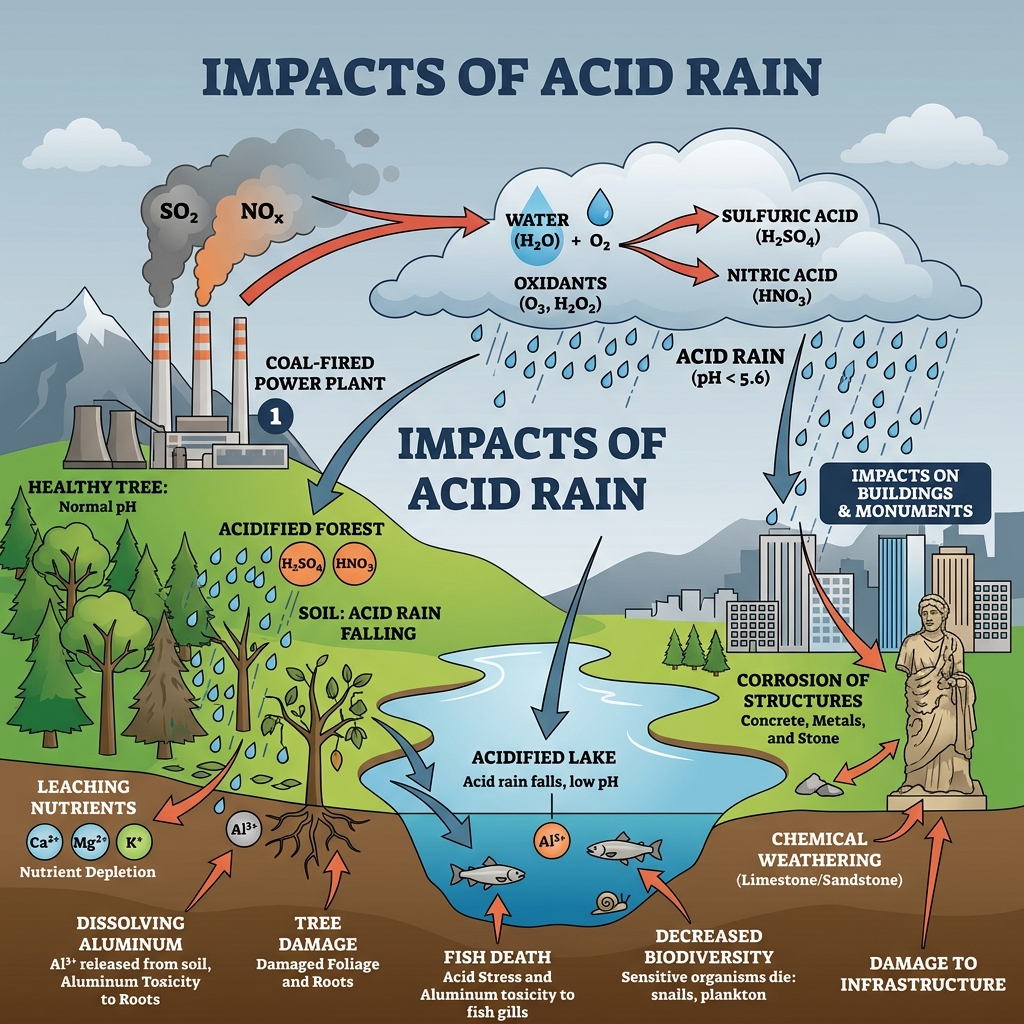
Key UnderstandingAcid deposition occurs when sulfur dioxide (SO₂) and nitrogen oxides (NOₓ) from fossil fuel combustion react with water in the atmosphere to form acidic compounds.
Acid deposition can be wet (rain, snow, fog) or dry (ash, dry particles falling to the ground).
Coal Power Plants
(SO₂ emissions)
➜
Reacts with H₂O
➜
Sulfuric Acid (H₂SO₄)
Vehicle Exhausts
(NOₓ emissions)
➜
Reacts with H₂O
➜
Nitric Acid (HNO₃)
Normal rain is slightly acidic (pH ~5.6) due to natural CO₂ in the air. Acid rain typically has a pH between 4.0 and 5.0.
8.3.5 — Impacts of Acid Rain
Environmental Impacts of Acid Rain
Key UnderstandingAcid deposition has profound impacts on terrestrial and aquatic ecosystems, as well as on human infrastructure.
1. Direct & Indirect Effects on Trees (Forests)
- Direct: Acid rain damages leaves/needles, breaking down the cuticle and reducing photosynthesis.
- Indirect (Soil): Acidifies soil, which leaches away essential nutrients (Calcium, Magnesium).
- Indirect (Toxicity): Acidic soil releases toxic Aluminum (Al3+) ions, which damage tree roots, preventing them from absorbing water.
2. Aquatic Ecosystems (Lakes & Rivers)
- Low pH combined with Aluminum runoff is highly toxic to fish (causes mucus to build up on gills, leading to asphyxiation).
- Decreases biodiversity; sensitive indicator species (like lichen and certain aquatic insects) die off first.
3. Human Infrastructure
Acid rain chemically weathers limestone and marble buildings and statues, and corrodes metal bridges and railways.
8.3.6 — Management Strategies
Managing Air Pollution
Key UnderstandingPollution management strategies can be evaluated at three levels: altering human activity, regulating the release of pollutants, and cleaning up damaged systems.
We use the "Replace, Regulate, Restore" framework to evaluate strategies.
| Strategy Level | Examples for Smog & Acid Rain | Evaluation |
|---|
| 1. Alter Human Activity (Replace) |
Switching from coal to wind/solar; walking/cycling instead of driving; using public transport. |
Pro: Prevents pollution at the source.
Con: Requires massive behavioral and economic shifts. |
| 2. Regulate Release (Regulate) |
Catalytic converters in cars (reduces NOₓ); scrubbing chimneys in coal plants to remove SO₂; taxes on high-emission vehicles. |
Pro: Technology exists and can be legislated.
Con: Expensive to retrofit factories; doesn't stop fossil fuel use. |
| 3. Clean Up (Restore) |
Adding crushed limestone (liming) to acidified lakes to neutralize the pH; replanting damaged forests. |
Pro: Saves ecosystems in immediate danger.
Con: Very expensive, temporary fix (acid rain will just fall again). |
8.3.7 — HL Extensions
Policy, Economics & Ethics HL
Key Understanding (HL)The implementation of air pollution management strategies requires careful consideration of economic impacts, environmental laws, and ethical responsibilities.
For HL students, understanding the science is not enough. You must apply the three lenses:
Economic Lens
Implementing scrubbers on coal plants costs millions. Who pays? Does the cost get passed to consumers? What is the economic cost of inaction (healthcare costs for asthma, lost agricultural yields from smog)?
Ethical Lens
Is it ethical for developed nations (who historically polluted the most) to demand developing nations curb their emissions at the expense of economic growth? This raises issues of environmental justice.
🌍 Cross-Border Pollution Acid rain does not respect borders. SO₂ emitted in the USA often falls as acid rain in Canada. This necessitates international treaties, such as the 1991 US-Canada Air Quality Agreement.
Review
Glossary — Essential Vocabulary
| Term | Definition |
|---|
| Primary Pollutant | A pollutant emitted directly from a source (e.g., NOₓ, SO₂). |
| Secondary Pollutant | A pollutant formed in the atmosphere through chemical reactions (e.g., Tropospheric Ozone). |
| Tropospheric Ozone | Ozone found at ground level; a harmful secondary pollutant and greenhouse gas. |
| Thermal Inversion | A weather condition where a layer of warm air traps cooler, polluted air near the ground. |
| Wet Deposition | Acid rain, snow, or fog. |
| Leaching | The process by which acid rain washes vital nutrients out of the soil. |
Review
Key Takeaways & Exam Tips
📝 Exam Hint: Strategy Evaluation When asked to "evaluate" a pollution management strategy, make sure you provide BOTH strengths and weaknesses. The best answers always structure their points using the "Alter, Regulate, Restore" framework.
- Don't confuse Ozone types: Stratospheric ozone = GOOD (protects from UV). Tropospheric ozone = BAD (causes respiratory issues and smog).
- Aluminum Toxicity: For acid rain questions regarding forests or lakes, always mention the release of toxic Al3+ ions from the soil. It shows higher-level understanding than just saying "the acid kills them."
- Topography matters: Be prepared to explain why a specific city (like Los Angeles) has worse smog than a flat city with the same number of cars.
✅
Topic 8.3 Complete!
You have successfully reviewed Urban Air Pollution.
7 / 7
Syllabus Understandings Covered