IB DP Environmental Systems & Societies
HL.a — Environmental Law
Higher Level Lens · New Syllabus (First Assessment 2026)
HL.a.1
Definition & Purpose of Law
Key UnderstandingLaws are rules that govern human behaviour and are enforced by social or governmental authority.
Why do we need laws? Often, it is more economically profitable in the short term to pollute or over-extract resources. Without legal boundaries and the threat of sanctions, many entities would not act sustainably.
- Societal Values: Laws often change when societal norms shift (e.g. banning plastic bags after public awareness increased).
- Enforcement: A law is only as good as its enforcement mechanism. Without sanctions, compliance is voluntary.
HL.a.2
The Two Domains of Environmental Law
Key UnderstandingEnvironmental law refers specifically to the rules about how human beings use and impact natural resources, with the aim of improving social and ecological sustainability.
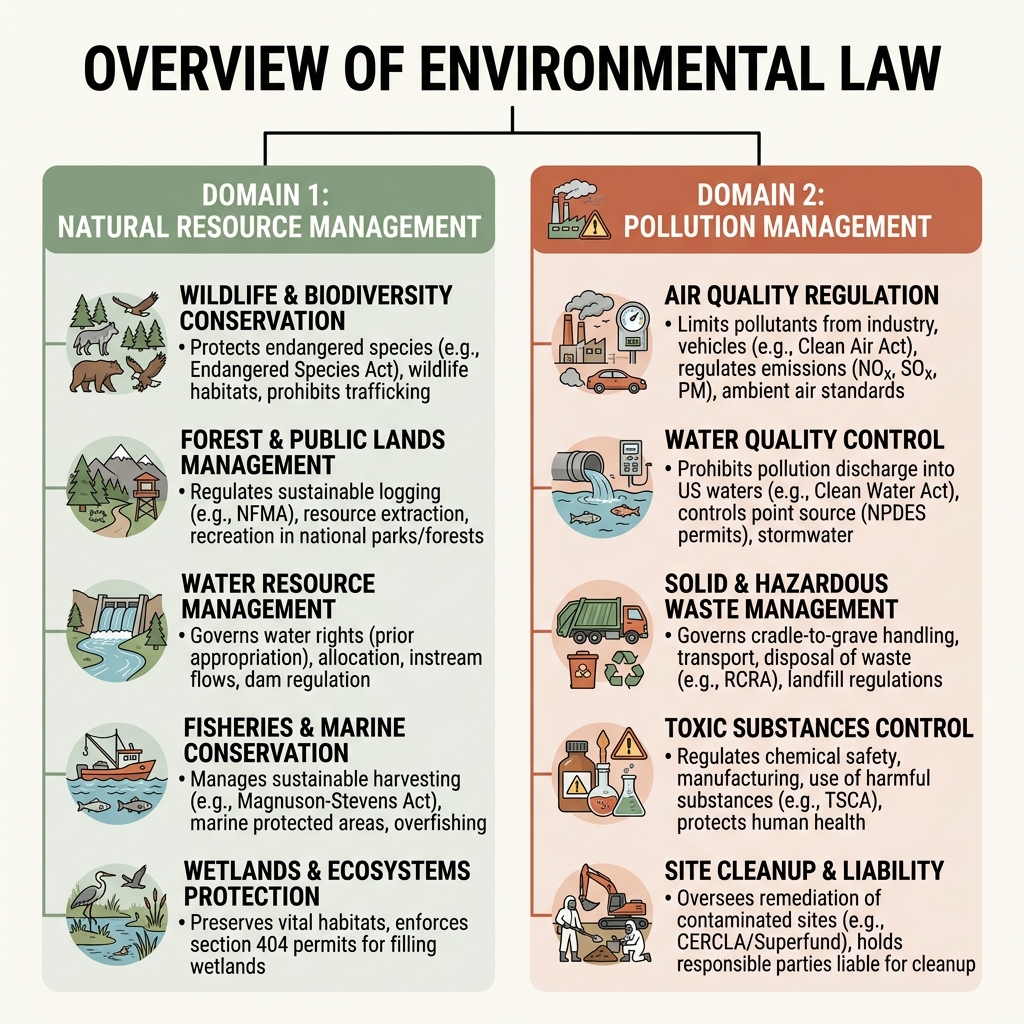
Domain 1: Resource Management
Laws dictating how much of nature we can extract.
- Fishing quotas to prevent collapse.
- Logging permits in forests.
- CITES (banning endangered species trade).
Domain 2: Pollution Management
Laws dictating what we can put back into nature.
- Clean Air Acts (limiting NOₓ/SO₂).
- Water quality standards for runoff.
- Montreal Protocol (banning CFCs).
HL.a.3
Lobbying & Environmental Justice
Key UnderstandingEnvironmental laws can have an important role in addressing and supporting environmental justice, but they can be difficult to approve due to lobbying.
Lobbying: The act of attempting to influence the decisions made by government officials. Powerful industries (fossil fuels, industrial agriculture) often spend millions lobbying politicians to weaken environmental regulations or create loopholes.
Environmental Justice: Ensures that all people, regardless of race or income, have equal protection from environmental hazards. Lobbying often protects corporate interests over the health of marginalized communities.
HL.a.4 / HL.a.5
Effectiveness & Constitutionalism
HL.a.4 Environmental law is built into existing legal frameworks, but its success can vary from country to country.
The strength of institutions (courts, EPA) and adequate funding directly dictate if a law succeeds or fails. A law on paper means nothing if a country cannot afford to hire inspectors.
HL.a.5 Environmental constitutionalism refers to the introduction of environmental rights and obligations into the constitution.
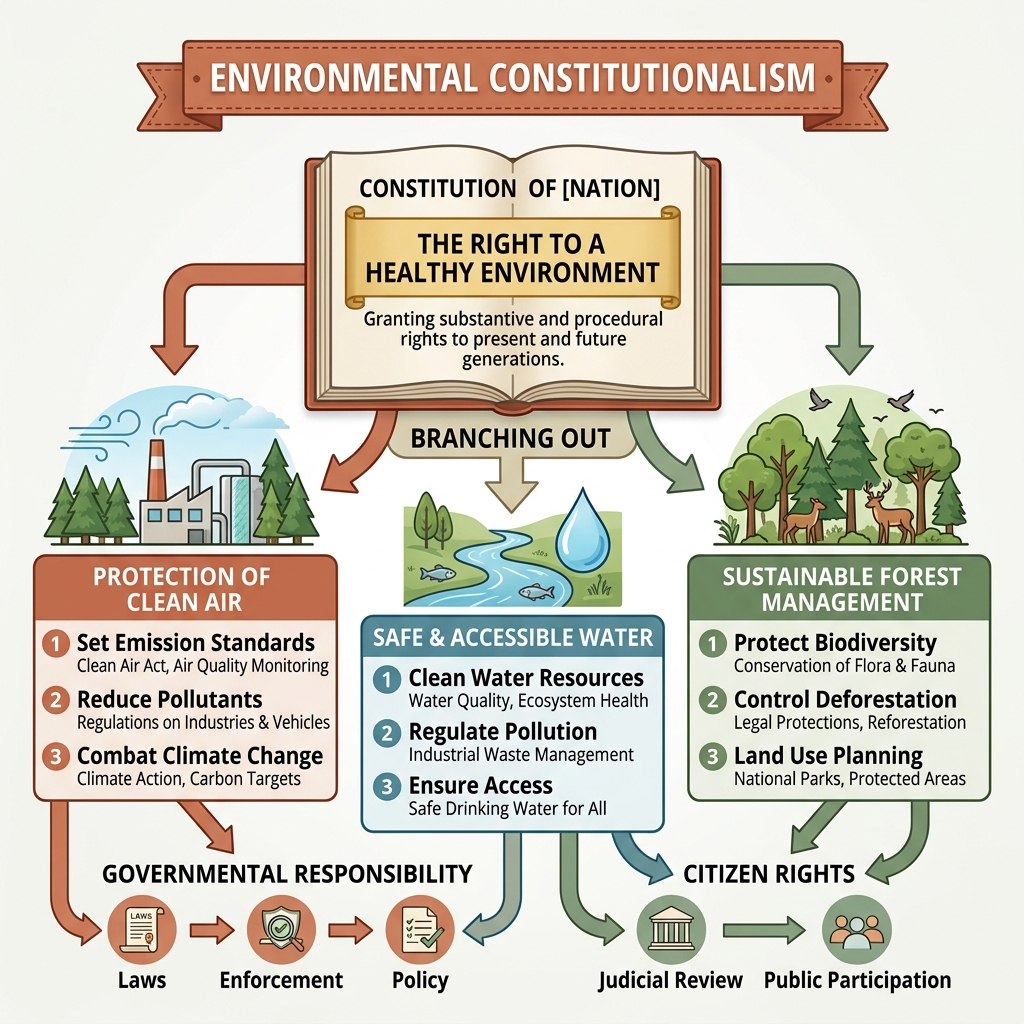
Embedding the "right to a healthy environment" into a national constitution empowers citizens to sue their government if it fails to protect the air, water, or forests (e.g. Ecuador's constitution).
HL.a.6
Levels of Environmental Law
Key UnderstandingEnvironmental laws can be drafted at the local, national or international level.
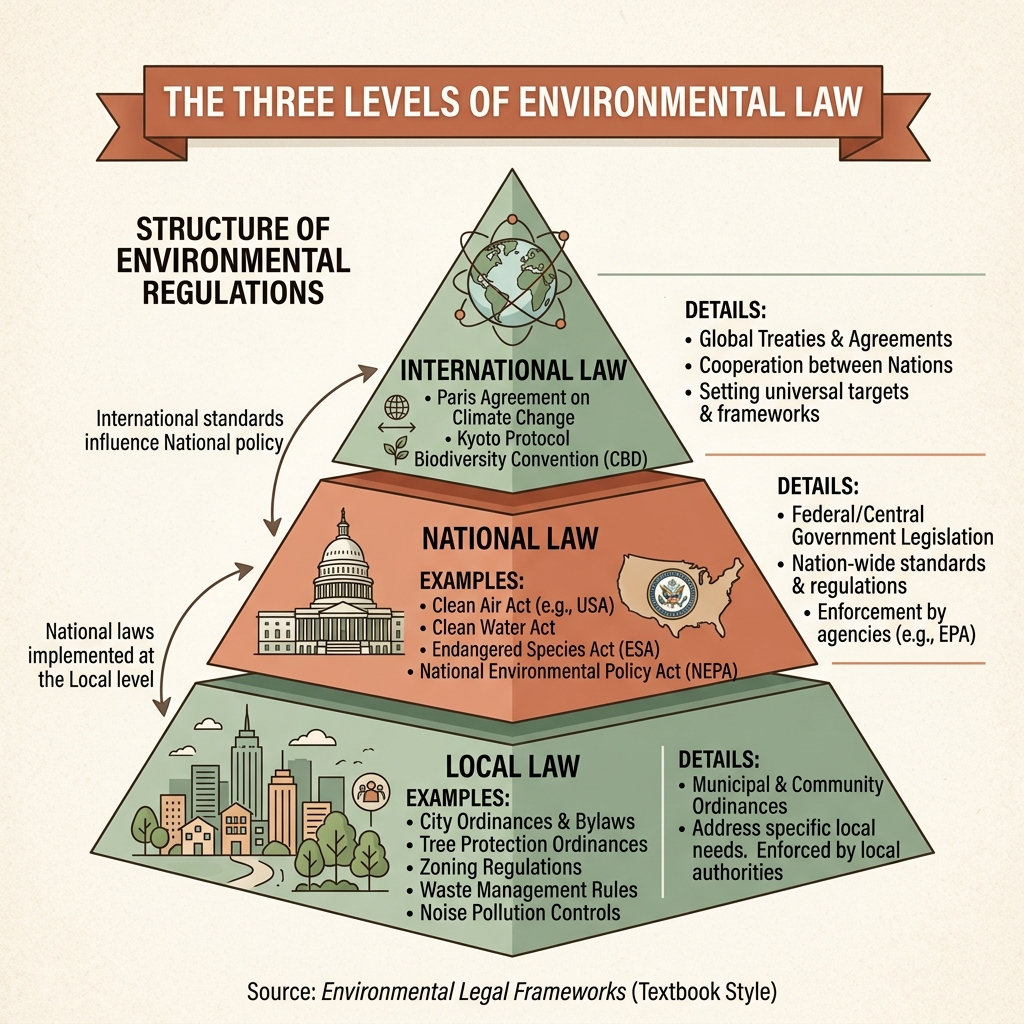
| Level | Example |
|---|
| Local | City ordinances on recycling; tree protection bylaws (e.g. Atlanta Tree Ordinance). |
| National | Country-wide regulations enforced by a central government (e.g. US Clean Air Act). |
| International | Treaties negotiated between multiple countries to address global issues (e.g. Paris Agreement). |
HL.a.7
Transboundary Issues
Key UnderstandingInternational law provides an essential framework for addressing transboundary issues of pollution and resource management.
Transboundary Pollution: Pollution that originates in one country but causes damage in another (e.g. acid rain, greenhouse gases, river pollution).
Key Examples:
- ASEAN Haze Agreement: An agreement between SE Asian nations to prevent and monitor land/forest fires (often from Indonesia) causing severe smog in neighboring countries.
- IUU Fishing: Illegal, Unreported, and Unregulated fishing requires international monitoring (like the FAO Plan of Action) because oceans do not have borders.
HL.a.8 / HL.a.9
UN Conferences & Protocols
HL.a.8 UN conferences produce international conventions (agreements) that are legally binding, and protocols that may become legally binding, to all signatories.
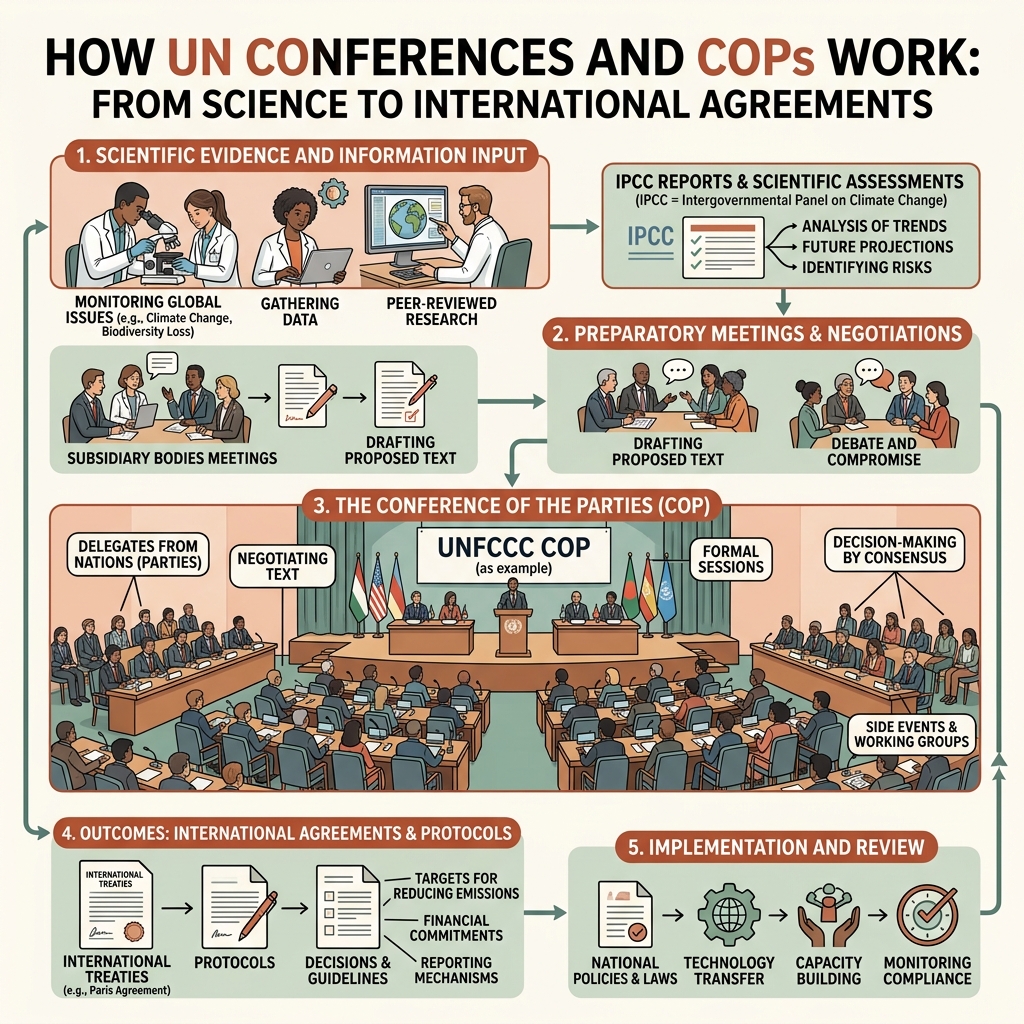
HL.a.9 International agreements can generate institutions or organizations to aid their implementation.
- Agreements: Broad frameworks (like UNFCCC).
- Protocols: Specific, often binding targets (like the Kyoto or Montreal Protocols).
- Institutions generated: The IPCC provides the science, while the UNFCCC Secretariat manages the legal/policy framework.
HL.a.10
International Courts & Tribunals
Key UnderstandingThe application of international environmental law has been examined within international courts and tribunals.
When countries or massive corporations violate environmental laws, the cases often go to international courts (like the European Court of Justice or the ICJ).
🌍 Case Study — Ogoniland (Nigeria) vs. ShellDecades of oil spills by Shell devastated the Niger Delta. Local communities and the UN brought international legal action. It highlighted the immense difficulty international courts face in holding massive multinational corporations accountable and determining appropriate financial compensation.
HL.a.11
Legal Personhood for Nature
Key UnderstandingThere are an increasing number of laws granting legal personhood to natural entities in order to strengthen environmental protection.
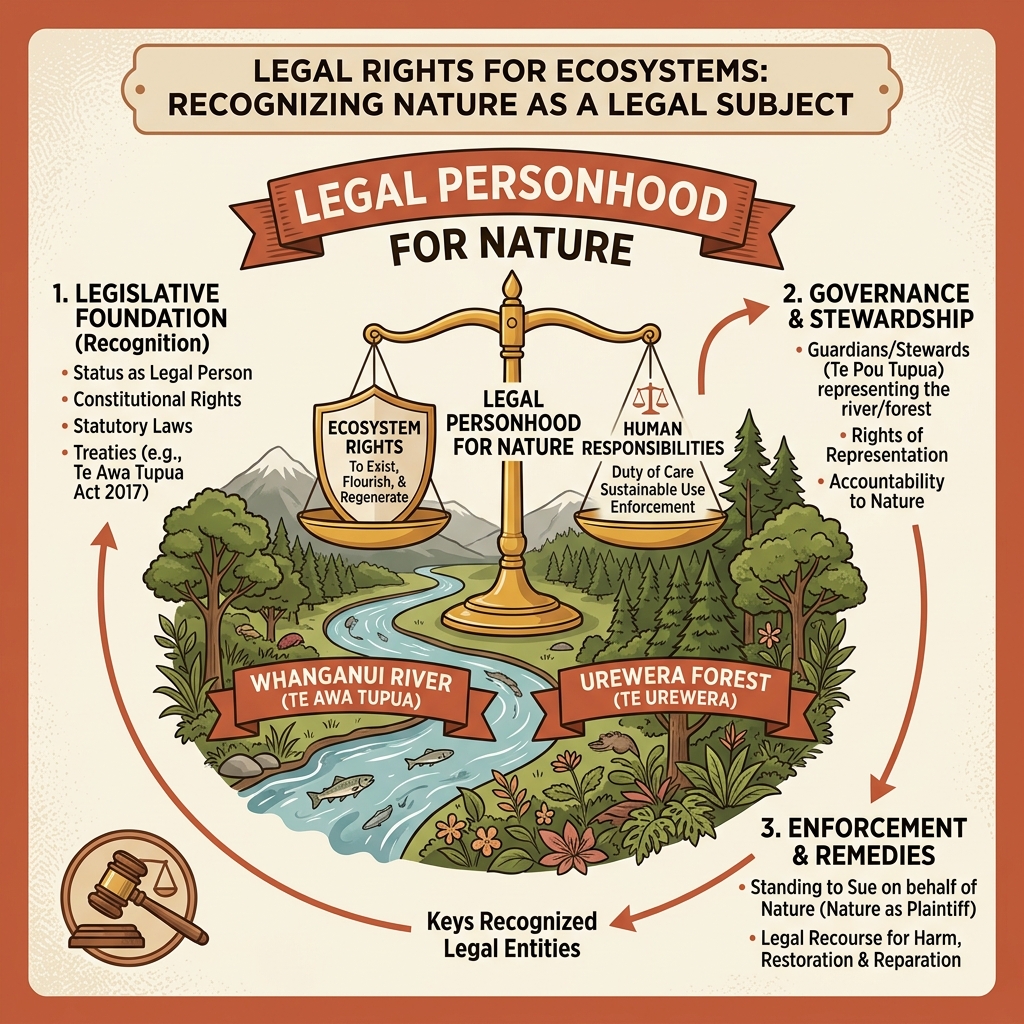
Historically, nature was "property." Now, by granting legal personhood, a river has the right to exist, thrive, and sue for damages, often represented by human guardians (frequently Indigenous groups).
🌍 Case Study — Te Urewera Act (New Zealand)In 2014, the Te Urewera forest was granted legal personhood. It is recognized as a living entity with its own rights, governed by a board of Māori (Tūhoe) and Crown representatives, reflecting a shift to ecocentric, Indigenous value systems.
HL.a.12
Legal vs. Economic Strategies
Key UnderstandingBoth legal and economic strategies can play a role in maintaining sustainable use of the environment.
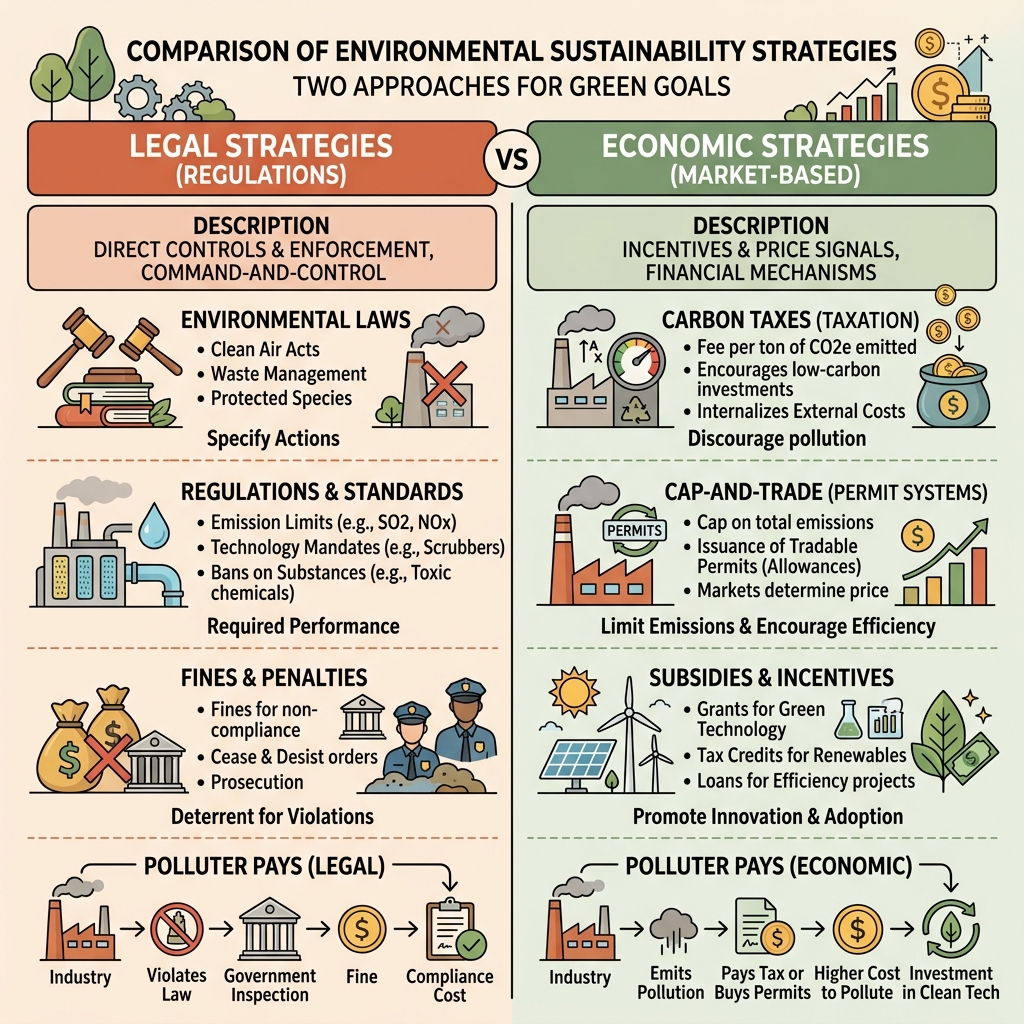
The most successful outcomes integrate both. For example, a legal framework bans emissions over a certain limit, while an economic Cap-and-Trade system incentivizes companies to stay under that limit so they can sell their excess permits.
Review
Glossary & Exam Tips
| Term | Definition |
|---|
| Transboundary Pollution | Pollution that originates in one country but causes damage in another. |
| Environmental Constitutionalism | The inclusion of environmental rights (like the right to clean air) in a nation's constitution. |
| Legal Personhood | Granting a non-human entity (like a river) the legal rights and standing usually reserved for humans or corporations. |
📝 Exam Hint: Applying the Lens In paper 2, you may be asked to evaluate a conservation strategy "through the lens of environmental law." You should discuss international treaties, the difficulty of enforcement across borders, the impact of lobbying, and the potential for legal personhood to protect the species or ecosystem.
✅
HL.a Lens Complete!
You have successfully reviewed all 12 understandings for Environmental Law.