IB DP Environmental Systems & Societies
HL.b — Environmental Economics
Higher Level Lens · Comprehensive Detailed Review
HL.b.1
Supply and Demand
Key UnderstandingEconomics studies how humans produce, distribute and consume goods and services, both individually and collectively.
The core concept of conventional economics is the relationship between Supply (the amount of a resource available from producers) and Demand (the amount consumers want to buy).
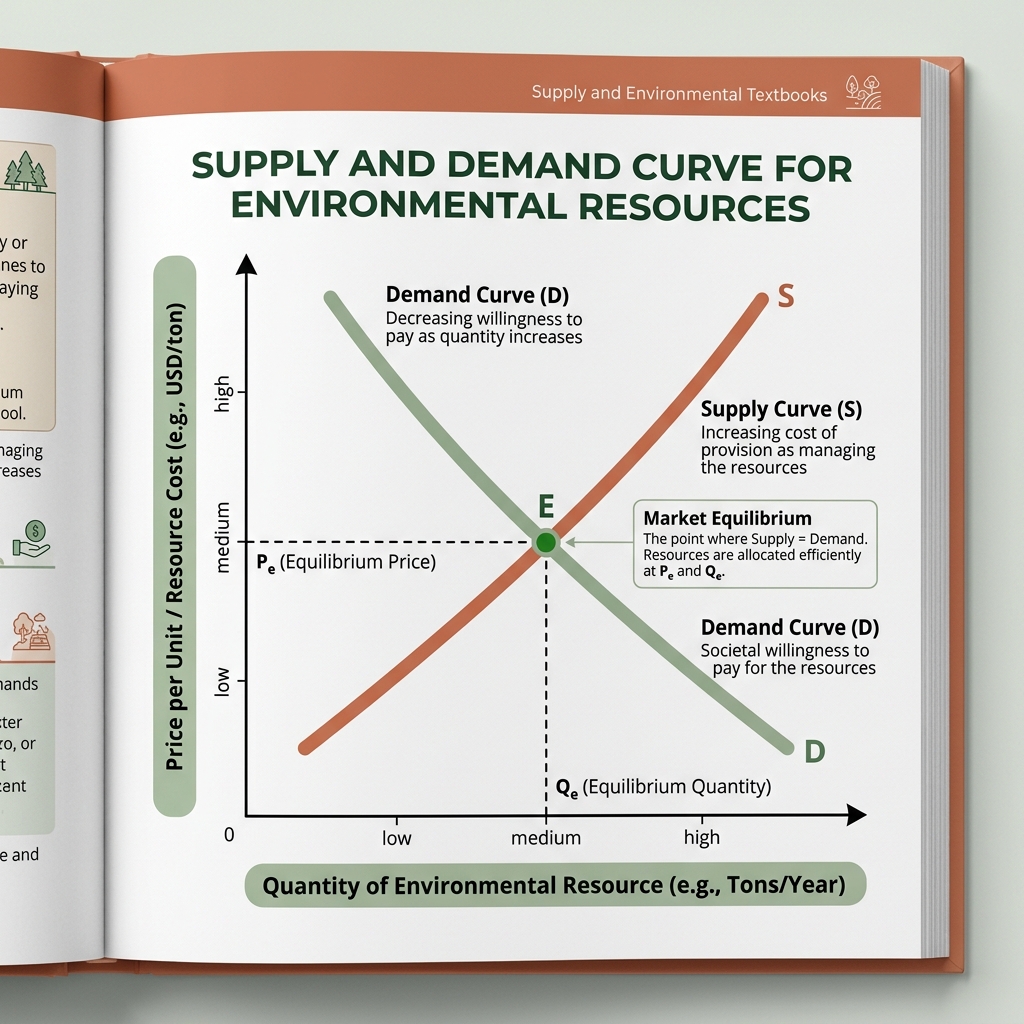
- Market Equilibrium: This is achieved where the supply curve and demand curve intersect. It is the point where the price producers are willing to accept perfectly matches the price consumers are willing to pay.
- Shifting the Demand Curve: Factors that can change demand include changes in consumer income, evolving preferences (e.g. going vegan for environmental reasons), or changes in the price of substitute goods.
- Government Interventions: If a government provides subsidies for renewable energy, it lowers the cost of production. This shifts the supply curve to the right, meaning more energy is supplied at a lower market price.
HL.b.2
Environmental Economics
Key UnderstandingEnvironmental economics is economics applied to the environment and environmental issues.
Economists are vital to managing environmental resources. They apply economic principles to pollution, conservation, and resource depletion, attempting to integrate the financial value of nature into economic systems to protect it.
Market-Based Instruments
Used by economists to address pollution by changing financial incentives and behaviors:
- Carbon Taxes (taxing emissions)
- Cap and Trade (Tradable Permits)
- Subsidies for Green Tech
- Fines for illegal dumping
Technocentric vs Ecocentric
- Technocentric View: Nature is a resource to be managed for human benefit. Economic growth is good and technology will solve resource scarcity.
- Ecocentric View: Nature has intrinsic value. We must limit economic growth to respect planetary boundaries and protect ecosystems.
HL.b.3 / HL.b.4
Market Failure & Polluter Pays Principle
HL.b.3 Market failure occurs when the allocation of goods and services by the free market imposes negative impacts on the environment.
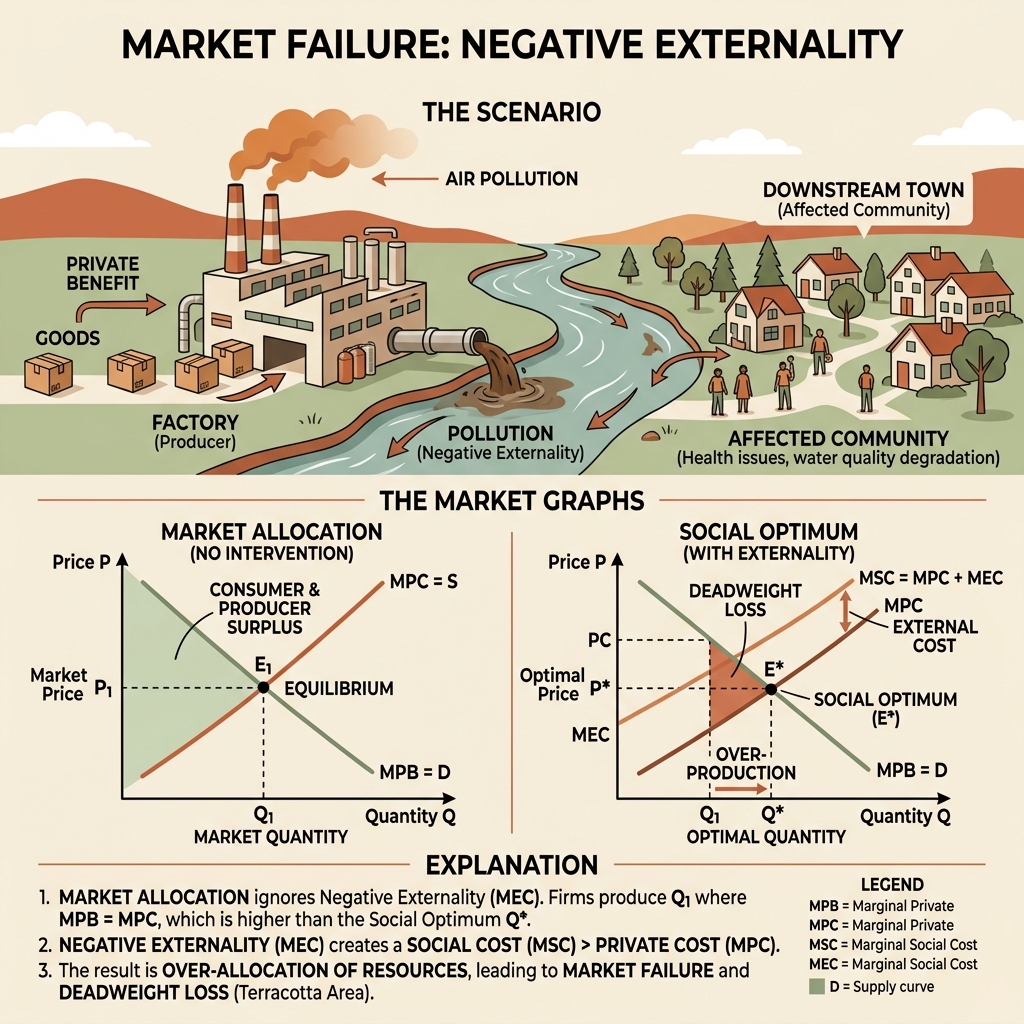
Market failure often happens due to Negative Externalities. An externality is a cost suffered by a third party as a result of an economic transaction. Because the factory doesn't pay for health damages, the product's price doesn't reflect its true cost to society.
HL.b.4 When the market fails to prevent negative impacts, the polluter-pays principle may be applied.
1. Factory pollutes river during manufacturing (Negative Externality)
↓
2. Government applies 'Polluter Pays' via Carbon Tax or Fines
↓
3. Factory's cost of production rises; Supply curve shifts left
↓
4. Factory invests in clean tech to avoid taxes (Market Failure Corrected)
Challenges in Developing Economies: Strict enforcement of the polluter-pays principle can cripple growing industries in developing nations that cannot afford clean technology, potentially leading to widespread job losses and economic instability.
HL.b.5
Greenwashing
Key Understanding“Greenwashing” or “green sheen” is where companies use marketing to give themselves a more environmentally friendly image.
Company wants to increase sales from eco-conscious consumers
↓
Company spends millions on PR rather than actually changing practices
↓
Consumers are misled and buy the product thinking it's sustainable
↓
Real environmental degradation continues unchecked
Common Greenwashing Tactics:
- Vague Language: Using unregulated, undefined terms like "eco-friendly," "all-natural," or "green" without any third-party certifications.
- Hidden Trade-offs: Advertising a minor green initiative (like using recycled packaging) while the main product itself is highly toxic or destructive.
- Irrelevant Claims: Boasting that a product is "CFC-Free" when CFCs have already been globally banned by law for decades.
- False Labels: Creating fake "eco-certification" logos that look official but are made up by the company itself.
Real Case Study — Volkswagen "Dieselgate": VW marketed their diesel cars as "clean diesel" and eco-friendly. It was later discovered they had installed "defeat devices" to cheat emissions tests, while their cars were actually emitting 40 times the legal limit of nitrogen oxides.
HL.b.6
The Tragedy of the Commons
Key UnderstandingThe tragedy of the commons highlights the problem where property rights are not clearly delineated and no market price is attached to a common good, resulting in overexploitation.
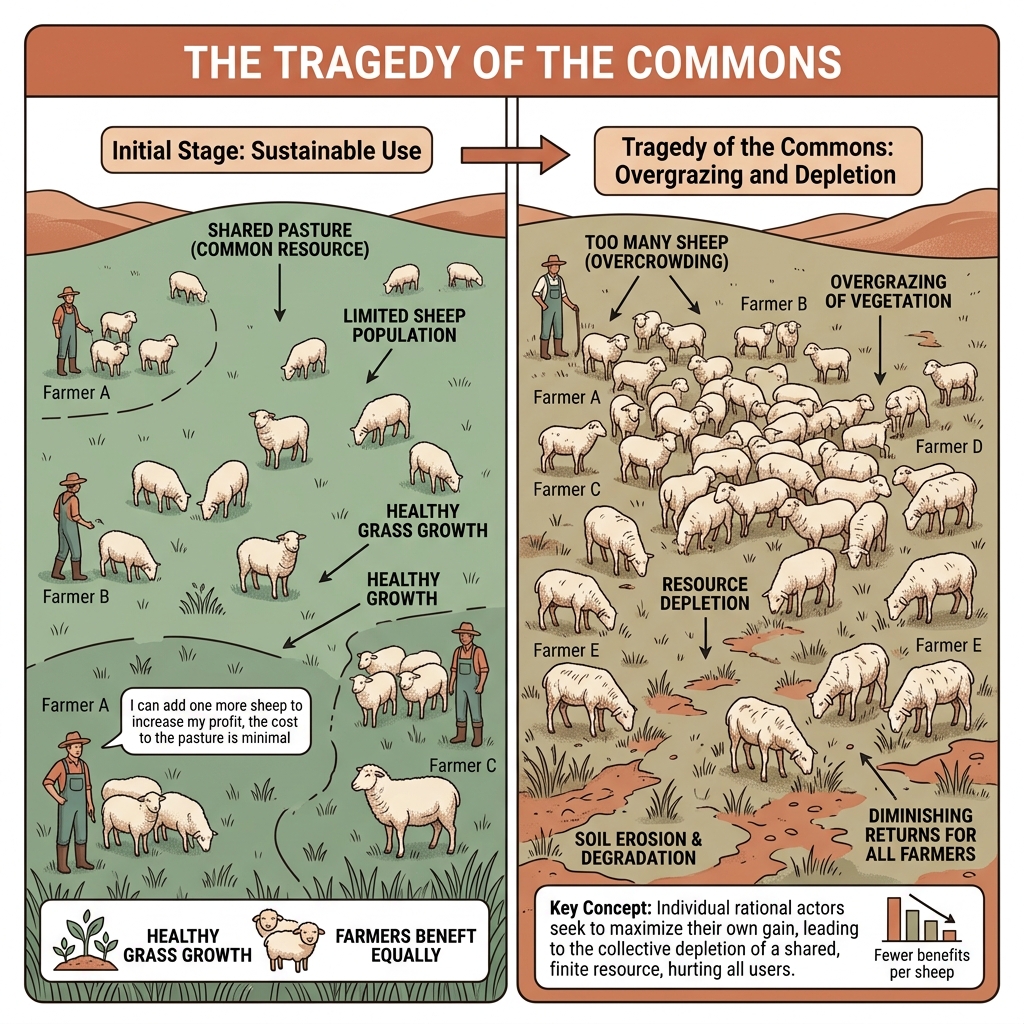
When a shared resource (like the atmosphere, open ocean fisheries, or a communal pasture) is open and accessible to everyone without rules, individuals acting rationally in their own self-interest will extract as much as possible. This ultimately destroys the resource, leading to ruin for everyone.
Real Case Study — Grand Banks Cod Fishery: For centuries, the Grand Banks off Newfoundland was a globally shared fishing ground. In the 1960s, massive industrial trawlers from multiple nations overfished the region, acting purely in their own economic self-interest. By 1992, the cod population collapsed entirely, destroying the local economy and ecosystem.
Alternative Solutions to the Tragedy:
Traditional economics argues that the only solutions are either strict government regulation or full privatization of the resource. However, Nobel Laureate Elinor Ostrom demonstrated that community-based resource management is highly effective. Local communities often successfully manage shared resources sustainably by creating their own social norms, establishing boundaries, and enforcing local sanctions without needing a central government.
HL.b.7 / HL.b.8
Environmental Accounting & Non-Use Value
HL.b.7 Environmental accounting is the attempt to attach economic value to natural resources and their depletion.
It integrates environmental costs (like pollution, carbon emissions, or loss of biodiversity) into a nation's or corporation's formal financial reporting. The primary challenge is establishing a consensus value—different stakeholders disagree wildly on what a forest or wetland is financially "worth" in a spreadsheet.
HL.b.8 In some cases, economic value can be established by use, but this is not the case for non-use values.
| Value Type | Definition & Example |
|---|
| Use Value | Directly using the resource (e.g. cutting timber, commercial fishing, tourism revenue). This is relatively easy to calculate based on market prices. |
| Non-Use Value | The value attached to a resource just for its existence, even if humans never visit it or use it (e.g. the existence value of blue whales or the deep Amazon). This is incredibly difficult to quantify economically and often ignored by traditional markets. |
HL.b.9 / HL.b.10
Ecological vs Environmental Economics
HL.b.9 Ecological economics views the economy as a subsystem of Earth’s larger biosphere.
While Environmental Economics attempts to fix market failures using taxes within the current capitalist system, Ecological Economics states that infinite growth on a finite planet is mathematically impossible. It argues that if the biosphere collapses, the entire economy collapses with it.
HL.b.10 While the economic valuation of ecosystem services is addressed by environmental economics, there is an even greater emphasis in ecological economics.
- Ecological economics attributes massive value to ecosystems beyond mere resource extraction, factoring in carbon sequestration, flood prevention, cultural heritage, and intrinsic value.
- Resource Transfer Agreements: Policies where wealthy nations financially compensate developing nations to protect their natural capital (e.g. the UN's REDD+ program).
Real Case Study — Costa Rica's PES Program: Costa Rica implemented a "Payment for Ecosystem Services" (PES) program, paying private landowners to protect their forests rather than log them, successfully reversing national deforestation.
HL.b.11 / HL.b.12
Measuring Economic Growth
HL.b.11 Economic growth is the change in the total market value of goods and services in a country over a period and is usually measured as the annual percentage change in GDP.
Limitations of GDP (Gross Domestic Product): GDP only measures economic transactions; it is not a measure of human well-being. If a country clear-cuts all its forests to sell the wood, GDP increases. If a massive oil spill happens and billions are spent cleaning it up, GDP increases. GDP completely ignores environmental destruction, resource depletion, and social inequality.
Alternative Metric — GPI: The Genuine Progress Indicator (GPI) subtracts the costs of negative effects (pollution, crime, resource depletion) from the GDP to provide a much more accurate assessment of a country's actual prosperity and well-being.
HL.b.12 Economic growth is influenced by supply and demand, and may be perceived as a measure of prosperity.
HL.b.13 / HL.b.14
Eco-Economic Decoupling
HL.b.13 Economic growth has impacts on environmental welfare.
Historically, unchecked economic growth has been directly and inextricably tied to increased resource extraction, habitat destruction, and massive increases in greenhouse gas emissions.
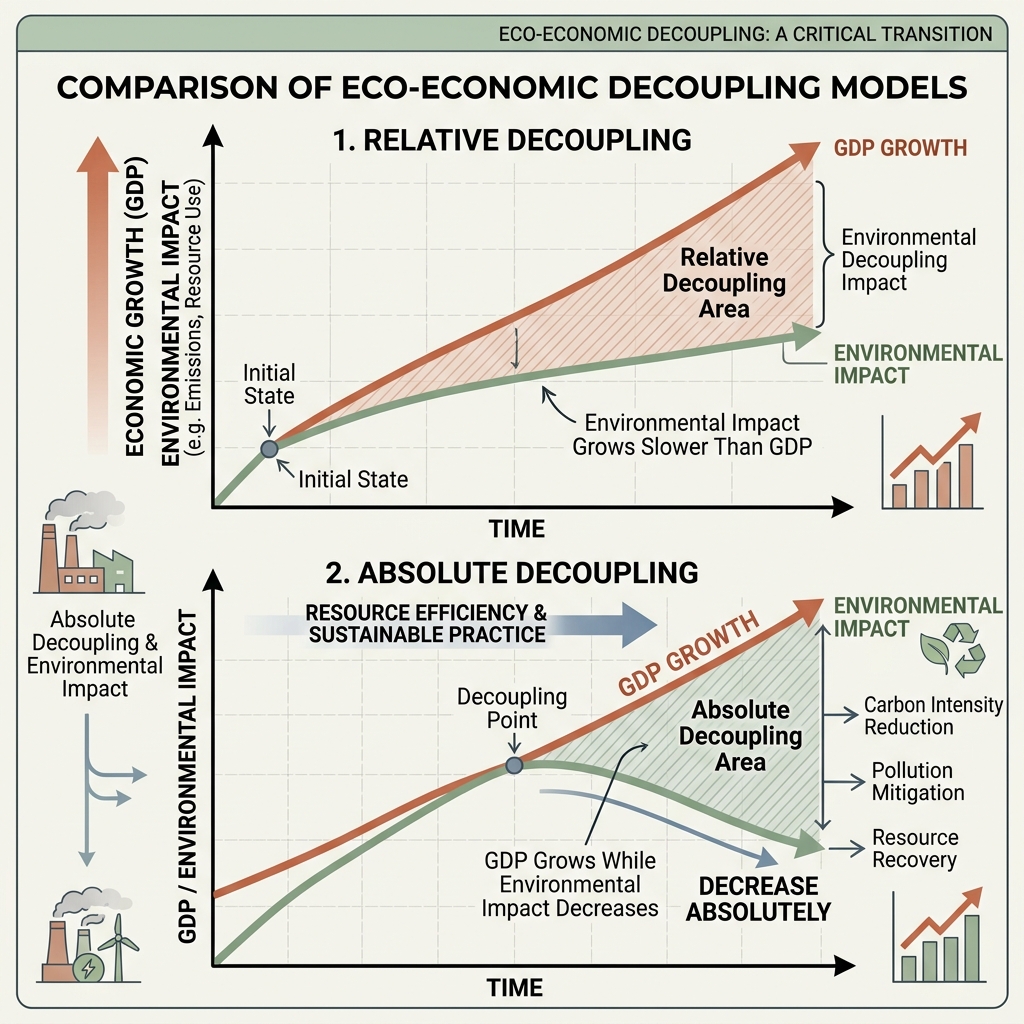
HL.b.14 Eco-economic decoupling is the notion of separating economic growth from environmental degradation.
Relative Decoupling
The economy grows faster than the rate of environmental degradation. We are getting more efficient per unit of GDP (e.g. cars get better gas mileage), but because the economy is growing so fast, the total environmental impact is still increasing.
Absolute Decoupling
The economy grows while total environmental degradation actually decreases (the curves separate entirely). This is the ultimate goal of sustainability, but it is exceedingly difficult to achieve on a global scale without a massive shift to renewables.
HL.b.15 / HL.b.16
Degrowth and Zero Growth Models
HL.b.15 Ecological economics supports the need for degrowth, zero growth or slow growth, and advocates planned reduction in consumption and production, particularly in high-income countries.
Degrowth is a planned, deliberate, and equitable reduction in the size of the economy to bring it back in balance with planetary boundaries.
Note: This is fundamentally different from a recession, which is an unplanned, chaotic economic collapse that causes mass unemployment and suffering.
- Barriers to Degrowth: Degrowth faces intense political resistance, corporate lobbying, and the reality that modern capitalist systems, pension funds, and banking structures are structurally reliant on perpetual growth to function.
HL.b.16 Ecological economists support a slow/no/zero growth model.
They argue that once a country reaches a certain level of wealth, further increases in GDP do not increase happiness or well-being. We should transition to a "steady-state economy" that focuses on quality of life, community, and ecological health rather than simply consuming more stuff.
HL.b.17
Circular & Doughnut Economics
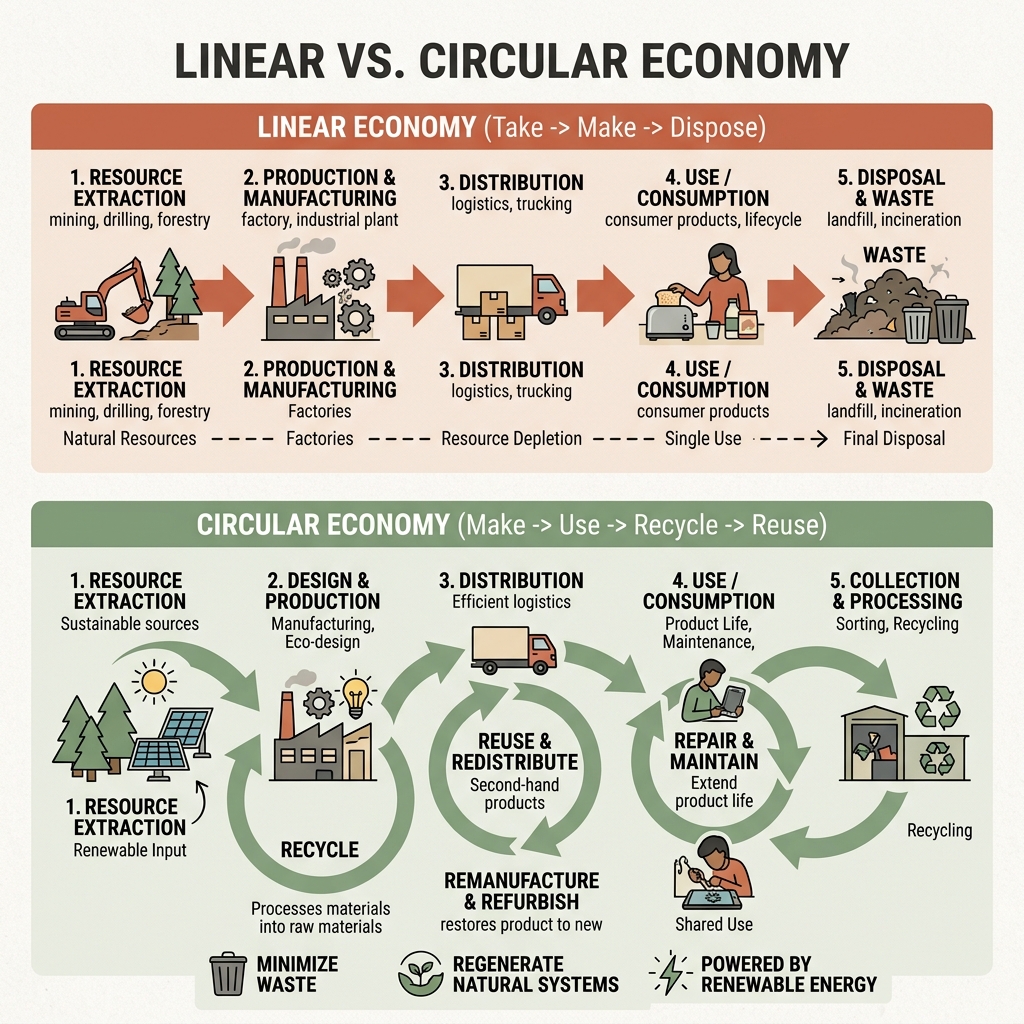
Key UnderstandingThe circular economy and doughnut economics models can be seen as applications of ecological economics for sustainability.
| Model | Explanation |
|---|
| Circular Economy | Replaces the linear "Take-Make-Dispose" model. It aims to eliminate the concept of waste entirely by designing products to be endlessly repaired, reused, remanufactured, or recycled back into the system (closing the loop). |
| Doughnut Economics | Created by Kate Raworth. The goal is to live in the "doughnut" — the safe and just space for humanity. We must ensure everyone has the Social Foundation (adequate food, water, equity, healthcare) without overshooting the outer Ecological Ceiling (climate change, biodiversity loss, ozone depletion). |
✅
HL.b Lens Complete!
You have successfully reviewed all 17 understandings, case studies, and flowcharts for Environmental Economics.