
IB DP Environmental Systems & Societies
HL.c — Environmental Ethics
Higher Level Lens · Comprehensive Detailed Review
HL.c.1 / HL.c.2
Ethics & Environmental Ethics
HL.c.1 Ethics is the branch of philosophy that focuses on moral principles and what behaviours are right and wrong.
Ethics guides human behavior based on what a society or individual deems to be fundamentally "good" or "bad". In environmental policy, Anthropocentric ethics often prioritize human economic growth over ecosystem health, leading to exploitation.
Environmental Crisis Emerges (e.g., Deforestation)
↓
Society applies Ethical Framework to Evaluate
↓
Policy Decision is Made (Protect vs Exploit)
HL.c.2 Environmental ethics is a branch of ethical philosophy that addresses environmental issues.
Traditional ethics focused entirely on human-to-human relationships. Environmental ethics fundamentally extends moral consideration to the non-human world (animals, plants, rivers, ecosystems). It highlights the severe limitations of traditional approaches that view nature merely as an exploitable resource.
HL.c.3
Conflicting Ethical Values
Key UnderstandingA variety of ethical frameworks and conflicting ethical values emerge from differing fundamental beliefs concerning the relationship between humans and nature.
How we act towards the environment depends entirely on our foundational beliefs regarding humanity's place in the world:
- Anthropocentrism: Humans are the most important entity in the universe. Nature exists solely to serve human needs and desires.
- Biocentrism / Ecocentrism: All living things (and whole ecosystems) have inherent value and rights, regardless of their usefulness or economic benefit to humans.
Conflict Example: An anthropocentric leader might argue it is unethical to deny humans timber to build homes, while an ecocentric leader would argue it is deeply unethical to destroy a living ecosystem.
HL.c.4 / HL.c.5
Instrumental vs Intrinsic Value
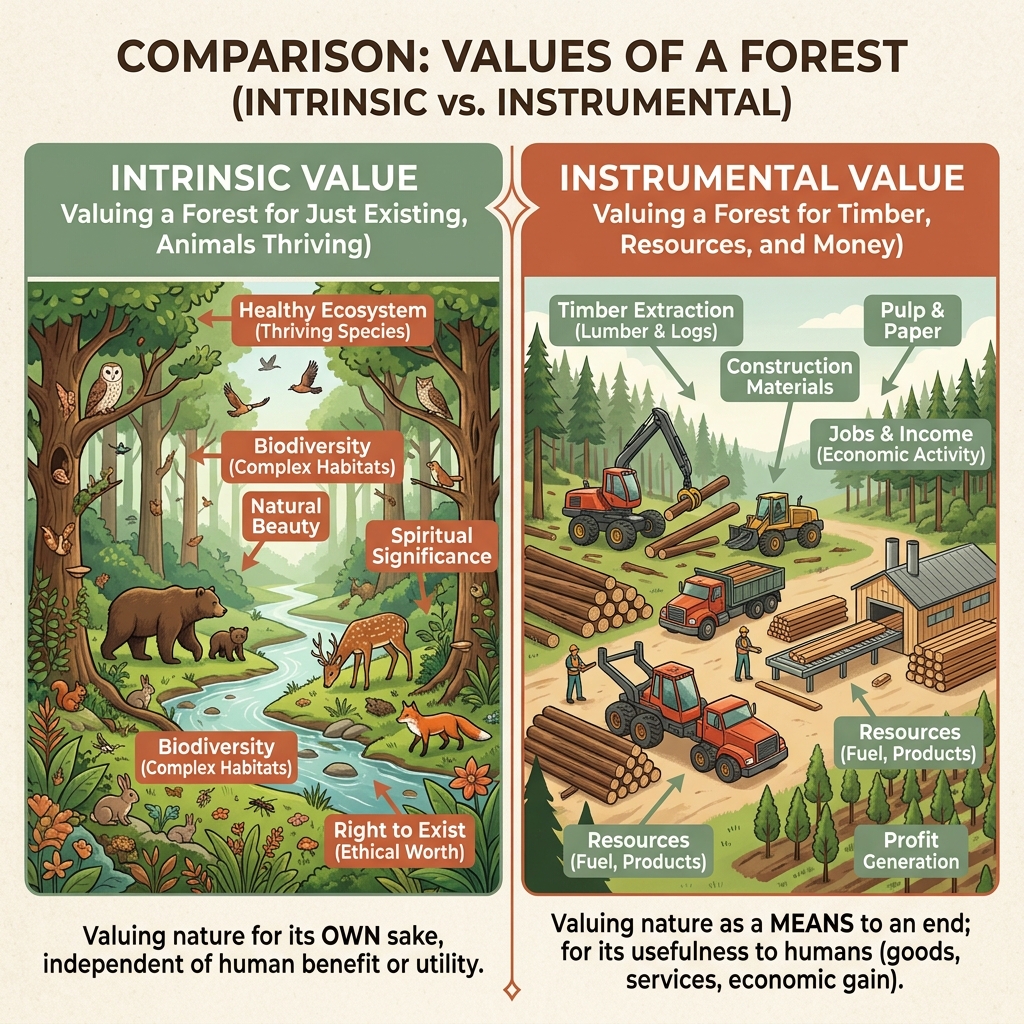
Instrumental Value (HL.c.4)
The usefulness an entity has for humans. Valuing nature strictly for what it can do for us. This risks commodifying nature.
- A forest is valuable because it provides timber and jobs.
- Tightly tied to Anthropocentric and Technocentric approaches.
Intrinsic Value (HL.c.5)
The value one may attach to something simply for what it is. Valuing nature just for existing.
- A forest has the right to exist, even if humans never visit it or extract a single resource from it.
- Tightly tied to Ecocentric approaches.
Real Case Study — Hetch Hetchy Valley: In the early 1900s, there was a massive debate over building a dam in Yosemite's Hetch Hetchy Valley. Gifford Pinchot (Instrumental value) argued the dam should be built to provide water for San Francisco humans. John Muir (Intrinsic value) argued the valley was a temple of nature that deserved to be preserved untouched. Pinchot won, and the dam was built.
HL.c.6 / HL.c.7
Moral Standing
HL.c.6 The concepts of instrumental and intrinsic value are not exclusive.
An entity can possess both simultaneously! A coral reef has immense instrumental value (protects human coastlines from storms, supports fisheries for human consumption, provides tourism revenue) AND immense intrinsic value (it is a beautiful, complex, living ecosystem with a fundamental right to exist regardless of human presence).
HL.c.7 An entity has “moral standing” if it is to be morally considered with regard to how we ought to act towards it.
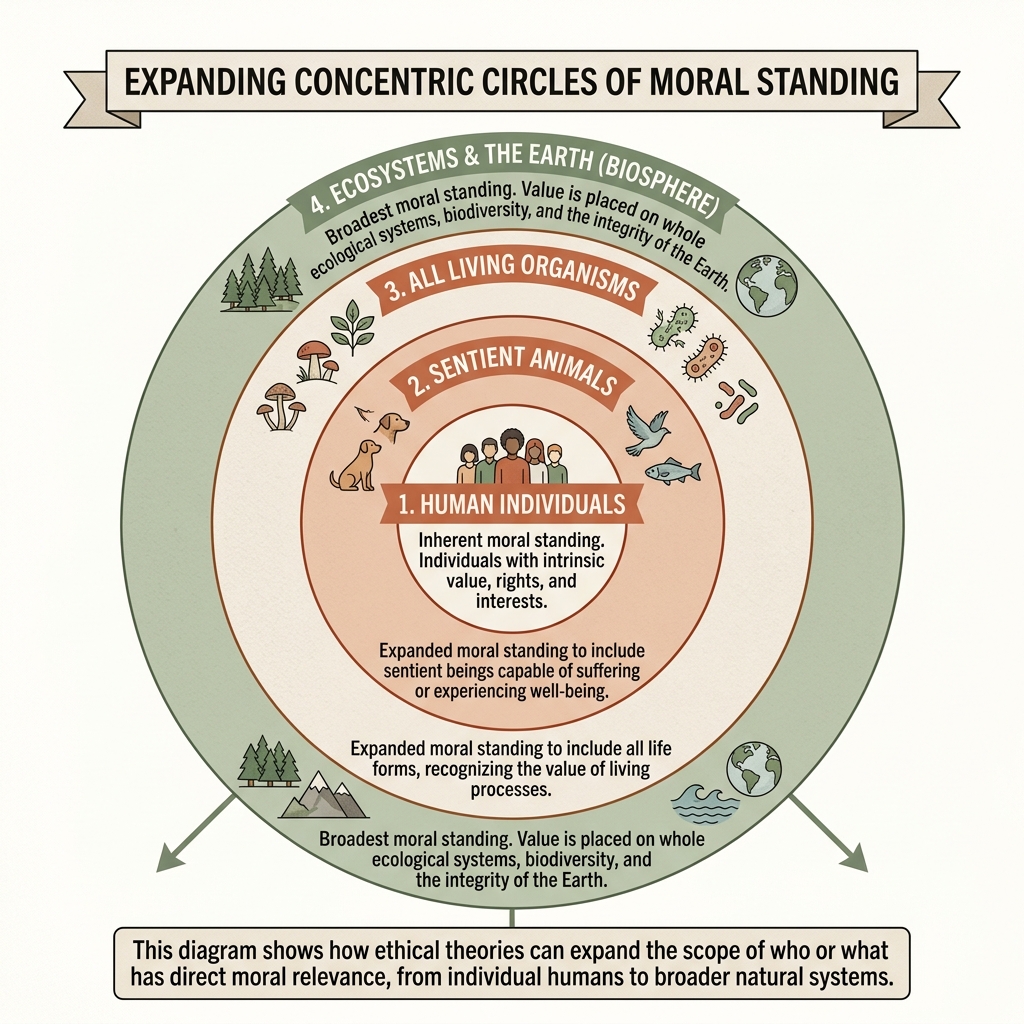
Who gets moral standing? Historically, it was granted only to humans. Over time, society expanded it to include animals (resulting in animal welfare laws). Today, cutting-edge environmental ethics debates whether to legally extend moral standing to non-living entities like rivers, mountains, or entire landscapes.
HL.c.8
The Three Traditional Ethical Frameworks
Key UnderstandingThere are three major approaches of traditional ethics: virtue ethics, consequentialist ethics and rights-based ethics.
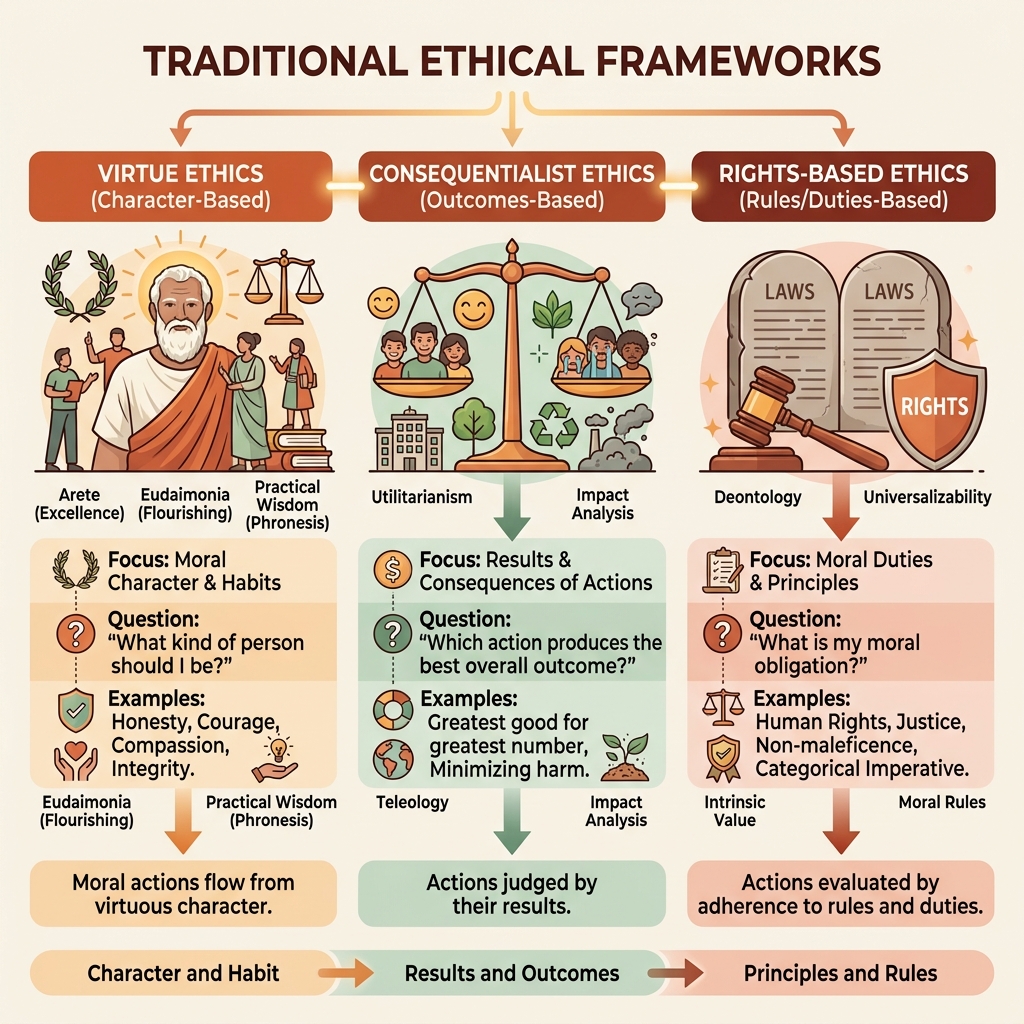
| Framework | Core Focus & Question |
|---|
| Virtue Ethics | Focuses on the character of the person acting. "What would a good, virtuous person do?" |
| Consequentialist | Focuses on the outcome of the action. "Will this cause the most good for the most people?" |
| Rights-Based | Focuses on the rules and rights involved. "Does this action violate someone's fundamental rights?" |
HL.c.9 / HL.c.10
Virtue vs. Consequentialist Ethics
Virtue Ethics (HL.c.9)
Focuses on the character of the person doing the action. Assumes that cultivating good character traits will lead to good actions.
Example: I will reduce my plastic waste and compost because it is the "right thing to do" and makes me a responsible citizen (even if my one individual action doesn't save the world).
Consequentialist Ethics (HL.c.10)
The consequences determine the morality. A common form is Utilitarianism (doing the greatest good for the greatest number).
Example: We should flood this pristine valley to build a hydroelectric dam because the clean electricity will benefit 1 million people, statistically outweighing the harm done to the valley.
Evaluation: Consequentialist ethics can be highly effective for making massive public policy decisions (like implementing carbon taxes to address climate change), but it deeply struggles to protect minorities, marginalized communities, or specific vulnerable ecosystems if destroying them happens to benefit the majority.
HL.c.11 / HL.c.12
Rights-Based Ethics & The Appeal to Nature
HL.c.11 Rights-based ethical systems focus on the actions and whether they conflict with the rights of others.
Also known as deontological ethics. It asserts that certain actions are inherently wrong, regardless of the consequences or benefits. For example, animal rights activists argue it is inherently wrong to test cosmetics on animals, even if it brings massive economic or medical benefits to humans, because animals have a fundamental, inviolable right not to suffer.
HL.c.12 The "Appeal to Nature" fallacy.
Some people hold the deeply flawed view that whatever is "natural" is automatically correct or good. This is a logical fallacy. Arsenic, tsunamis, earthquakes, and deadly viruses are completely natural, but they are clearly not "good." We cannot simply state that an environmental policy or product is automatically beneficial just because it is labeled "natural."
HL.c.13
Environmental & Social Justice
Key UnderstandingEnvironmental movements and social justice movements have developed from separate histories but are increasingly seeking common goals of equitable and just societies.
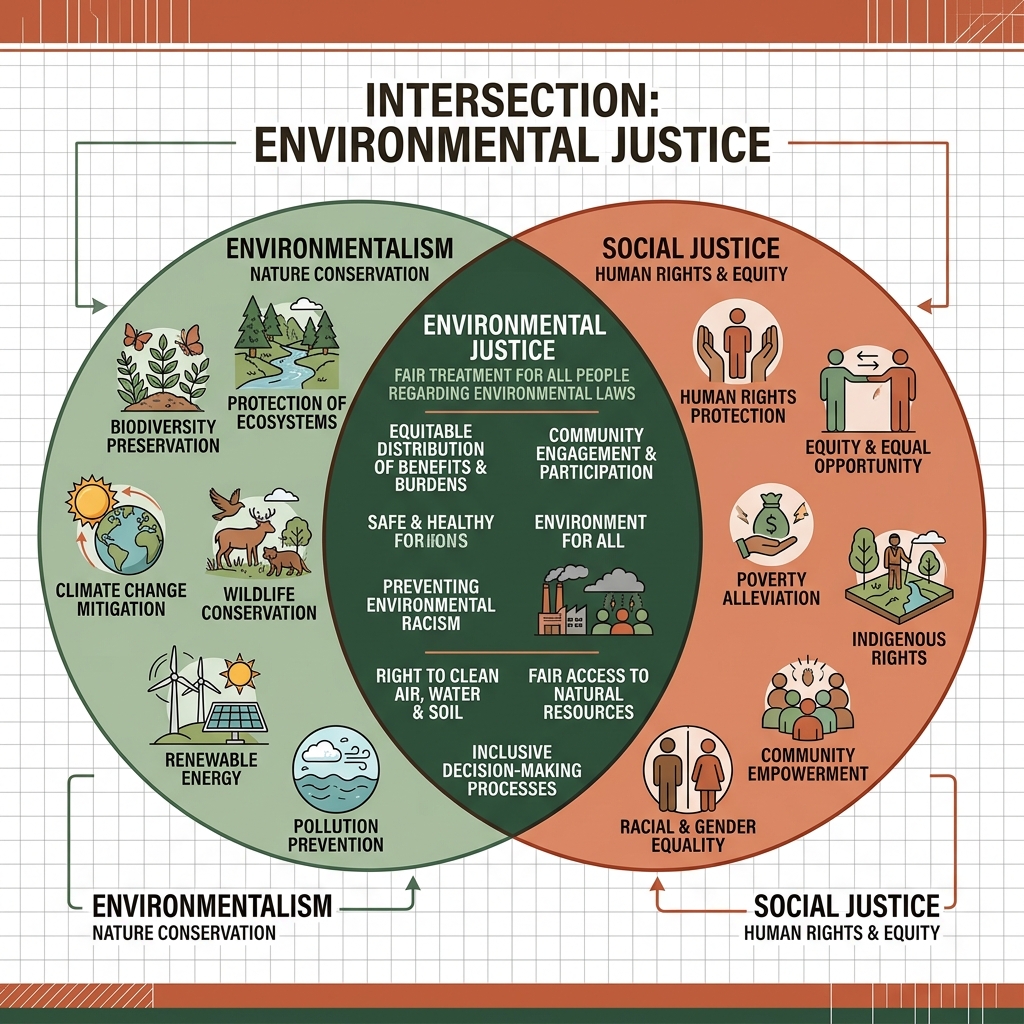
Historically, environmentalism focused heavily on saving untouched wilderness and protecting wildlife, while social justice focused on human rights, equity, and poverty. Today, they intersect deeply to form the concept of Environmental Justice.
Systemic Inequality & Racism
↓
Marginalized Communities lack Political Power to fight back
↓
Corporations choose to build Toxic Waste sites in those neighborhoods
↓
Result: Environmental Injustice & Health Crises
Real Case Study — The Flint Water Crisis: In Flint, Michigan, a majority-Black and lower-income community, the local government switched the city's water supply to the highly polluted Flint River to save money. The water corroded lead pipes, poisoning thousands of children. Residents were ignored for over a year due to systemic environmental racism. This proves that you cannot achieve true environmental sustainability without achieving social justice.
✅
HL.c Lens Complete!
You have successfully reviewed all 13 understandings, case studies, and flowcharts for Environmental Ethics.